

TL;DR:
- Facial anatomy critically influences Mohs surgery success by guiding precise excisions, flap planning, and reconstructions. Understanding vascular territories, subunit structures, and tissue planes helps prevent deformity and functional impairment. Intraoperative assessment of individual anatomical variability ensures optimal, personalized patient outcomes.
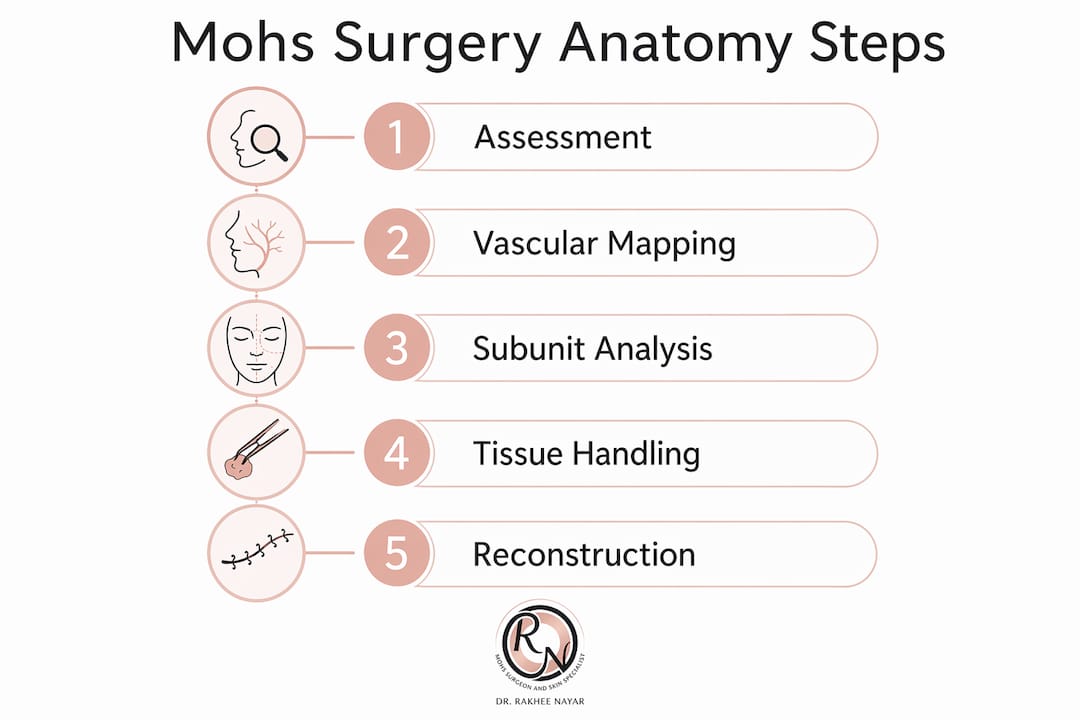
Facial anatomy is the single most important variable determining whether Mohs micrographic surgery achieves both complete tumour clearance and an acceptable functional and cosmetic result. The face is not a uniform surgical field. It contains distinct vascular territories, structurally dependent subunits such as the nasal ala and eyelids, and tissue planes where a millimetre of error translates directly into visible deformity or permanent dysfunction. Mohs surgery achieves up to 99% cure rates while preserving maximum healthy tissue, but that precision is only meaningful when the surgeon understands the anatomy governing every excision and reconstruction decision. This article explains why is facial anatomy important in Mohs surgery across four clinical dimensions: vascular supply, structural subunits, tissue handling, and reconstruction planning.
How facial vascular anatomy influences Mohs surgery and reconstruction

Blood supply governs every reconstructive decision made after a Mohs excision. A flap that looks geometrically sound on paper will fail if it crosses a vascular boundary or sacrifices a dominant perforator. A 2026 cadaveric study published in PLOS ONE established that facial arterial perforators ≥0.5 mm in diameter represent the optimal targets for flap design, as they reliably perfuse defined skin territories. This means that flap planning must begin with perforator identification, not with defect geometry.
The distribution of these perforators is non-uniform across the face. The perioral and nasal regions carry a higher density of perforators from the facial artery and its branches, whilst the temporal and preauricular zones rely more heavily on the superficial temporal and transverse facial arteries. This regional variation means that a donor site suitable in one facial zone may be poorly vascularised in another, even when the surface distance appears negligible.
Critically, textbook vascular patterns match only approximately 40% of cases in clinical practice. This figure is not a statistical curiosity. It means that a surgeon relying solely on anatomical memory rather than intraoperative assessment will encounter unexpected vessel positions in the majority of complex reconstructions. Micro-CT and cadaveric mapping studies now provide granular data on perforator clustering, allowing surgeons to anticipate territories and select donor sites with reduced perfusion risk.
| Facial artery | Primary territory | Perforator density | Typical diameter |
|---|---|---|---|
| Facial artery | Perioral, nasal sidewall | High | ≥0.5 mm |
| Superficial temporal artery | Temple, forehead | Moderate | 0.4–0.6 mm |
| Transverse facial artery | Cheek, preauricular | Moderate | 0.3–0.5 mm |
| Supratrochlear artery | Central forehead, glabella | High | ≥0.5 mm |
| Infraorbital artery | Medial cheek, lower eyelid | Low to moderate | 0.3–0.4 mm |
Pro Tip: Before harvesting any local flap on the face, use a handheld Doppler probe to confirm perforator location. Perforator mapping reduces the risk of inadvertent vessel sacrifice and improves flap survival, particularly in the perinasal and periocular zones where vascular anatomy is most variable.
Mapping perforators before reconstruction also helps surgeons select donor sites that minimise functional and cosmetic morbidity at the harvest location itself, a consideration that is frequently underweighted in surgical planning.
Why facial subunits determine reconstructive strategy after Mohs excision
The face is divided into aesthetic and functional subunits, including the nose, eyelids, lips, cheeks, forehead, and ears, each governed by distinct structural requirements. Reconstruction that ignores subunit boundaries produces visible step-offs, distorted free margins, and, in the worst cases, functional impairment such as ectropion or nasal valve collapse. Understanding facial structure is therefore not an aesthetic preference but a clinical necessity.
The nasal ala is the most instructive example. It is a free-standing structure supported by fibrofatty tissue rather than cartilage, which makes it uniquely vulnerable to collapse following full-thickness excision. Nasal ala reconstruction requires assessing structural stability before closure. If the ala shows any tendency to collapse, cartilage grafting from the auricular concha or nasal septum must be incorporated into the repair to maintain the airway and prevent postoperative deformity. Closing skin over an unsupported framework produces a result that deteriorates over weeks as scar contracture draws the ala inward.
Periocular reconstruction presents a different challenge. The eyelid is a multilayered structure with anterior and posterior lamellae, each requiring independent repair when both are compromised. Failure to reconstruct the posterior lamella with a mucosal substitute or tarsal graft results in corneal exposure and chronic irritation. Nasal and periocular reconstructions rely on multilayered support frameworks beyond the skin, requiring staged options including cartilage grafts for functional integrity.
Key facial subunits and their primary reconstructive considerations:
- Nasal ala: Assess for structural collapse; incorporate auricular cartilage graft if unsupported; use interpolated flap for large defects
- Eyelid: Reconstruct anterior and posterior lamellae independently; avoid tension on the lid margin to prevent ectropion
- Lip: Preserve orbicularis oris continuity for competence; respect the vermilion border to avoid visible step-off
- Ear: Cartilage framework must be maintained or reconstructed; skin grafts are appropriate for superficial defects
- Forehead: Respect the frontalis muscle plane; transposition flaps should follow relaxed skin tension lines
- Cheek: Large defects may require cervicofacial advancement; subunit boundaries guide scar placement
Pro Tip: Assess subunit stability before committing to a closure technique. A defect that appears straightforward on the surface may involve deeper structural compromise that will only become apparent under tension. Probing the defect margins and testing tissue mobility before designing a flap prevents the need for revision surgery.
Preservation of healthy tissue only prevents deformity when reconstruction respects subunit boundaries and structural support, creating a unified approach between excision and repair. This principle underpins the entire logic of anatomy-informed Mohs surgery.
How tissue handling and margin accuracy depend on anatomical knowledge
Surgical anatomy relevance extends beyond the reconstruction phase. It directly governs how accurately the Mohs surgeon identifies and processes tumour margins during the excision itself. A 2026 article in the Journal of Drugs in Dermatology demonstrated that frozen section facing loss during tissue processing creates positional deviations between the observed histological margin and the actual tumour boundary in the patient. This means that minimum margins after a positive Mohs stage must be adjusted to account for the tissue lost during facing, or recurrence risk increases.
Understanding facial anatomy guides this adjustment. The thickness of the dermis, the density of adnexal structures, and the depth of subcutaneous fat vary considerably across facial regions. The thin skin of the eyelid behaves differently under the cryostat than the thicker skin of the cheek or scalp. A surgeon who understands these regional differences can anticipate facing loss, adjust margin width accordingly, and orient tissue sections to maximise diagnostic accuracy.
The following steps in tissue handling are directly informed by anatomical knowledge:
- Excision geometry: The shape and angle of the excision must account for the curvature of the facial surface and the depth of the tumour relative to underlying structures such as cartilage or muscle.
- Tissue orientation: Correct mapping of the excised specimen to the patient’s anatomy is mandatory. Errors in orientation lead to incorrect identification of the positive margin and misdirected re-excision.
- Facing depth calibration: Regional skin thickness determines how much tissue is lost during cryostat sectioning. Thinner facial skin requires shallower facing to preserve diagnostic tissue.
- Margin adjustment after positive stage: When a stage returns positive, the minimum margin for the subsequent excision must incorporate the calculated facing loss to avoid under-excision.
- Depth assessment: Anatomical knowledge of the relevant tissue plane, whether above or below the superficial musculoaponeurotic system (SMAS), guides the depth of each subsequent stage and reduces the risk of inadvertent injury to motor nerves.
Mohs surgery techniques continue to evolve in response to this kind of quantitative margin modelling, reinforcing the case for anatomy-based surgical planning at every stage of the procedure.
Comparing reconstruction options based on anatomical defect location
Anatomy dictates not just whether to reconstruct but which technique offers the best outcome for a given defect. Defect size and location dictate interpolation flap choice, with blood supply and donor site factors including hair-bearing skin and tissue laxity influencing every technical decision.
| Reconstruction option | Vascular base | Best suited locations | Key limitation |
|---|---|---|---|
| Primary closure | Local perforators | Small defects, lax skin | Tension distorts free margins |
| Local transposition flap | Adjacent perforators | Cheek, forehead, temple | Limited reach for large defects |
| Forehead interpolation flap | Supratrochlear artery | Nasal tip, dorsum, ala | Two-stage; visible pedicle |
| Nasolabial interpolation flap | Facial artery perforators | Nasal ala, columella | Hair-bearing skin in men |
| Postauricular flap | Posterior auricular artery | Ear, small facial defects | Limited tissue volume |
| Full-thickness skin graft | Recipient bed vascularity | Eyelid, concave surfaces | Colour and texture mismatch |
The forehead flap, based on the supratrochlear artery, remains the gold standard for large nasal defects because it delivers well-vascularised, colour-matched tissue to a structurally demanding location. The nasolabial flap, supplied by perforators from the facial artery, suits alar reconstruction but requires careful donor site assessment in male patients where hair-bearing skin would produce an unacceptable result. Cosmetic outcomes in Mohs surgery are directly tied to how well the chosen reconstruction respects both the vascular anatomy and the subunit boundaries of the recipient site.
Pro Tip: When flap survival is uncertain due to vascular compromise or prior radiotherapy, consider involving a plastic surgeon with experience in perforator flap design. The dual training model, combining Mohs excision expertise with reconstructive plastic surgery, is well suited to complex facial defects.
Key takeaways
Facial anatomy is the clinical foundation of Mohs surgery, governing excision accuracy, tissue processing, flap viability, and subunit reconstruction at every stage of the procedure.
| Point | Details |
|---|---|
| Vascular anatomy governs flap survival | Perforators ≥0.5 mm define skin territories; map them before harvesting any facial flap. |
| Subunit boundaries prevent functional loss | Ignoring subunit structure risks ectropion, nasal collapse, and lip incompetence after closure. |
| Tissue facing affects margin accuracy | Frozen section facing loss creates positional deviations; adjust minimum margins to compensate. |
| Reconstruction choice follows defect location | Forehead and nasolabial flaps are anatomy-specific; selecting the wrong flap risks both function and aesthetics. |
| Anatomical variability is the norm | Textbook vascular patterns match only approximately 40% of cases, making intraoperative assessment non-negotiable. |
Expert anatomy-informed Mohs surgery in the UK
If you are seeking Mohs surgery performed with a rigorous understanding of facial anatomy and reconstructive principles, Rakhee Nayar – Mohs Surgeon and Skin Specialist offers precisely that combination. Miss Rakhee Nayar holds dual training in both Mohs micrographic surgery and plastic surgery, a pairing that directly addresses the clinical demands described throughout this article.

Her practice in North West England treats basal cell carcinoma and squamous cell carcinoma on the face with the precision that sensitive anatomical locations demand. From perforator-based flap planning to cartilage-supported nasal reconstruction, every procedure is grounded in current anatomical evidence. Explore the full scope of Mohs micrographic surgery services, or review the range of facial reconstruction options available following excision. Private consultations and e-consultations are available for both UK-based and international patients.
FAQ
Why is facial anatomy important in Mohs surgery?
Facial anatomy determines excision accuracy, flap viability, and reconstruction quality. The face contains distinct vascular territories and structurally dependent subunits where small anatomical errors produce functional impairment or visible deformity.
How does vascular anatomy affect flap choice after Mohs excision?
Facial arterial perforators ≥0.5 mm define skin territories that govern which donor sites are safe to harvest. Selecting a flap without confirming perforator location risks ischaemia and flap failure.
What is facing loss and why does it matter for Mohs margins?
Facing loss refers to tissue removed during cryostat sectioning in frozen section processing. This creates a positional deviation between the observed histological margin and the actual tumour boundary, requiring minimum margin adjustments to reduce recurrence risk.
Which facial subunits require the most careful reconstructive planning?
The nasal ala and eyelids require the most careful planning because both depend on structural support beyond the skin. The nasal ala may need cartilage grafting to prevent collapse, whilst the eyelid requires independent anterior and posterior lamellar reconstruction.
When should a plastic surgeon be involved in Mohs reconstruction?
A plastic surgeon should be involved when defects are large, involve structurally critical subunits, or when prior radiotherapy compromises local vascularity. Dual-trained surgeons combining Mohs and plastic surgery expertise are well suited to these cases.
Recommended
- Facial Mohs surgery recovery: your complete workflow
- Mohs vs standard excision: what matters for your care
- Explaining cosmetic outcomes in Mohs surgery
- Mohs surgery myths vs facts: what patients need to know
Filed under Mohs Surgery


