Facial reconstruction is surgery performed to restore the normal appearance and function of the face after trauma, disease, or congenital deformity. It is formally classified as reconstructive surgery, not cosmetic surgery, because its primary goal is to correct a deficit caused by illness or injury rather than to improve an otherwise normal appearance. Miss Rakhee Nayar, GMC-registered Consultant Plastic Surgeon and FRCS (Plast), practises this field with dual training in both plastic surgery and Mohs micrographic surgery, making her particularly well placed to manage facial defects that arise after skin cancer removal. The techniques involved range from simple wound closures to complex microvascular procedures, and the right approach depends entirely on the size, location, and cause of the defect.
What is facial reconstruction used to treat?
Facial reconstruction addresses a wide range of medical conditions where the face has lost normal form or function. The cause determines both the urgency and the complexity of the surgical plan.
The most common indications seen in a specialist practice include:
- Skin cancer defects. After excision of basal cell carcinoma or squamous cell carcinoma, particularly following Mohs micrographic surgery, the resulting wound must be closed in a way that restores both appearance and function. The importance of reconstruction after skin cancer removal is frequently underestimated by patients.
- Traumatic injuries. Road traffic accidents, assaults, and falls can cause facial fractures, soft tissue loss, and burns that require staged surgical repair.
- Congenital conditions. Cleft lip and palate are the most recognised examples, but other structural abnormalities of the nose, orbit, or jaw also require reconstruction from early childhood onwards.
- Oncological resection. Removal of tumours involving deeper facial structures, including bone and muscle, leaves defects that cannot heal without surgical intervention.
- Burns and radiation damage. Thermal injury and the long-term effects of radiotherapy cause tissue contracture and scarring that impair movement and expression.
Functional restoration is the clinical priority in every case. Facial reconstruction aims to restore breathing, eating, speaking, and facial expression, not merely to improve appearance. A multidisciplinary team, typically including a reconstructive surgeon, oncologist, speech therapist, and clinical psychologist, coordinates care for complex cases.
Which surgical techniques are used in facial reconstruction?
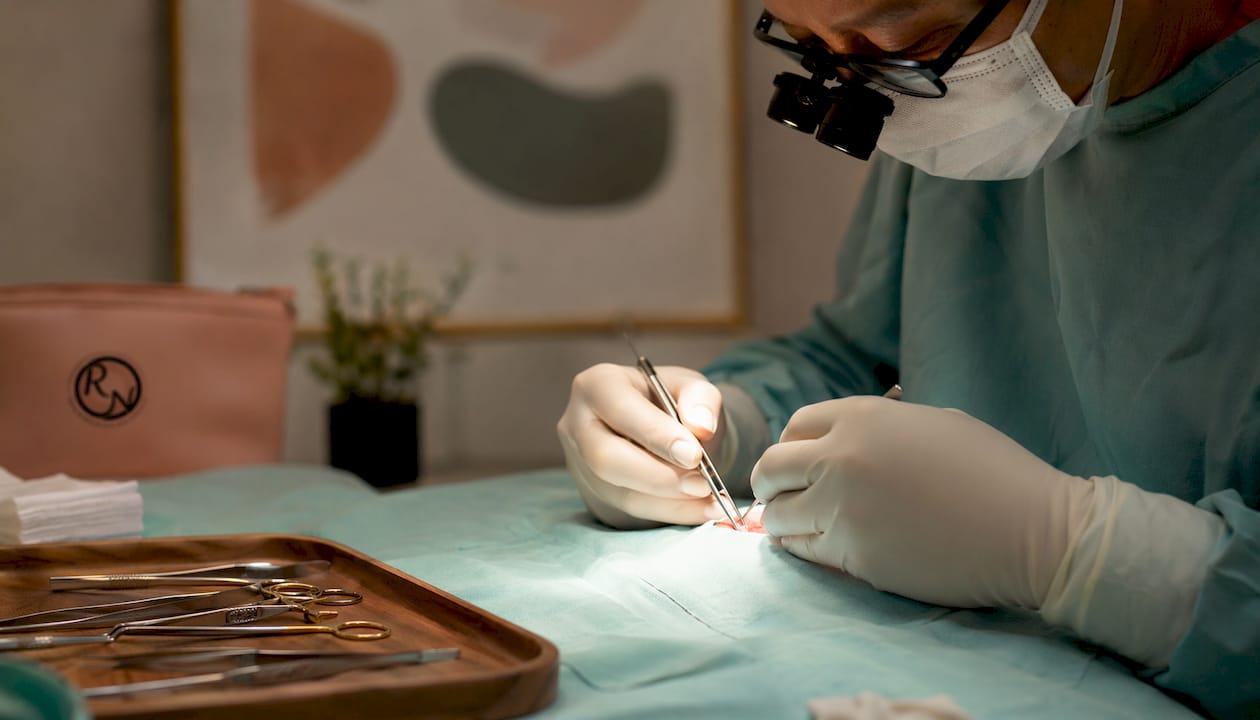
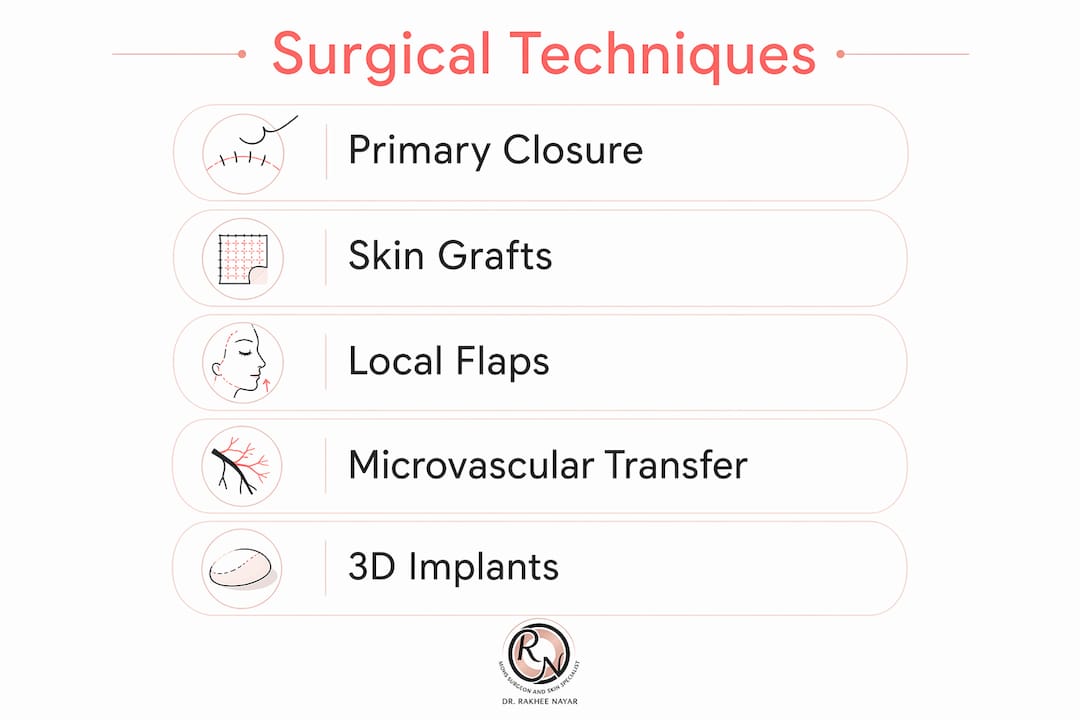
Facial reconstruction techniques span a broad spectrum, from straightforward primary closure to highly complex microsurgery. The choice of technique follows a reconstructive ladder: surgeons begin with the simplest option that will reliably achieve the desired outcome and move to more complex methods only when simpler ones are insufficient.
Primary closure and skin grafts
Primary closure stitches wound edges directly together and works well for small defects with sufficient surrounding tissue. Skin grafts transfer a thin layer of skin from a donor site, usually the thigh or behind the ear, to cover larger wounds. Grafts are reliable but produce a visible colour and texture difference, which limits their use on prominent facial areas.
Local and regional flaps
A local flap moves adjacent skin and its underlying blood supply into the defect. Because the tissue comes from the same anatomical area, colour and texture matching is far superior to a graft. The keystone flap is one well-established example: keystone flap reconstruction avoids donor site morbidity while achieving good colour and texture matching for facial wounds. Regional flaps, such as the paramedian forehead flap used in nasal reconstruction, recruit tissue from a slightly more distant site and are suited to larger or deeper defects.
Microvascular free tissue transfer
For major defects involving bone, muscle, or large areas of skin, microvascular free tissue transfer is the gold standard. A block of tissue, complete with its own artery and vein, is harvested from a distant donor site such as the forearm, thigh, or fibula and reconnected to blood vessels in the face under a microscope. Complex microvascular reconstruction allows surgeons to restore bone and soft tissue contours that no other technique can replicate.
Patient-specific implants and 3D planning
Advances in digital technology have changed how surgeons plan and execute complex reconstructions. Virtual surgical planning uses CT scan data to design the procedure before the patient enters theatre. Patient-specific implants, including those made from PEEK (polyether ether ketone), are manufactured to fit the exact contour of an individual’s skull or orbital rim. 3D surgical planning improves accuracy in restoring facial anatomy and reduces operative time.
Pro Tip: If you are preparing for a consultation about facial reconstruction, ask your surgeon specifically whether 3D virtual planning is part of their workflow. It is now considered standard practice for complex bony reconstructions and significantly improves symmetry outcomes.
The goal of every technique is the same: to restore identity and confidence by addressing both form and function, so that patients can move forward after trauma or disease.
What does recovery look like after facial reconstruction?
Recovery after facial reconstruction varies considerably depending on the complexity of the procedure. Minor repairs after small skin cancer excisions may require only one to two weeks of downtime, while major free flap reconstructions can involve several weeks in hospital followed by months of outpatient follow-up.
Physical healing milestones
Swelling and bruising are universal in the first two weeks. Most patients see significant reduction in swelling by six weeks, though full tissue settling takes three to six months. Sensation returns gradually as nerve endings regenerate, and this process can take up to a year in areas of extensive repair.
Scar management begins as soon as wounds are healed. Standard scar care protocols combine tape fixation for the first month with topical ointments and silicone gel for a further three months. Adhering to this regimen consistently makes a measurable difference to the final scar appearance.
Steps patients typically follow during recovery
- Rest and wound protection (weeks 1–2). Keep the face elevated, avoid sun exposure, and attend wound check appointments as scheduled.
- Scar taping (weeks 3–6). Apply paper or silicone tape daily to reduce tension across the healing scar line.
- Topical scar therapy (months 2–4). Use prescribed silicone gel or ointment twice daily. Postoperative scar management combining these agents over several months significantly improves scar appearance.
- Functional rehabilitation (months 1–3). Speech therapy or physiotherapy may be needed if the reconstruction involved the mouth, jaw, or muscles of expression.
- Psychological support (ongoing). Emotional adjustment continues well beyond physical healing and should be addressed proactively.
Pro Tip: Ask your surgical team for a written scar management plan before you leave hospital. Patients who follow a structured protocol from day one consistently achieve better cosmetic outcomes than those who begin scar care late.
Psychological aspects of recovery
The emotional response to seeing a changed face is often more intense than patients anticipate. Research shows that 71% of patients report anxiety about seeing their face after surgery, and nearly half experience more distress than they expected. Greater preoperative preparation correlates directly with higher satisfaction and reduced immediate distress. This finding underlines why psychological counselling before surgery is not optional. It is a clinical necessity.
Individual factors also shape scar perception. Younger and female patients tend to report greater aesthetic concerns after facial reconstruction, which means counselling should be tailored to the individual rather than delivered as a standard script.
How does facial reconstruction differ from cosmetic surgery?
Facial reconstruction fundamentally differs from cosmetic surgery in its purpose. Reconstructive surgery restores lost appearance and function caused by trauma or disease. Cosmetic surgery improves the appearance of a face that is already within normal limits. The distinction matters clinically, legally, and financially.
| Feature | Reconstructive surgery | Cosmetic surgery |
|---|---|---|
| Primary goal | Restore function and form after injury or disease | Improve appearance of a normal face |
| NHS funding | Available when medical necessity is documented | Not funded by the NHS |
| Clinical evidence required | Nasal endoscopy, airflow measurements, psychological evaluation | Not applicable |
| Typical indications | Skin cancer defects, trauma, congenital deformity | Rhinoplasty for appearance, facelifts, blepharoplasty |
| Aesthetic improvement | Secondary outcome, or addressed privately | Primary outcome |
NHS eligibility and private care pathways
NHS coverage for facial reconstruction applies only when there is clear documented medical necessity, such as restoring breathing, eating, or speaking, or treating significant trauma. Purely aesthetic improvements are not funded. Patients seeking NHS funding for reconstructive rhinoplasty, for example, must demonstrate functional impairment through clinical evidence including imaging and nasal airflow measurements.
NHS reconstructive rhinoplasty is approved for post-traumatic deformities or congenital nasal defects that impair breathing or cause significant disfigurement. Psychological evaluation may also be required to support the funding application.
Private care pathways offer greater flexibility. Patients who have completed NHS-funded reconstruction but wish to refine the aesthetic result can access further procedures privately. Private consultations also allow faster access to specialist surgeons, more detailed preoperative planning, and greater choice of technique. For patients seeking aesthetic refinements alongside medical reconstruction, private treatment allows both goals to be addressed within a single care plan.
Key takeaways
Facial reconstruction is the most effective surgical approach for restoring both the appearance and function of the face after trauma, disease, or congenital deformity, and its outcomes depend on technique selection, scar management, and psychological preparation.
| Point | Details |
|---|---|
| Reconstruction versus cosmetic surgery | Reconstructive surgery corrects deficits caused by illness or injury; cosmetic surgery improves a normal face. |
| Technique selection follows a ladder | Surgeons begin with the simplest reliable option and progress to microvascular free flaps only when needed. |
| Scar management is time-sensitive | Taping for one month followed by silicone gel for three months significantly improves final scar appearance. |
| Psychological preparation reduces distress | 71% of patients report anxiety about their post-surgical appearance; preoperative counselling measurably reduces this. |
| NHS funding requires documented medical necessity | Clinical evidence of functional impairment, such as airflow measurements or imaging, is required to access NHS reconstruction. |
What I have learned from years of facial reconstruction practice
By Miss Rakhee Nayar
The question patients ask most often is not “will it work?” It is “will I recognise myself?” That question tells me everything about where the real work lies in facial reconstruction.
Technically, the surgery is solvable. We have reliable techniques for almost every defect size and location. What is harder to solve is the gap between a patient’s expectation and their experience of the first weeks after surgery. Swelling distorts everything. Scars look their worst at six weeks before they begin to soften. Patients who have not been prepared for this window of time often interpret normal healing as a poor result.
My clinical experience has taught me that the surgeons who achieve the best patient satisfaction are not necessarily those with the most complex technical repertoire. They are the ones who invest time before the operation explaining what the face will look like at each stage of recovery. A patient who knows that swelling peaks at 48 hours and that scars fade over 12 months is a patient who can tolerate the process.
I also want to be direct about something that is rarely said plainly: reconstruction after skin cancer is not a cosmetic afterthought. It is an integral part of the oncological treatment plan. When Mohs surgery removes a tumour with clear margins, the defect that remains must be closed in a way that does not compromise future surveillance, does not distort surrounding structures, and gives the patient back a face they can live with. That requires a surgeon who understands both the cancer and the reconstruction. Dual training in Mohs and plastic surgery is not a marketing point. It changes the clinical decisions made in theatre.
— Miss Rakhee Nayar
Facial reconstruction at Rakhee Nayar – Mohs Surgeon and Skin Specialist
Rakhee Nayar – Mohs Surgeon and Skin Specialist offers consultant-led facial reconstruction surgery at Circle Cheshire in North West England, with private consultations and e-consultations available for UK-based and international patients. Miss Nayar’s dual training in Mohs micrographic surgery and plastic surgery means that tumour removal and wound reconstruction are planned together from the outset, not treated as separate episodes of care.

Every patient receives an individualised treatment plan covering technique selection, scar management, and psychological preparation. Whether you are facing reconstruction after skin cancer treatment or a traumatic injury, a consultation with Miss Nayar will give you a clear picture of your options, realistic timelines, and what to expect at each stage of recovery. Private fees are available on request. This article does not constitute medical advice. Consult a GMC-registered specialist for guidance specific to your situation.
FAQ
What is facial reconstruction surgery?
Facial reconstruction surgery restores the normal appearance and function of the face after trauma, disease, or congenital deformity. It is classified as reconstructive rather than cosmetic surgery because it corrects a deficit caused by illness or injury.
Does the NHS fund facial reconstruction?
The NHS funds facial reconstruction when there is documented medical necessity, such as impaired breathing, eating, or speaking, or significant disfigurement from trauma or congenital conditions. Purely aesthetic improvements are not funded, and clinical evidence is required to support any funding application.
How long does recovery take after facial reconstruction?
Recovery varies by procedure complexity. Minor repairs may require one to two weeks, while major reconstructions involving free tissue transfer can take several weeks in hospital followed by months of outpatient care, with scar management continuing for at least four months.
What is the difference between a flap and a skin graft?
A skin graft transfers a thin layer of skin from a donor site and produces a visible colour difference. A flap moves adjacent tissue with its own blood supply, giving a far better colour and texture match, which makes flaps the preferred choice for most visible facial areas.
How can I prepare psychologically for facial reconstruction?
Research shows that patients who receive detailed preoperative information about their expected appearance at each stage of healing report significantly less distress and greater satisfaction after surgery. Ask your surgical team for a structured preparation plan and access to psychological support before your operation.