
A plastic surgeon is defined as a specialist trained in the surgical restoration and reconstruction of skin, soft tissue, and underlying structures. A dermatologist, by contrast, specialises in diagnosing and medically managing diseases of the skin, hair, and nails. Understanding the role of plastic surgeon vs dermatologist is not academic. For UK adults facing a suspicious lesion or a confirmed skin cancer diagnosis, knowing which specialist to see, and when, directly affects the speed and quality of their care. Miss Rakhee Nayar, GMC-registered Consultant Plastic Surgeon and Mohs surgeon at Rakhee Nayar – Mohs Surgeon and Skin Specialist, holds dual training in both disciplines, a combination that remains rare and clinically significant.
What is the role of plastic surgeon vs dermatologist in skin care?
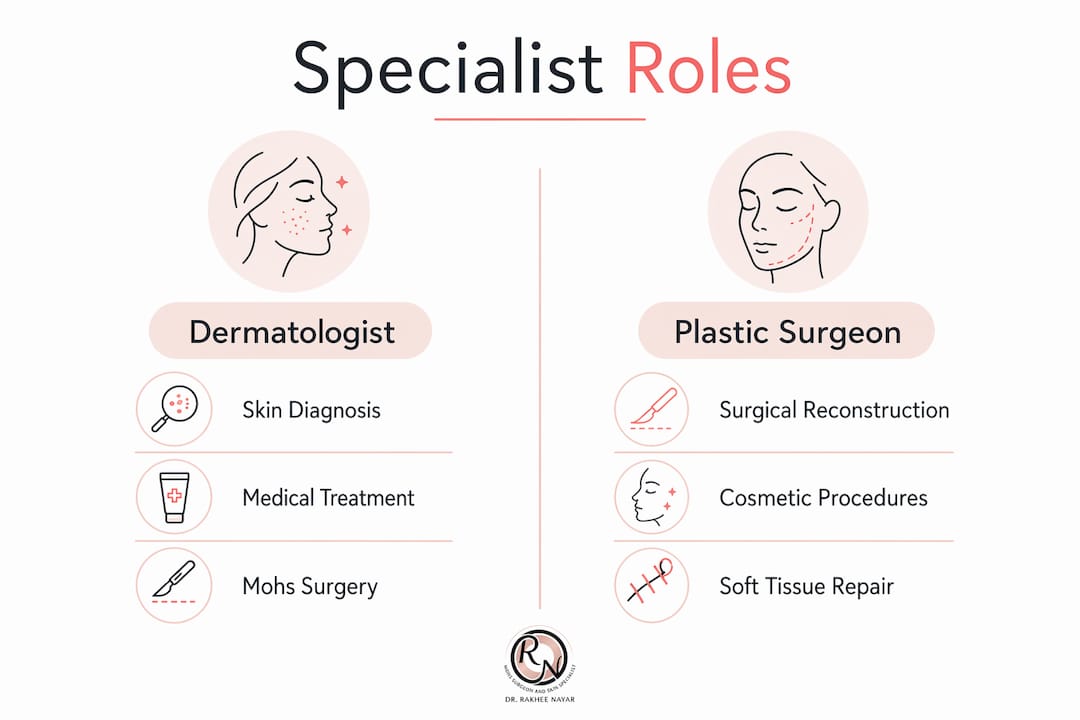
Dermatologists focus on diagnosis and medical management of skin diseases, including biopsies and Mohs surgery. Plastic surgeons specialise in restoration and reconstruction after trauma, disease, or cancer removal. These are complementary roles, not competing ones. The distinction matters most when a patient moves from diagnosis into treatment and then into reconstruction.
Dermatologists are trained in the full spectrum of skin disease. Their scope covers acne, eczema, psoriasis, and pigmentation disorders, as well as the detection and surgical management of skin cancers including basal cell carcinoma and squamous cell carcinoma. They are typically the first specialist to evaluate a suspicious lesion, and they carry out a wide range of minor surgical procedures in clinic.
Plastic surgeons operate at the intersection of function and form. Their training centres on restoring what disease or injury has taken away. When a skin cancer excision leaves a significant defect on the nose, eyelid, or lip, the plastic surgeon’s role is to close that defect in a way that preserves both appearance and function. This is not cosmetic surgery in the popular sense. It is reconstructive work with clinical consequences.
What training and expertise separate these two specialists?
The training pathways for dermatologists and plastic surgeons diverge early and remain distinct throughout specialist registration.
Dermatologists complete core medical training followed by a specialist registrar programme in dermatology, typically accredited by the British Association of Dermatologists (BAD). Their surgical skills include punch biopsies, shave excisions, curettage, and Mohs micrographic surgery. Mohs micrographic surgery is a staged, tissue-sparing technique that enables complete margin assessment, making it the gold standard for high-risk facial skin cancers. Dermatologists who perform Mohs surgery receive additional subspecialty training in this technique.
Plastic surgeons complete core surgical training and then a specialist registrar programme in plastic surgery, accredited by the British Association of Plastic, Reconstructive and Aesthetic Surgeons (BAPRAS). Their training covers:
- Local flap design and execution, including rotation, advancement, and transposition flaps
- Skin grafting, both split-thickness and full-thickness
- Layered wound closure respecting tissue planes
- Facial subunit anatomy and reconstruction of the nose, eyelids, lips, and ears
- Scar revision and complex wound management
Pro Tip: When a skin cancer sits on a cosmetically sensitive area of the face, ask your referring clinician whether a specialist with dual training in Mohs surgery and plastic surgery is available. This combination reduces the number of appointments and optimises both clearance and reconstruction in a single care pathway.
The key difference is scope of reconstruction. A dermatologist excels at removing disease with precision. A plastic surgeon excels at rebuilding what remains. Both skills are needed in complex skin cancer care.
When should you see a dermatologist, and when is a plastic surgeon more appropriate?
The answer depends on three factors: the nature of the condition, the size and location of the lesion, and what treatment is required after excision.
A dermatologist is the right first point of contact for:
- A new or changing skin lesion requiring assessment and diagnosis
- Inflammatory skin conditions such as eczema, psoriasis, or rosacea
- Skin cancer excision where the resulting defect is small and can be closed directly
- Mohs micrographic surgery for basal cell or squamous cell carcinoma on the face
- Medical management of skin disease with topical or systemic treatments
A plastic surgeon becomes the appropriate specialist when:
- A skin cancer excision leaves a defect too large or complex for direct closure
- The lesion sits on the nose, eyelid, lip, or ear, where function and appearance are both at risk
- Reconstruction requires a local flap or skin graft to restore normal contour
- A previous repair has failed or produced a functionally limiting scar
Anatomical location dictates the choice of surgical method and specialist. A basal cell carcinoma on the nasal tip, for example, requires a plastic surgeon with detailed knowledge of nasal subunit anatomy and vascular supply. Removing the cancer is one task. Rebuilding the nose so it looks and breathes normally is another.
NHS referral pathways reflect this division. Urgent suspected skin cancer cases are prioritised and seen within weeks under the two-week-wait pathway. Non-urgent dermatology or plastic surgery cases face considerably longer waits, with initial consultations ranging from 3 to 12 months and total treatment timelines sometimes extending to 18 months. That gap is one reason many patients with facial skin cancers seek private care, where appointments and treatment can be coordinated far more quickly.
How do dermatologists and plastic surgeons collaborate in skin cancer care?
Complex skin cancer cases benefit from multidisciplinary teams including dermatologists and plastic surgeons working closely together. This is not an informal arrangement. In NHS settings, skin cancer multidisciplinary team meetings bring together dermatologists, plastic surgeons, oncologists, and specialist nurses to agree on treatment plans for higher-risk cases.
A typical collaborative pathway for a facial skin cancer looks like this:
- The dermatologist assesses the lesion, confirms the diagnosis with a biopsy, and plans the excision method.
- Mohs micrographic surgery is performed, removing the cancer in staged layers with real-time margin assessment.
- The resulting defect is mapped and its dimensions recorded.
- The plastic surgeon plans the reconstruction, selecting the appropriate flap or graft based on defect size, location, and the patient’s tissue quality.
- Reconstruction is carried out, restoring the skin surface, underlying structure, and, where relevant, function such as eyelid closure or nasal airflow.
- Both specialists review the outcome and coordinate any further management.
Collaboration between the two specialists ensures both disease management and functional, aesthetic restoration. This is the clinical standard for complex facial skin cancer, not an optional extra.
“The most important thing I can tell a patient facing facial skin cancer is this: the surgery that removes the cancer and the surgery that rebuilds your face are equally important. One without the other is incomplete care. Choosing a team, or a specialist, who understands both sides of that equation changes outcomes in ways that are visible every day of a patient’s life.”
The role of the multidisciplinary team in skin cancer care is now well-established in UK clinical guidance. Patients treated within coordinated pathways experience fewer complications, better cosmetic results, and higher rates of complete cancer clearance.
What should patients expect from treatment, recovery, and outcomes?
Recovery and risks vary significantly between dermatology and plastic surgery interventions. Patient counselling must address these differences to set realistic expectations.
Dermatology treatments
Dermatology procedures such as Mohs surgery, curettage, and minor excisions are typically performed under local anaesthetic in a clinic setting. Recovery is generally measured in days to a couple of weeks. Wound care is straightforward, and most patients return to normal activity quickly. The trade-off is that direct closure of larger defects may produce a more visible scar than a planned reconstructive repair.
Plastic surgery reconstruction
Reconstructive procedures involve more extensive surgery. Plastic surgeons perform local flap reconstruction, skin grafting, and layered closure techniques to restore form and function after lesion excision. Recovery after a local flap repair on the face typically takes several weeks. Swelling, bruising, and temporary changes in sensation are normal. The goal is to restore appearance and critical functions, for example on eyelids, lips, or the nose.
The table below summarises the key differences patients should understand before choosing a care pathway.
| Factor | Dermatology intervention | Plastic surgery reconstruction |
|---|---|---|
| Anaesthetic | Local, in clinic | Local or general, theatre setting |
| Recovery time | Days to 2 weeks | 2 to 6 weeks depending on complexity |
| Scar outcome | Variable, depends on closure | Planned for minimal distortion |
| Functional restoration | Limited to excision | Central to the surgical plan |
| NHS wait (non-urgent) | 3 to 12 months | 3 to 12 months |
| Private availability | Yes | Yes, often faster coordination |
Pro Tip: If your skin cancer sits on or near the eyelid, nose, or lip, ask specifically about facial reconstructive surgery options before excision takes place. Planning reconstruction in advance produces better results than attempting repair after the fact.
Precise surgical planning for facial lesion excision requires balancing complete clearance with minimising distortion. Plastic surgeons use advanced flap and graft methods that respect vascular supply and facial subunits to maintain natural function and contour. This level of planning is what separates a good cosmetic outcome from a poor one, and it begins before the first incision.
For patients considering private treatment, costs vary by procedure complexity and are not publicly listed as a fixed schedule. A consultation with a GMC-registered specialist will provide a personalised cost estimate based on the specific clinical picture.
Key takeaways
The single most important distinction in plastic surgery vs dermatology is this: dermatologists diagnose and remove skin disease, while plastic surgeons restore what excision leaves behind. Both roles are necessary, and the best outcomes arise when they work together.
| Point | Details |
|---|---|
| Dermatologist duties | Dermatologists diagnose skin disease, perform biopsies, and carry out Mohs surgery for cancer removal. |
| Plastic surgeon responsibilities | Plastic surgeons reconstruct defects using flaps, grafts, and layered closure to restore function and appearance. |
| When to see a dermatologist | See a dermatologist first for any new or changing lesion, inflammatory condition, or initial skin cancer assessment. |
| When reconstruction is needed | A plastic surgeon is required when excision leaves a defect on a complex anatomical area such as the nose or eyelid. |
| Collaboration improves outcomes | Multidisciplinary teams combining both specialties produce higher cure rates and better cosmetic results in complex cases. |
My view on where these two specialties meet
Patients often arrive at a consultation having already decided which type of specialist they need. They have read something online, spoken to a friend, or been told by their GP to see “a skin doctor.” What they rarely understand is that the most consequential decision is not which specialist to see first. It is whether the two specialists involved in their care are actually talking to each other.
I trained in both plastic surgery and Mohs surgery because I saw, early in my career, that the handoff between excision and reconstruction was where outcomes fell apart. A dermatologist might achieve clear margins on a nasal tip cancer, then refer the patient to a plastic surgeon who has never seen the defect in theatre. The reconstruction is planned from a photograph and a letter. That is not optimal care.
What I have found, working with patients at Rakhee Nayar – Mohs Surgeon and Skin Specialist, is that dual training changes the conversation entirely. When the same clinician understands both the oncological imperative of clear margins and the reconstructive imperative of preserving facial subunits, the plan is coherent from the start. The surgical excision and reconstruction are designed together, not bolted together after the fact.
My honest view is that the dermatologist vs plastic surgeon framing is slightly misleading for patients with facial skin cancer. The question is not which specialist you need. The question is whether your care team has the combined expertise to manage both sides of the problem. For straightforward lesions in non-sensitive areas, a single specialist is entirely appropriate. For anything on the face, particularly the nose, eyelids, or lips, I would always recommend a pathway that includes both disciplines, whether delivered by two specialists working in tandem or by one clinician trained in both.
This is not a self-serving position. It is what the evidence supports, and it is what I would recommend to a member of my own family.
— Miss Rakhee Nayar
Specialist skin cancer care at Rakhee Nayar – Mohs Surgeon and Skin Specialist
Rakhee Nayar – Mohs Surgeon and Skin Specialist offers a fully integrated pathway for patients with skin cancer on the face and other cosmetically sensitive areas. Miss Nayar’s dual training in Mohs micrographic surgery and plastic surgery means that excision and reconstruction are planned as a single procedure, not two separate referrals.

Private consultations are available in North West England, with e-consultations for patients across the UK and internationally. Whether you need expert skin cancer detection and Mohs surgery, or facial reconstruction after excision, the clinic provides consultant-led care from assessment through to recovery. To arrange a consultation, visit mohssurgeon.co.uk.
This article is for information only and does not constitute medical advice. Consult a GMC-registered specialist for personalised clinical guidance.
FAQ
What is the main difference between a dermatologist and a plastic surgeon?
A dermatologist diagnoses and medically manages skin diseases, including performing Mohs surgery to remove skin cancer. A plastic surgeon reconstructs tissue defects left after excision, restoring both function and appearance.
When should I see a plastic surgeon rather than a dermatologist?
See a plastic surgeon when a skin cancer excision leaves a defect in a complex area such as the nose, eyelid, or lip, or when reconstruction requires a local flap or skin graft. Dermatologists typically manage the initial diagnosis and excision.
Can one specialist perform both Mohs surgery and reconstruction?
Yes. Clinicians with dual training in Mohs surgery and plastic surgery, such as Miss Rakhee Nayar, can perform both the cancer removal and the reconstruction, which improves planning and often produces better cosmetic outcomes.
How long is the NHS wait to see a dermatologist or plastic surgeon?
Urgent suspected skin cancer cases are seen within weeks under the two-week-wait pathway. Non-urgent cases face initial consultation waits of 3 to 12 months, with total treatment timelines sometimes reaching 18 months depending on region and demand.
Does Mohs surgery always require a plastic surgeon for reconstruction?
Not always. Small defects in non-sensitive areas can often be closed directly by the Mohs surgeon. Larger or more complex defects, particularly on the face, are best reconstructed by a plastic surgeon to preserve function and minimise scarring.