Travelling for skin cancer treatment is defined as seeking specialist oncological or surgical care outside your local healthcare system, typically to access procedures not available domestically, reduce waiting times, or lower treatment costs. Patients diagnosed with basal cell carcinoma, squamous cell carcinoma, or melanoma increasingly consider this option when NHS waiting lists delay intervention or when procedures such as Mohs micrographic surgery are not accessible locally. Cost savings can reach 50%–70% compared with equivalent private oncology services in some destinations. That figure alone explains why the question of why travel for skin cancer treatment appears so frequently after a diagnosis. Rakhee Nayar – Mohs Surgeon and Skin Specialist provides specialist Mohs surgery and private consultations for both UK-based and international patients, offering a clinically rigorous alternative to travelling far afield.
Why travel for skin cancer treatment: the core reasons
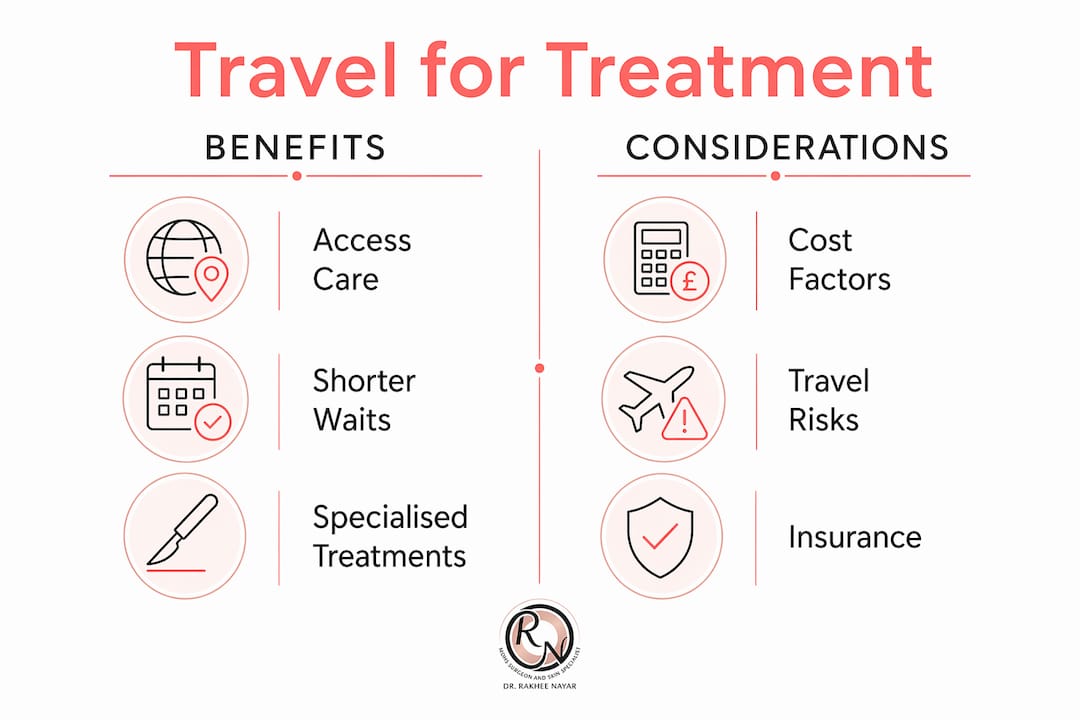
Three factors drive most decisions to seek care abroad: access to specialist procedures, shorter waiting periods, and lower costs. Each carries real clinical weight, and understanding them helps patients make informed choices rather than reactive ones.
Access to specialist procedures
Mohs micrographic surgery is the most common procedure prompting patients to travel. It removes skin cancer layer by layer, with microscopic margin control at each stage, preserving the maximum amount of healthy tissue. This matters most on the face, ears, nose, and hands, where tissue loss has both functional and cosmetic consequences. Surgical candidacy depends on tumour size, location, and histology, meaning expert pathology assessment is a prerequisite, not an optional step.
Beyond Mohs surgery, some patients travel for access to advanced immunotherapy protocols or proton beam therapy, which remain available only in a limited number of specialist centres globally. The NHS does fund proton beam therapy in specific cases, but eligibility criteria are strict and waiting times can be lengthy. Patients who do not qualify, or who cannot wait, may look abroad for equivalent access.
Waiting times and treatment delays
Multi-week waits in public systems can delay treatment initiation, and in aggressive or rapidly growing tumours, that delay carries clinical risk. Shorter time to treatment is particularly relevant for squamous cell carcinoma, which carries a higher metastatic potential than basal cell carcinoma.
Pro Tip: If your NHS referral is delayed, ask your GP to confirm the urgency category in writing. In England, an urgent suspected cancer referral comes under the NHS target to diagnose or rule out cancer within 28 days, and a written record helps if you later seek private care.
What specialised skin cancer treatments prompt patients to travel?
The decision to travel is rarely about general dermatology. It is almost always about accessing a specific procedure or a specific level of expertise.
| Treatment type | Domestic NHS availability | Private UK availability | Availability abroad |
|---|---|---|---|
| Mohs micrographic surgery | Limited specialist centres | Available at specialist clinics | Available in select international centres |
| Standard surgical excision | Widely available | Widely available | Widely available |
| Immunotherapy (advanced melanoma) | Available via NICE-approved pathways | Available privately | Available in specialist oncology centres |
| Proton beam therapy | Very limited, strict eligibility | Not widely available privately | Available in specialist international centres |
| Facial reconstructive surgery post-excision | Available, but waiting times vary | Available at specialist clinics | Available in select centres |
The table above shows that Mohs surgery and facial reconstruction are the two areas where private specialist access, whether in the UK or internationally, offers the clearest advantage over standard NHS pathways. Latest Mohs surgery techniques continue to evolve, with same-day excision and reconstruction now standard practice at experienced centres.
Patients also value second-opinion programmes and multidisciplinary team reviews, which are often only accessible through specialist private or international centres. A second opinion on histology or surgical planning can materially change the treatment approach, particularly for tumours near critical structures.
Pro Tip: Before committing to treatment abroad, request a formal written opinion from a UK-based specialist. This gives you a clinical benchmark against which to assess any international proposal, and it protects you if complications arise later.
How does travelling for skin cancer treatment affect cost and wait times?
Cost is a significant factor, but it requires careful interpretation. The headline saving of 50%–70% applies to the treatment invoice itself. It does not automatically account for travel, accommodation, repeat visits, or the cost of managing complications at home after returning.
Understanding the cost comparison
The cost of private Mohs surgery in the UK depends on tumour complexity, the number of stages required and whether facial reconstruction is needed. Costs in some international destinations are lower, but the gap narrows considerably once flights, accommodation, and post-operative follow-up are factored in. Patients should request itemised cost breakdowns from any international centre before committing.
Insurance and financial planning
Medical travel insurance covers acute complications but rarely covers the planned treatment itself. This is a critical distinction. If you travel abroad for Mohs surgery and develop a post-operative wound infection requiring hospitalisation, your travel insurer may cover the emergency admission. They will not reimburse the original surgery. Insurance policies focused on emergency events make pre-travel financial planning essential, not optional.
Full disclosure of your cancer history during insurance underwriting is non-negotiable. Claims are denied when cancer history is omitted, even for complications entirely unrelated to the primary diagnosis. This is not a technicality. It is a standard underwriting condition across all major medical travel insurers.
Key financial considerations before travelling for treatment:
- Obtain a full itemised quote from the treating centre, including anaesthesia, pathology, and reconstruction fees.
- Confirm whether follow-up appointments are included or billed separately.
- Check whether your UK-based oncologist or GP will provide ongoing monitoring after you return.
- Budget for at least one unplanned return visit if complications arise.
- Confirm the currency of the quote and any exchange rate risk if paying in advance.
Pro Tip: Ask the international centre for a written treatment plan, not just a price. A plan that specifies the number of surgical stages, the reconstruction method, and the follow-up protocol gives you a clinically meaningful basis for comparison, not just a financial one.
What practical preparations are needed when travelling for treatment?
Safe medical travel requires preparation well beyond booking flights and accommodation. The clinical and logistical groundwork determines whether the experience is safe and productive.
Essential documents to carry
- A copy of your biopsy report, including the histology findings and tumour classification.
- A letter from your UK oncologist or GP confirming your diagnosis, current treatment plan, and any relevant medical history.
- A full medication list, including dosages, generic names, and the prescribing clinician’s contact details.
- Copies of any imaging, including dermoscopy photographs or MRI scans if relevant to your case.
- Your travel insurance policy documents, with the emergency contact number clearly marked.
- Physician letters confirming medication necessity for any restricted drugs, such as codeine, which require formal documentation to cross international borders legally.
Managing medication and skin protection
Certain medications require formal documentation to comply with international regulations. Opioid-based pain relief and some immunosuppressants fall into this category. Contact the embassy of your destination country at least four weeks before travel to confirm requirements.
Skin sensitivity increases during and after treatment. Patients should use high-SPF sun protection and wear protective clothing, particularly in sunny destinations. This is not cosmetic advice. Photosensitivity during treatment increases the risk of further skin damage, which can complicate healing and confuse post-operative assessment. Advice on skin care during cancer treatment can help patients manage sensitivity and support recovery during travel.
Timing your travel relative to surgery
A cancer diagnosis does not preclude travel, but treatment side effects must be carefully managed with medical input. Plan to arrive at your destination at least 48 hours before your procedure. This allows time to recover from the journey, attend a pre-operative consultation, and complete any required pre-admission tests. Do not schedule a return flight on the day of surgery or the day after.
What are the risks and recovery considerations when having treatment abroad?
Travelling for skin cancer treatment carries specific risks that differ from those of domestic care. Most are manageable with preparation, but they require honest assessment before departure.
Post-operative flying and wound complications
Surgeons advise waiting 5–7 days after surgery before flying. This waiting period reduces the risk of wound dehiscence and deep vein thrombosis. Flying too soon after facial surgery, in particular, increases swelling and may compromise wound closure. Budget for at least one additional week of accommodation beyond the expected procedure date to allow for this.
Key risks to discuss with your treating surgeon before departure:
- Wound infection, particularly in humid or high-temperature climates.
- Deep vein thrombosis during long-haul flights post-operatively.
- Delayed wound healing if reconstruction involves flap or graft techniques.
- Difficulty accessing emergency care if complications arise in an unfamiliar healthcare system.
- Communication barriers between the international treating team and your UK-based follow-up clinician.
Follow-up care and monitoring after returning home
Post-operative wound care involves monitoring for infection, protecting the surgical site, and having prompt access to emergency facilities if needed. Arrange follow-up with a UK-based clinician before you travel, not after you return. Your GP or a private specialist should be briefed on the procedure, the reconstruction method used, and the expected healing timeline. Request a full operative report from the treating centre in English before you leave.
Skin health practices for recovery should begin immediately after surgery. Keep the wound site clean and dry, avoid direct sun exposure on the healing area, and attend all scheduled dressing changes. If the international centre provides a wound care protocol, share it with your UK clinician so that follow-up care is consistent.
Key takeaways
Travelling for skin cancer treatment offers genuine benefits, but the decision requires careful clinical and financial planning before departure.
| Point | Details |
|---|---|
| Access drives most decisions | Patients travel primarily for Mohs surgery, advanced immunotherapy, or specialist reconstruction not available locally. |
| Cost savings require full accounting | Headline savings of 50%–70% on treatment fees narrow when travel, accommodation, and follow-up costs are included. |
| Insurance requires full disclosure | Omitting cancer history during underwriting leads to claim denial, even for unrelated acute complications. |
| Flying too soon carries real risk | Surgeons recommend waiting 5–7 days post-operatively before flying to reduce wound and DVT risk. |
| Follow-up must be arranged in advance | Confirm UK-based post-operative monitoring before departure, not after returning home. |
Specialist Mohs surgery in the UK: an alternative worth considering
For many patients weighing the option of treatment abroad, a specialist private clinic in the UK offers the same clinical advantages without the logistical complexity of international travel.
Rakhee Nayar – Mohs Surgeon and Skin Specialist provides consultant-led Mohs micrographic surgery at a specialist clinic in North West England, with Miss Nayar holding dual training in both Mohs surgery and plastic surgery. This combination means that excision and reconstruction are managed by a single consultant, reducing handover risk and improving cosmetic outcomes. Private consultations and e-consultations are available for patients across the UK and internationally. If you are at the stage of weighing your skin cancer treatment options, early detection and specialist assessment remain the most important first steps. Contact the clinic directly to discuss your diagnosis and arrange a consultation.
This article is for informational purposes only and does not constitute medical advice. Consult a GMC-registered specialist before making any treatment decisions.
FAQ
Why do patients travel for skin cancer treatment?
Patients travel primarily to access specialist procedures such as Mohs micrographic surgery, to reduce waiting times, or to lower treatment costs. Cost savings of 50%–70% on treatment fees are reported in some international destinations compared with domestic private rates.
What documents do I need to travel for skin cancer treatment?
Carry your biopsy report, an oncologist or GP letter confirming your diagnosis and treatment plan, a full medication list, and physician letters for any restricted drugs. Formal documentation is required to cross international borders with certain medications, including some pain relief.
When can I fly after skin cancer surgery?
Surgeons recommend waiting 5–7 days after surgery before flying. This reduces the risk of wound complications and deep vein thrombosis during the flight.
Does travel insurance cover skin cancer treatment abroad?
Medical travel insurance covers acute complications but does not cover the planned treatment itself. Full disclosure of your cancer history is required during underwriting. Omitting this information leads to claim denial, including for complications unrelated to the primary diagnosis.
Is Mohs surgery available in the UK without travelling abroad?
Mohs micrographic surgery is available at specialist private clinics in the UK, including through Rakhee Nayar – Mohs Surgeon and Skin Specialist in North West England. Private access typically offers shorter waiting times than NHS pathways for this procedure.
Recommended
- How to support skin cancer patients: practical help guide
- High-risk skin cancer: Expert treatment guide for UK patients
- How is skin cancer staged: a patient’s guide
- Types of skin cancer and advanced facial treatments UK
Filed under Choosing Your Care