
Reconstructive surgery after skin cancer is defined as a surgical process that restores the form and function of tissue removed during cancer excision. Knowing how to plan for reconstructive surgery makes a measurable difference to your outcome, your recovery, and your confidence throughout the process. The planning phase covers four distinct areas: pre-operative health preparation, choosing the right surgical technique, structuring your recovery, and asking the right questions before you consent. This guide addresses each area directly, drawing on clinical guidance relevant to patients undergoing procedures such as Mohs micrographic surgery followed by facial or skin reconstruction.
What pre-operative preparations are essential before reconstructive surgery?
Pre-operative preparation is the single most controllable factor in surgical outcomes. Physical preparation is as decisive as logistical planning, and neglecting it increases the risk of wound complications, delayed healing, and anaesthetic problems.
Stop smoking well before your procedure
Patients must stop smoking at least 4 weeks before surgery. Smoking restricts blood flow to healing tissue, which significantly raises the risk of tissue necrosis, wound breakdown, and infection. Four weeks is the minimum; stopping earlier gives your body more time to restore normal tissue oxygenation.
Follow fasting instructions precisely
Pre-operative fasting requires stopping all food at least 8 hours before surgery. Clear fluids may be permitted up to 1 hour before your arrival time, but you must confirm this with your surgical team. Fasting prevents aspiration during anaesthesia, which is a serious and avoidable risk.
Optimise your nutrition and hydration
Good nutritional status supports wound healing. Protein, vitamin C, and zinc are particularly relevant to tissue repair. If you have a poor appetite or a condition affecting absorption, speak to your GP about supplementation before your procedure date.
Review all medications with your surgeon
Blood thinners such as warfarin, aspirin, and clopidogrel affect bleeding during surgery. Your surgeon will advise whether to pause or adjust these. Patients managing chronic conditions including hypertension or diabetes should have these well controlled before their procedure date, as optimising blood pressure and general health directly affects anaesthetic tolerance and wound healing.
Arrange practical support in advance
Arrange for a caregiver to assist you for at least 24 hours after discharge. Post-anaesthesia effects impair motor function and judgement, so you must not drive or be left alone. Organise your transport home before your surgery date, not on the day.
Pro Tip: Prepare a reconstructive surgery checklist at least two weeks before your procedure. Include your medication list, fasting start time, transport arrangements, and the name and contact number of your designated caregiver.
On the day, bring a photo ID, your consent forms, any pre-operative investigation results, a list of current medications, and comfortable loose clothing that does not need to go over your head if your surgery involves the face or neck.
Which reconstructive surgery options are considered after skin cancer removal?
The type of reconstruction chosen depends on the size and location of the defect left after cancer excision, the patient’s general health, and the surgeon’s assessment of the best functional and aesthetic result. Mohs micrographic surgery removes cancer with tissue-sparing precision, which directly influences how much reconstruction is needed.
Primary closure
Primary closure means the wound edges are brought together and sutured directly. This is suitable for small defects with sufficient surrounding tissue. Recovery is generally straightforward, with sutures removed within 5–14 days depending on location.
Skin grafts
A skin graft takes skin from a donor site, typically the upper arm, thigh, or behind the ear, and places it over the defect. Split-thickness grafts use the outer skin layers; full-thickness grafts include deeper layers and produce a better cosmetic result. Donor site management is a critical consideration. Patients should understand the expected scarring and functional impact at the donor site before consenting.
Local flaps
Local flaps use adjacent skin and underlying tissue, which is rotated or advanced to cover the defect. They are widely used in facial reconstruction because the skin colour and texture match is superior. Recovery involves monitoring flap perfusion in the early days after surgery.
Free flaps
Free flaps transfer tissue, including its blood supply, from a distant donor site. They are reserved for larger or more complex defects. Recovery is more demanding and typically involves a hospital stay of several days.
Pro Tip: Ask your surgeon to explain the reconstructive ladder. This is the clinical framework surgeons use to select the simplest technique that achieves the best outcome for your specific defect.
| Technique | Best suited for | Donor site involved | Recovery expectation |
|---|---|---|---|
| Primary closure | Small defects with lax surrounding skin | No | 1–2 weeks |
| Skin graft | Moderate defects, varied locations | Yes | 3–6 weeks |
| Local flap | Facial and cosmetically sensitive areas | Minimal | 2–4 weeks |
| Free flap | Large or complex defects | Yes, distant site | 4–8 weeks or more |
Balancing functional restoration with cosmetic outcome is the core objective of facial reconstruction surgery. The goal is not perfection. It is the best achievable restoration of appearance and function for your individual anatomy and cancer defect.
How should patients plan and manage the recovery process?
Recovery from reconstructive surgery is a phased process spanning weeks to months. Recognising these distinct phases helps with both practical planning and mental preparation.
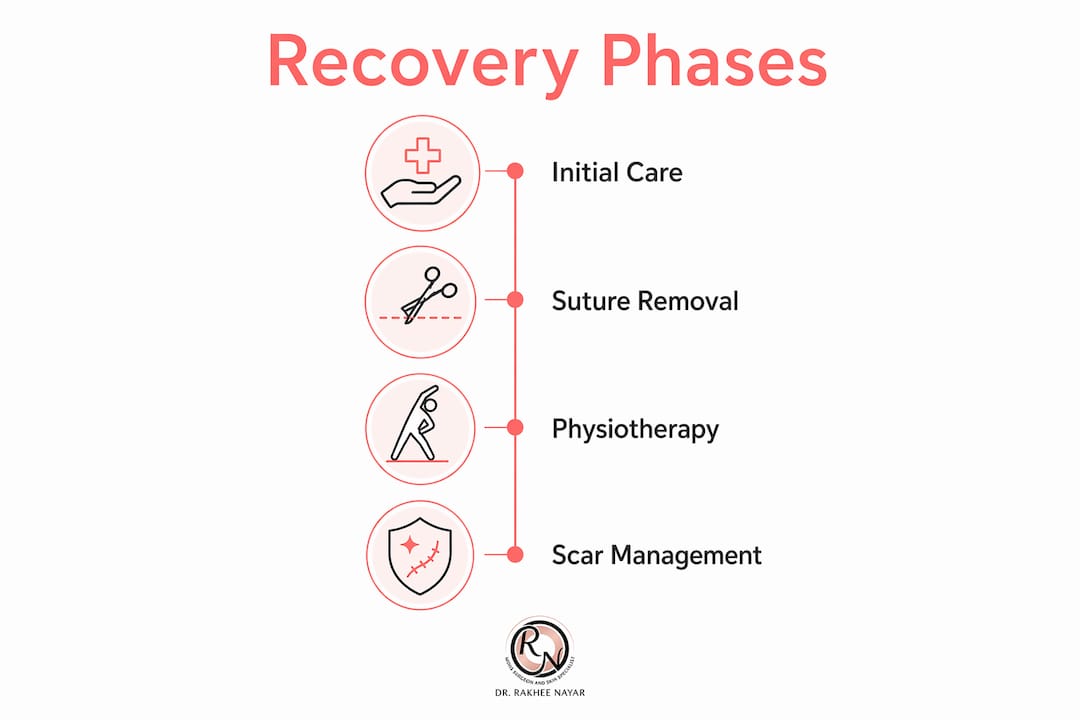
Phase 1: Initial wound care (days 1–14)
The first two weeks focus on wound protection, swelling management, and infection prevention. Keep the wound clean and dry as instructed. Avoid bending, lifting, or straining, as these raise blood pressure in the head and face and can disrupt healing tissue. Sleep with your head elevated if your surgery involved the face.
Phase 2: Suture and drain removal (weeks 1–3)
Sutures are typically removed between 5 and 14 days, depending on location and technique. If drains were placed, these are removed once output reduces to a safe level. Attend all scheduled appointments during this phase. Missing a suture removal appointment can lead to scarring or wound complications.
Phase 3: Physiotherapy and functional rehabilitation (weeks 3–12)
Some patients require physiotherapy, particularly after reconstruction involving the neck, eyelid, or lip, where movement and function need to be restored. Your surgical team will refer you if this is indicated. Scar massage and silicone-based products are typically introduced at 6–8 weeks once the wound has fully closed.
Phase 4: Long-term scar management (months 3–12)
Scars continue to mature for up to 12 months. Sun protection is non-negotiable during this period, as UV exposure causes permanent pigmentation changes in healing skin. Some patients benefit from light therapy for scar reduction as an adjunct to standard scar management. Revisional procedures, if needed, are generally not considered until the scar has fully matured.
Pro Tip: Prepare your home before your surgery date. Place frequently used items at waist height to avoid reaching. Install a grab bar near the bath or shower if your mobility will be affected. Prepare a drain care kit if your surgeon has indicated drains will be used.
Home environment modifications such as grab bars and accessible medication storage reduce strain and support patient safety during early recovery. These adjustments take less than an hour to arrange and can prevent a fall or a wound disruption.
- Confirm your first post-operative appointment before you leave hospital.
- Write down wound care instructions and keep them visible at home.
- Identify one person responsible for your care in the first 48 hours.
- Stock your home with prescribed dressings, pain relief, and easy-to-prepare food.
- Note the signs of complications: increasing redness, warmth, discharge, fever, or sudden pain.
Detailed reconstructive pathway planning that includes written milestones and follow-up appointments improves patient confidence and adherence to recovery. Ask your surgical team for a written plan before you leave the consultation.
| Recovery stage | Approximate timeframe | Key focus |
|---|---|---|
| Initial wound care | Days 1–14 | Wound protection, swelling, infection prevention |
| Suture/drain removal | Weeks 1–3 | Attendance at scheduled appointments |
| Functional rehabilitation | Weeks 3–12 | Physiotherapy, scar massage, silicone products |
| Long-term scar maturation | Months 3–12 | Sun protection, revisional assessment if needed |
What questions should patients ask their surgeon before reconstructive surgery?
Asking the right questions before you consent is one of the most practical steps in preparing for surgery. A clear pre-operative dialogue with your surgeon reduces anxiety, sets realistic expectations, and defines your responsibilities during recovery.
The cosmetic outcomes checklist for skin cancer surgery provides a useful framework for structuring this conversation. Use the following questions as a starting point.
Questions about the procedure:
- Which reconstructive technique do you recommend for my defect, and why?
- What are the alternatives, and what are the trade-offs between them?
- Will the reconstruction be performed at the same time as the cancer excision, or as a separate procedure?
- How will Mohs surgery affect the size and shape of the defect to be reconstructed?
Questions about risks and outcomes:
- What are the specific risks for my chosen technique, including donor site complications?
- What does a realistic outcome look like for my anatomy and defect size?
- What is the likelihood of needing a revisional procedure?
- How will scarring present at 6 months and at 12 months?
Questions about recovery and aftercare:
- What restrictions will I have in the first two weeks?
- When can I return to work and normal activities?
- Will I need physiotherapy or specialist scar management?
- Who do I contact if I have concerns between appointments?
Questions about cost and logistics:
- What is the total cost of the procedure, including follow-up appointments?
- Are revisional procedures included in the quoted fee?
- What does the private care pathway look like from consultation to discharge?
Ask for a written summary of the agreed reconstructive plan. This should include the technique, the expected timeline, follow-up dates, and the contact details for your clinical team. Understanding the reasons to reconstruct after skin cancer, including functional and psychological benefits, helps patients engage more confidently with this process.
Key takeaways
Effective planning for reconstructive surgery after skin cancer requires pre-operative health optimisation, a clear understanding of surgical options, and a written phased recovery plan agreed with your surgeon before the procedure date.
| Point | Details |
|---|---|
| Stop smoking early | Cease smoking at least 4 weeks before surgery to reduce tissue necrosis and wound breakdown. |
| Follow fasting rules | Stop food 8 hours before surgery and confirm clear fluid guidance with your surgical team. |
| Know your surgical options | Primary closure, skin grafts, local flaps, and free flaps each suit different defect sizes and locations. |
| Plan your recovery in phases | Recovery spans weeks to months; written milestones and home preparation improve adherence and confidence. |
| Ask the right questions | Clarify technique, risks, donor site implications, costs, and aftercare responsibilities before consenting. |
What I have learnt from planning reconstructive surgery with patients
The most common gap I see is not in surgical technique. It is in expectation management. Patients arrive having researched procedures thoroughly, but many have not been told clearly that reconstruction aims for restoration, not perfection. That distinction matters enormously for how a patient experiences their recovery.
Surgical success is defined as functional and aesthetic restoration, not a return to an unchanged appearance. When I explain this early, patients cope better with the normal stages of healing, including swelling, bruising, and early scar visibility, because they understand these are part of the process rather than signs that something has gone wrong.
The second thing I would emphasise is the value of a written reconstructive plan. Engaging patients in creating a written plan builds confidence and improves recovery adherence. I give every patient a document that maps their pathway from the day of surgery to their final review. It lists appointments, wound care instructions, and the criteria for seeking urgent advice. Patients tell me consistently that this single document reduces their anxiety more than anything else.
Physical preparation is the third area where I see patients underestimate their own agency. Stopping smoking, controlling blood pressure, and improving nutrition before surgery are not optional extras. They are clinical interventions that directly affect whether your tissue heals cleanly. I have seen patients who made these changes in the weeks before surgery achieve noticeably better early wound healing than those who did not.
Finally, involve your caregiver early. The person supporting you at home needs to understand your wound care routine, your medication schedule, and the signs of complications. Brief them before your surgery date, not on the day of discharge.
— Miss Rakhee Nayar
Specialist reconstructive surgery at Mohs Surgeon UK
Miss Rakhee Nayar – Mohs Surgeon and Skin Specialist holds dual training in both Mohs micrographic surgery and plastic surgery, a combination that directly benefits patients planning reconstruction after skin cancer excision. This means the same consultant who removes your cancer can plan and perform your reconstruction with full knowledge of the defect.

Private consultations are available at Circle Cheshire in North West England, with e-consultations offered for patients unable to attend in person. Miss Nayar provides personalised reconstruction plans covering surgical technique, recovery milestones, and follow-up care. Patients considering Mohs surgery and reconstruction can book a consultation to discuss their specific diagnosis, anatomy, and goals. For patients already diagnosed, the facial reconstruction surgery service page outlines the full range of techniques available.
This article is for information only and does not constitute medical advice. Consult a GMC-registered specialist for advice specific to your condition.
FAQ
What does planning for reconstructive surgery involve?
Planning for reconstructive surgery involves pre-operative health optimisation, selecting the appropriate surgical technique, arranging home and caregiver support, and agreeing a written recovery plan with your surgeon before the procedure date.
How long before surgery should I stop smoking?
Patients should stop smoking at least 4 weeks before surgery. Smoking cessation at this point significantly reduces the risk of tissue necrosis and wound healing complications.
What are the main reconstructive options after skin cancer removal?
The main options are primary closure, skin grafts, local flaps, and free flaps. The choice depends on the size and location of the defect left after cancer excision, including after Mohs micrographic surgery.
How long does recovery from reconstructive surgery take?
Recovery is a phased process. Initial wound care spans the first two weeks, sutures are removed within 1–3 weeks, and scar maturation continues for up to 12 months. The full timeline depends on the technique used and the individual patient’s healing.
What should I ask my surgeon before consenting to reconstruction?
Ask about the recommended technique and alternatives, realistic outcomes and scarring expectations, donor site implications, recovery restrictions, follow-up arrangements, and the total cost of private care including any revisional procedures.