TL;DR:
- Mohs surgery effectively removes skin cancer with high cure rates but often results in complex facial wounds.
- Facial reconstruction may require plastic surgeon involvement for large, deep, or cosmetically sensitive defects.
- Expert reconstruction improves aesthetic and functional outcomes, reducing the risk of long-term confidence issues.
Mohs micrographic surgery is rightly celebrated as the gold standard for removing skin cancers from the face, but many patients are surprised to discover that the removal itself is only part of the story. Once the cancer is gone, what remains is a wound that may be surprisingly wide, deep, or awkwardly positioned on a structure as visible as your nose, eyelid, or lip. The shape, confidence, and function of your face afterwards depends enormously on who closes that wound and how. Understanding the relationship between Mohs excision and skilled facial reconstruction can transform your expectations and, ultimately, your results.
Key Takeaways
| Point | Details |
|---|---|
| Mohs excises cancer | Mohs surgery offers outstanding cure rates for skin cancer but often leaves defects requiring specialist repair. |
| Plastic surgeon expertise | For complex facial defects, plastic surgeons provide tailored techniques that maximise cosmetic and functional results. |
| Low risk, high reward | UK benchmarks show major complications are rare, so specialist reconstruction delivers excellent outcomes for most patients. |
| Patient-centred approach | Discussing goals with your surgical team ensures repairs match your needs for both health and appearance. |
| Face matters most | Expert reconstruction is especially crucial for visible facial areas where appearance and function are intertwined. |
Understanding Mohs surgery and its limitations
Mohs surgery is a highly specialised technique for removing skin cancers, layer by layer, while checking each removed layer under a microscope for remaining cancer cells. The surgeon continues until a clear margin is confirmed. This meticulous process means only cancerous tissue is removed, sparing as much healthy skin as possible.
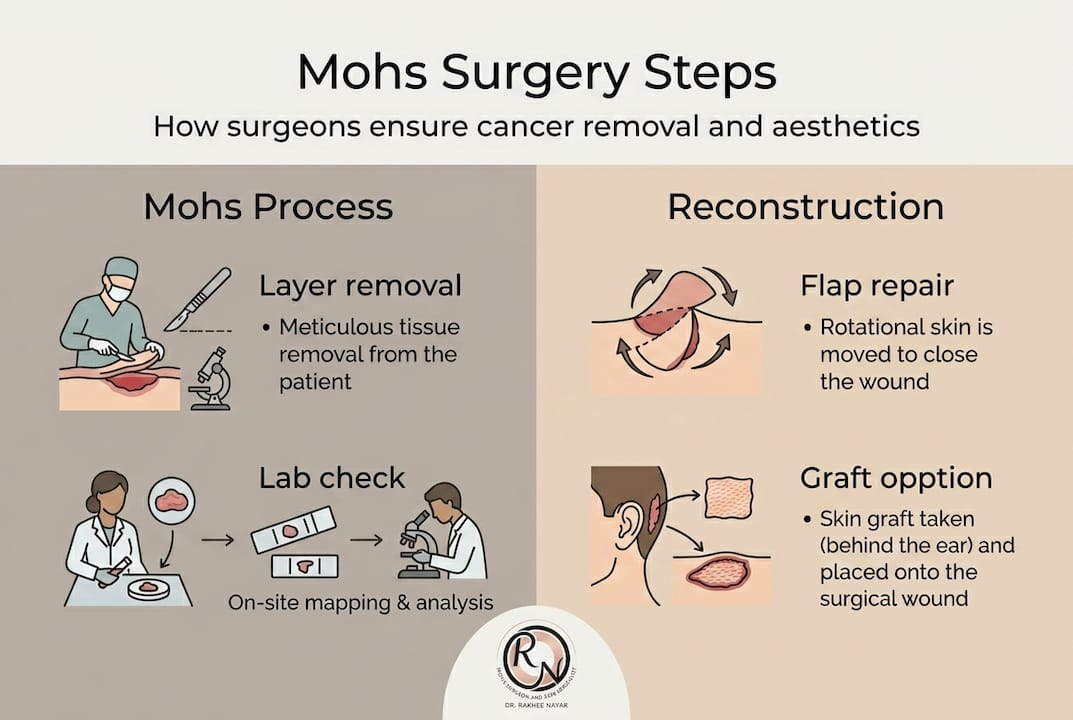
When you’re considering choosing Mohs surgery for a facial skin cancer, it is worth understanding exactly what happens at every stage. The procedure is primarily performed by specialist dermatologists trained in Mohs technique. During the operation, each excised layer is mapped, colour-coded, and processed in an on-site laboratory. The surgeon examines 100% of the surgical margin, not just random sections. This is what makes Mohs so precise.
The results speak for themselves in terms of cancer control. Cure rates up to 99% are achievable for basal cell carcinoma (BCC) and squamous cell carcinoma (SCC), and a UK study of 1,000 patients found that overall complication rates were low: minor complications in 3.6% of cases, intermediate in 3.1%, and major in just 0.8%, with higher risk noted at forehead sites and when grafts were used. These statistics confirm that the surgery itself is extremely safe in experienced hands.
However, having your cancer removed does not automatically mean your face looks or functions exactly as it did before. The wound left behind after Mohs excision can be considerable, particularly when the tumour was large, deep, or growing beneath the skin surface in ways that were not visible externally. On cosmetically sensitive areas like the nose, eyelids, ears, and lips, even a well-planned excision can leave a defect that requires careful thought and skilled surgical judgement to repair.
What Mohs surgery explained in detail reveals is that the Mohs surgeon’s primary goal is complete cancer removal. Wound repair is a secondary stage. For straightforward wounds on non-critical sites, the Mohs surgeon may close the wound directly. But as the British Association of Dermatologists confirms, complex cases are routinely referred to plastic surgeons, oculoplastic surgeons, or ENT (ear, nose, and throat) specialists.
Key reasons why visible defects arise after Mohs surgery include:
- Tumour size: Larger cancers inevitably leave larger wounds, even with tissue-sparing Mohs technique
- Location: Structures like the nasal tip, inner corner of the eye, and upper lip require intricate repair
- Depth: Cancers invading deeper layers may leave composite defects affecting skin, cartilage, or muscle
- Skin laxity: In younger patients or areas with little spare skin, tension-free closure is harder to achieve
- Previous treatment: Patients who have had radiotherapy or prior surgery may have compromised local tissue
Understanding these limitations is not meant to alarm you. It simply clarifies that Mohs surgery and facial reconstruction are two related but distinct disciplines, and that the best outcomes frequently depend on expertise in both.
When is a plastic surgeon needed after Mohs surgery?
Having established how Mohs surgery works, let’s examine when and why a plastic surgeon is called in.
Not every Mohs wound requires specialist reconstruction. Many smaller defects in areas with good skin laxity, such as the cheek or scalp, can be closed directly by the Mohs surgeon with excellent results. The decision about who should close the wound, and how, depends on a combination of factors.
The following criteria typically prompt referral to reconstruction after Mohs surgery by a plastic surgeon:
- Anatomical site: Wounds on the nose, eyelids, lips, ears, and temples carry the highest aesthetic and functional risk
- Defect size: Larger defects (generally over 1.5 to 2 cm in diameter) frequently need flaps or grafts rather than simple closure
- Depth of resection: Full-thickness defects, or those involving cartilage or bone, require multi-layer reconstruction
- Tissue availability: Limited local tissue or poor skin quality restricts the options for straightforward repair
- Patient expectations: When appearance and confidence are a priority, specialist input makes a significant difference
| Defect complexity | Typical closure | Who closes? |
|---|---|---|
| Small, low-risk site | Primary closure | Mohs surgeon |
| Moderate, accessible site | Local flap or graft | Mohs or plastic surgeon |
| Large, cosmetically sensitive | Regional flap, complex repair | Plastic surgeon |
| Full-thickness or functional | Multi-layer reconstruction | Plastic surgeon |
The British Association of Dermatologists is clear that Mohs surgeons perform excision and simple repairs, but that complex cases are referred on. This is not a reflection of the Mohs surgeon’s skill; it is a reflection of how specialised reconstructive techniques have become. Plastic surgeons train specifically in tissue movement, scar management, and the restoration of complex three-dimensional facial structures. These are skills developed over years of dedicated surgical practice.

For patients prioritising aesthetic results, it is also worth considering skin cancer reconstruction options and discussing them with your team before your Mohs procedure, not after. This allows for coordinated care planning rather than reactive decisions made at the end of a surgical day.
Pro Tip: If your skin cancer is on the nose, eyelid, lip, or ear, ask specifically before your procedure whether a plastic surgeon will be involved in the reconstruction. Knowing this in advance allows you to plan, prepare, and set realistic expectations.
Reconstruction techniques and expertise
With the criteria for surgeon involvement established, let’s explore the techniques plastic surgeons use after Mohs excision.
Plastic surgeons are trained to think about wound repair differently. The goal is not simply to close a hole; it is to restore form, movement, texture, and proportion to an area of the face that others see every day. The choice of technique depends on the size and location of the defect, the quality of surrounding tissue, and your individual facial anatomy.
Reconstruction methods used by plastic surgeons after Mohs include:
- Primary closure: The wound edges are drawn together and sutured directly. Works well for smaller, linear defects in areas with skin to spare.
- Split-thickness skin grafts: A thin layer of skin is taken from a donor site, usually the thigh or upper arm, and placed over the defect. Best for larger, flat areas where colour match is less critical.
- Full-thickness skin grafts: Skin including the full dermal layer is harvested, often from behind the ear or the inner upper arm, for a better colour and texture match on the face.
- Local flaps: Adjacent skin and tissue is moved into the defect using a variety of geometrical designs, such as the rhomboid flap, the rotation flap, or the transposition flap. These redistribute tension and blend with local skin characteristics.
- Regional flaps: Larger movements of tissue, sometimes with their own blood supply, are used for more significant defects.
| Technique | Best suited for | Key advantage |
|---|---|---|
| Primary closure | Small defects, good laxity | Simple, fast recovery |
| Full-thickness graft | Nose, eyelid, small face areas | Good colour and texture match |
| Split-thickness graft | Large, flat areas | Covers wide defects |
| Local flap | Most facial sites | Excellent skin match, blends naturally |
| Regional flap | Large or complex defects | Can cover substantial tissue loss |
A UK study confirms that grafts and forehead sites carry slightly higher complication rates, which underscores the value of experienced surgical judgement in selecting the right approach. A plastic surgeon’s expertise lies in reading the specific anatomy in front of them and choosing the technique most likely to give a natural result with minimal scarring.
For patients with SCC facial reconstruction needs or those facing BCC surgery and aesthetics concerns, this level of surgical nuance matters enormously. A well-executed local flap on the nose can be virtually undetectable once healed. A poorly planned repair of the same wound could result in distortion, ectropion (pulling of the eyelid), or an asymmetrical nasal tip.
Many patients also benefit from considering aesthetic outcomes after cancer in a broader context, particularly if they wish to address changes in the surrounding skin as part of their recovery.
Pro Tip: Ask your surgical team to show you before-and-after photographs specifically of cases similar to yours, in terms of site, defect size, and technique used. This gives you a realistic and personalised reference point for the results you can expect.
Outcomes, risks and patient experience
To round off, it’s crucial to understand what patients actually experience after Mohs and reconstruction, including outcomes and risks.
The evidence from UK practice is reassuring. Mohs units across the country report major complications affecting cosmetic appearance or function in fewer than 1% of cases. Flaps and grafts carry a slightly higher risk profile than direct closure, but they are often necessary to achieve the best results in high-visibility areas. This is a trade-off worth making when the alternative is a visible, poorly healed scar on your face.
“The benchmark in UK Mohs units is clear: serious complications affecting appearance or function occur in less than 1% of patients. When flaps or grafts are needed, they are the right choice for optimal results in visible areas.”
Recovery after Mohs and reconstruction varies by the complexity of the repair. Practical steps to optimise your healing include:
- Keep the wound moist: Moist wound healing with appropriate dressings significantly reduces scarring compared to allowing wounds to dry out
- Avoid sun exposure: New scar tissue is highly vulnerable to ultraviolet damage; SPF 50+ is essential for at least 12 months
- Do not smoke: Smoking restricts blood flow and is one of the most significant risk factors for flap and graft failure
- Follow your surgeon’s suture care instructions: Removing sutures at the right time is important for minimising scar width and tension
- Attend all follow-up appointments: Scar maturation takes up to 18 months; early intervention with treatments like silicone gel or massage can significantly improve the final result
Patients frequently report that the physical recovery from Mohs surgery recovery tips is manageable, but that the psychological adjustment to changes in appearance takes longer. This is completely normal. Having a surgeon who takes the time to explain what to expect at each stage makes a significant difference to how confident you feel during recovery.
Questions worth asking your team before surgery:
- What technique do you plan to use and why is it the best option for my specific defect?
- What are the realistic expectations for my scar at three months, six months, and two years?
- What secondary procedures are available if I am unhappy with the outcome?
Why specialist reconstruction matters more than patients think
There is a widespread and understandable tendency among patients to focus entirely on the cancer diagnosis and removal. Survival and cure are rightly the first priority. But once the cancer is gone, patients often find that how they look in the mirror becomes unexpectedly important to their wellbeing, relationships, and confidence.
The difference between a functional repair and a genuinely good aesthetic outcome is not trivial. Functional means the wound is closed and has healed. Aesthetic means your nose looks like your nose, your eyelid closes properly, and your lip moves naturally when you smile. These are not vanity concerns; they are quality-of-life concerns that directly affect how you engage with the world around you.
In our experience, patients who receive specialist-led reconstruction with a plastic surgeon who understands both the oncological and aesthetic demands of facial surgery consistently report higher satisfaction and a faster return to social confidence. The investment in expert aesthetic advice during the planning stage, not after a disappointing outcome, is what separates good results from exceptional ones. Expecting a dermatologist to complete a complex nasal reconstruction is like expecting a cardiologist to perform orthopaedic surgery; the skills are related but the specialist training is distinct and genuinely matters.
Find expert care for Mohs surgery and facial reconstruction
If you’re ready to explore your options or want tailored advice for facial reconstruction after Mohs, here’s where to start.
Miss Rakhee Nayar holds the rare distinction of being dual-trained in both Mohs surgery and plastic surgery, meaning she can oversee both the cancer excision and the reconstruction in a single, coordinated care plan. This approach removes the uncertainty that can arise when two separate teams must hand over your care mid-treatment.

Whether you need to learn about Mohs surgery before making any decisions, explore the full range of facial reconstruction surgery options, or book a consultation with one of the UK’s leading UK Mohs surgery specialists, the clinic offers private and e-consultation appointments to patients across the UK and internationally. Your face deserves the kind of expertise that treats cancer removal and aesthetic restoration as equal priorities.
Frequently asked questions
Can Mohs surgery alone achieve the best cosmetic outcome?
Mohs surgery is excellent for cancer removal, but as the British Association of Dermatologists notes, complex cases need plastic surgeon involvement for the best aesthetic and functional results.
What complications are possible after Mohs and reconstruction?
UK Mohs units report that major complications affecting appearance or function occur in fewer than 1% of cases, though flap and graft repairs carry a slightly higher risk than direct closure.
Which reconstruction techniques do plastic surgeons use after Mohs?
Plastic surgeons use a range including primary closure, grafts, and flaps, selecting the approach based on the defect’s location, size, and depth.
How can patients ensure the best outcomes after Mohs surgery?
Seek a coordinated team that includes plastic surgery expertise for complex facial cases, and prioritise recovery habits such as sun protection, not smoking, and attending follow-up appointments for optimal healing.
Is plastic surgeon involvement more important for facial skin cancer?
Yes, because of the higher aesthetic and functional demands of visible facial structures; specialist involvement in complex cases ensures both function and confidence are fully restored.
Recommended
- Reconstruction After Mohs Surgery | Natural Results
- Surgical excision for skin cancer: treatment & reconstruction
- What is Mohs Micrographic Surgery? | Miss Rakhee Nayar
- Aesthetic surgery after cancer: options and expert insights
Filed under Facial Reconstruction