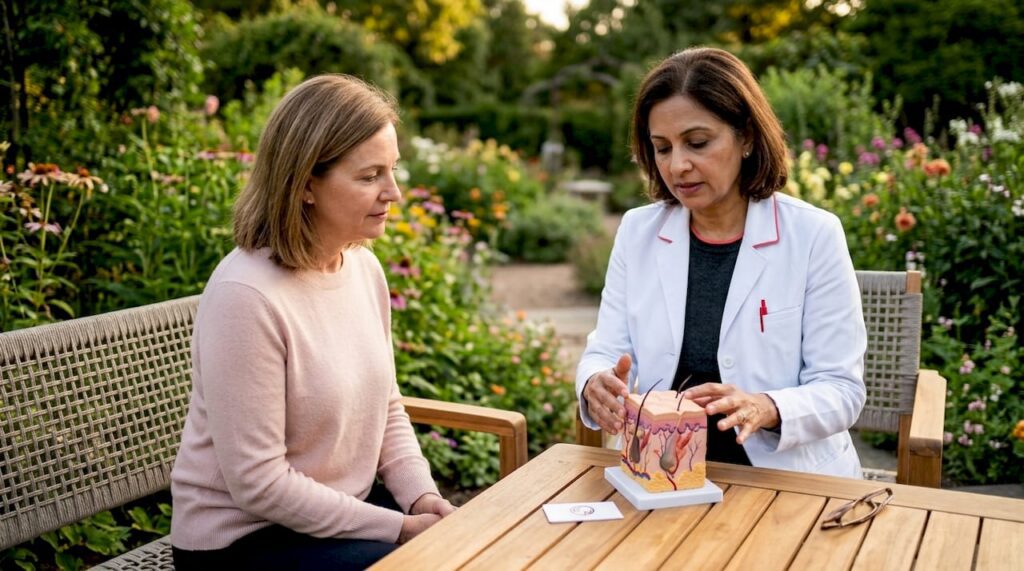
Dermatologic oncology is the branch of medicine dedicated to diagnosing, treating, and managing skin cancers and cancer-related skin conditions. The field covers the full spectrum of skin malignancies, from basal cell carcinoma (BCC) and squamous cell carcinoma (SCC) to melanoma, and draws on the expertise of dermatologists, plastic surgeons, oncologists, and pathologists working together. In the UK, this care is delivered through NHS Skin Cancer Multidisciplinary Teams (MDTs) and specialist private practices such as Rakhee Nayar – Mohs Surgeon and Skin Specialist, where dual-trained consultants manage both tumour removal and reconstruction. Understanding how this field works helps patients make informed decisions at every stage of their care.
What is dermatologic oncology and who does it treat?
Dermatologic oncology is the specialised medical discipline focused on skin cancer care, from first suspicion through to long-term follow-up. The term is not always used in everyday NHS language, where “skin cancer services” or “skin cancer MDT” are more common, but the clinical scope is identical. Specialists in this field diagnose malignant lesions, plan treatment, perform surgery, and co-ordinate ongoing monitoring.
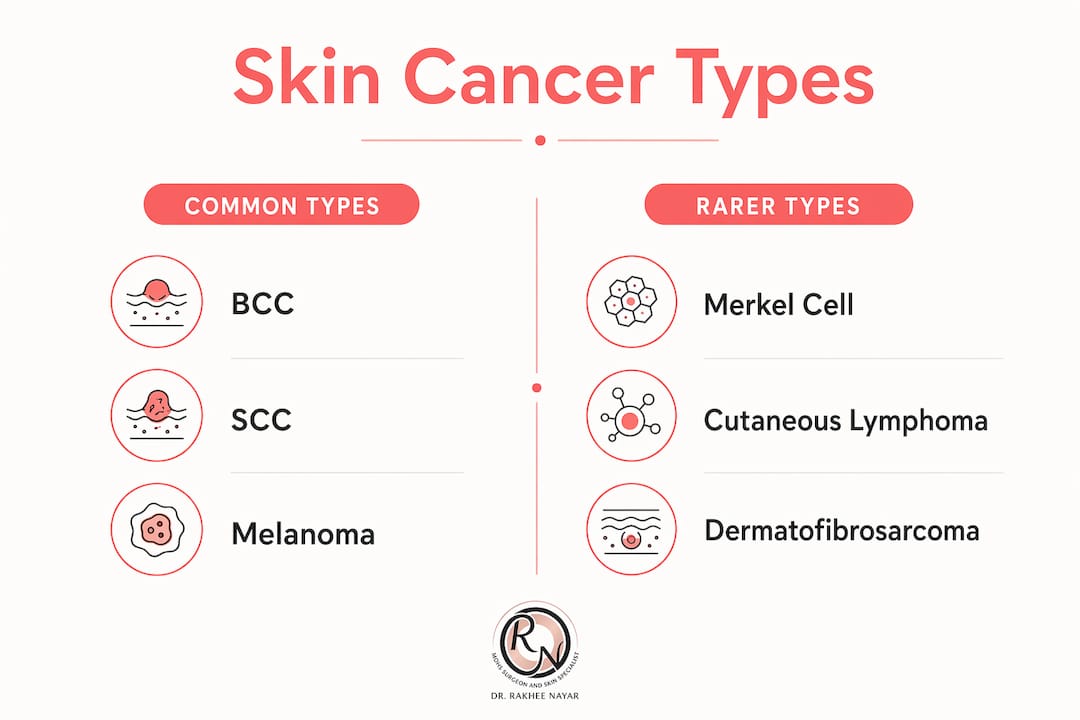
The field addresses three principal cancer types: BCC, SCC, and melanoma. Each carries different risks, requires different treatment approaches, and demands different levels of urgency. Patients referred under the two-week-wait urgent suspected cancer pathway are assessed by a team that spans dermatology, surgery, and oncology, not a single clinician.

Dermatologic oncology also covers rarer conditions such as Merkel cell carcinoma, cutaneous lymphoma, and dermatofibrosarcoma protuberans. These cases almost always require specialist MDT input and, in many instances, referral to a tertiary centre. The breadth of the field is one reason why team-based care is the standard, not the exception.
What are the common types of skin cancer treated?
Skin cancer is the most commonly diagnosed cancer group in the UK. Urgent suspected skin cancer referrals in England increased 2.6-fold between 2013 and 2022, reaching 624,253 referrals, with a median conversion rate to confirmed cancer of 6.9% in 2022. That figure means the majority of referrals result in a benign diagnosis, which is why clear communication from specialist practitioners is central to good care.
Basal cell carcinoma
BCC is the most frequently diagnosed skin cancer in the UK. It arises from basal cells in the deepest layer of the epidermis and typically appears on sun-exposed areas such as the face, scalp, and ears. BCC rarely spreads to other organs but can cause significant local tissue destruction if left untreated. High-volume NHS trusts diagnose up to 8.2 times more BCCs than the national median, reflecting wide regional variation in access to specialist services.
Squamous cell carcinoma
SCC develops from squamous cells in the outer layers of the skin. It carries a higher risk of metastasis than BCC, particularly when it arises on the lip, ear, or in patients who are immunosuppressed. SCC often presents as a firm, red nodule or a flat lesion with a scaly, crusted surface. Prompt biopsy and histological confirmation are required before treatment planning begins.
Melanoma
Melanoma originates in melanocytes, the pigment-producing cells of the skin. It is less common than BCC or SCC but carries the highest mortality risk of the three. Early-stage melanoma is highly treatable; advanced melanoma may require systemic therapy including immunotherapy or targeted agents. Recognising the symptoms of skin cancer early is the single most important factor in improving melanoma outcomes.
| Cancer type | Cell of origin | Metastatic risk | Common sites |
|---|---|---|---|
| Basal cell carcinoma | Basal epidermal cells | Very low | Face, scalp, ears, neck |
| Squamous cell carcinoma | Squamous epidermal cells | Moderate | Lip, ear, hands, scalp |
| Melanoma | Melanocytes | High if advanced | Back, legs, face, nails |
What roles do dermatologic oncologists and MDTs play?
Dermatologic oncologists are clinicians with specialist training in skin cancer diagnosis and treatment. In the UK, this expertise is held by consultant dermatologists, consultant plastic surgeons with a skin cancer focus, and clinical or medical oncologists. There is no single GMC-registered specialty called “dermatologic oncology” in the UK; instead, the field is defined by the scope of practice and the MDT structure within which clinicians work.
Skin Cancer MDT meetings bring together clinical oncology, medical oncology, dermatology, and plastic surgery specialists to develop consensus treatment plans. Patients may not meet every team member directly, but every complex case benefits from the collective expertise of the full group. This model is the standard of care across NHS tertiary centres and specialist private practices.
The MDT’s core functions include:
- Reviewing biopsy results and staging investigations
- Agreeing the most appropriate treatment modality for each patient
- Planning reconstructive surgery where needed after tumour removal
- Identifying cases requiring systemic therapy, radiotherapy, or clinical trial entry
- Co-ordinating follow-up schedules and surveillance imaging
Pro Tip: If you are referred to a skin cancer service, ask whether your case will be discussed at an MDT meeting. For complex or high-risk lesions, MDT review is standard practice and gives you access to the collective judgement of multiple specialists.
Skin Cancer Advanced Clinical Practitioners (ACPs) play an important role in results clinics, where they explain biopsy findings and help patients understand whether a lesion is malignant or benign. Specialist practitioners lead these clinics to support patient understanding and manage expectations, particularly given that most referrals do not result in a cancer diagnosis.
Miss Rakhee Nayar, GMC-registered Consultant Plastic Surgeon (FRCS Plast, MD), exemplifies the dual-trained specialist model. Her background in both plastic surgery and Mohs surgery means she can manage tumour excision and facial reconstruction within a single care episode, which reduces the number of procedures a patient needs and improves cosmetic outcomes.
What are the main skin cancer treatment options?
Skin cancer treatment options depend on the cancer type, its size and location, the patient’s general health, and whether the lesion is primary or recurrent. Surgery remains the first-line treatment for most BCCs and SCCs. Melanoma management is more complex and often involves a combination of surgery, sentinel lymph node biopsy, and systemic therapy.
Mohs micrographic surgery
Mohs micrographic surgery is the gold standard for certain facial skin cancers. The technique involves removing the tumour in thin layers, examining each layer under a microscope in real time, and continuing until all margins are clear. This approach conserves the maximum amount of healthy tissue while achieving high cure rates. It is particularly suited to BCCs and SCCs on the face, ears, nose, and eyelids, where tissue preservation and cosmetic outcome are both priorities.
Other surgical and non-surgical treatments
The main treatment modalities used in dermatologic oncology include:
- Standard surgical excision with predetermined margins, suitable for most primary BCCs and SCCs away from the face.
- Cryotherapy, which uses liquid nitrogen to freeze and destroy superficial BCCs and actinic keratoses; appropriate only for low-risk, superficial lesions.
- Topical therapies such as imiquimod cream or 5-fluorouracil, used for superficial BCCs and field cancerisation where surgery is not appropriate.
- Radiotherapy, offered when surgery is not feasible or as adjuvant treatment after excision of high-risk SCC.
- Systemic therapy, including immunotherapy agents such as pembrolizumab for advanced melanoma, and hedgehog pathway inhibitors such as vismodegib for locally advanced BCC.
| Treatment | Best suited to | Setting |
|---|---|---|
| Mohs surgery | Facial BCC, SCC, recurrent tumours | Specialist private or NHS tertiary |
| Standard excision | Primary BCC, SCC off the face | NHS or private |
| Cryotherapy | Superficial BCC, actinic keratoses | Primary or secondary care |
| Topical therapy | Superficial BCC, field cancerisation | Primary care or dermatology |
| Radiotherapy | Inoperable or high-risk SCC | NHS oncology centre |
| Systemic therapy | Advanced melanoma, advanced BCC | NHS oncology centre |
AI and teledermatology in the referral pathway
AI tools like DERM have been approved by NICE for conditional NHS use to assist in triaging suspected skin cancer. DERM analyses dermoscopic images remotely to help prioritise urgent versus routine cases, potentially halving dermatologist referrals without compromising patient safety. This matters because it directs the most urgent patients to specialist assessment faster.
Teledermatology with dermoscopic imaging is increasingly used for initial patient assessment, allowing remote evaluation of lesions before face-to-face consultations. NHS regions using this approach report improvements in the speed and accuracy of urgent suspected cancer referrals. NICE endorses these technologies as a way to improve efficiency without reducing the quality of care patients receive.
Pro Tip: If your GP refers you under the two-week-wait pathway, you may be assessed via a teledermatology service before your first appointment. This is not a delay; it is a clinical triage step that helps the team prioritise the most urgent cases.
How does early detection improve skin cancer outcomes?
Early detection is the most reliable way to improve survival in skin cancer. Melanoma detected at stage I carries a significantly better prognosis than melanoma identified at stage III or IV, when the cancer has spread to lymph nodes or distant organs. The same principle applies to SCC: early excision prevents local invasion and reduces the risk of metastasis.
The symptoms of skin cancer to watch for include:
- A new or changing mole, particularly one that is asymmetric, has an irregular border, contains multiple colours, or is growing in diameter
- A pearly or translucent nodule, often with visible blood vessels, which may suggest BCC
- A firm, red, scaly, or crusted lesion that does not heal, which may indicate SCC
- A dark streak under a nail or a lesion on the palm or sole, which can be a sign of acral melanoma
- Any lesion that bleeds without injury or itches persistently
Early skin cancer detection benefits from NHS initiatives combining teledermatology and AI tools, enabling prompt triage and reducing unnecessary specialist referrals. Patients who present early are more likely to be treated with less extensive surgery, experience fewer complications, and require less complex reconstruction.
Follow-up care after treatment is not optional. Patients treated for BCC, SCC, or melanoma carry an elevated risk of developing a further primary skin cancer. NHS follow-up schedules vary by cancer type and risk level, but most patients are reviewed at three to twelve month intervals for a minimum of five years. Patients should also conduct monthly self-examinations and report any new or changing lesions promptly.
Skin health practices including daily broad-spectrum sunscreen use (SPF 30 or above), protective clothing, and avoidance of sunbeds reduce the risk of new primary skin cancers. These measures are recommended by Cancer Research UK and the British Association of Dermatologists (BAD) for all patients with a personal history of skin cancer.
Patients who have undergone reconstructive surgery after skin cancer removal may also benefit from post-surgical skin care guidance. Devices used in aesthetic medicine for skin rejuvenation, such as microneedling technology, are sometimes considered in the recovery phase, though any such intervention should be discussed with your treating specialist before proceeding.
Key takeaways
Dermatologic oncology delivers the best outcomes when specialist surgery, MDT review, and early detection work together within a co-ordinated care pathway.
| Point | Details |
|---|---|
| Definition of the field | Dermatologic oncology covers diagnosis, treatment, and follow-up for all skin cancer types. |
| MDT is standard care | Skin Cancer MDT meetings involve dermatology, oncology, and plastic surgery specialists for every complex case. |
| Mohs surgery leads for facial cancers | Mohs micrographic surgery is the gold standard for BCCs and SCCs on the face, conserving tissue and achieving high cure rates. |
| AI is changing triage | NICE-approved tools like DERM can halve unnecessary dermatologist referrals while maintaining patient safety. |
| Early detection saves lives | Melanoma and SCC identified at an early stage require less extensive treatment and carry a significantly better prognosis. |
Specialist skin cancer care with Rakhee Nayar – Mohs Surgeon and Skin Specialist
Rakhee Nayar – Mohs Surgeon and Skin Specialist offers private consultations for patients across the UK and internationally, with in-person appointments at Circle Cheshire in North West England and e-consultation options for those unable to attend in person. Miss Nayar’s dual training in plastic surgery and Mohs surgery means that skin cancer detection and reconstruction are managed within a single specialist-led pathway. Patients receive a clear diagnosis, a treatment plan discussed at MDT level where appropriate, and access to early detection guidance to support informed decision-making. Private consultation fees are available on request. This article does not constitute medical advice; please consult a GMC-registered specialist for assessment and treatment recommendations specific to your situation.
FAQ
What is dermatologic oncology in simple terms?
Dermatologic oncology is the medical field focused on diagnosing and treating skin cancers, including basal cell carcinoma, squamous cell carcinoma, and melanoma. It involves specialists from dermatology, plastic surgery, and oncology working together.
What do dermatologic oncologists do?
Dermatologic oncologists diagnose skin cancers, plan and perform treatment, and co-ordinate follow-up care. In the UK, this work is carried out within Skin Cancer MDT meetings that include dermatologists, plastic surgeons, and oncologists.
What are the warning signs of skin cancer?
Warning signs include a new or changing mole, a pearly nodule with visible blood vessels, a red scaly lesion that does not heal, and any lesion that bleeds without injury. The NHS two-week-wait pathway exists for patients with these features.
How is Mohs surgery different from standard excision?
Mohs micrographic surgery removes skin cancer in thin layers, examining each layer under a microscope until all margins are clear. Standard excision removes the tumour with a fixed margin without real-time margin assessment.
How do I find a specialist for skin cancer in the UK?
Ask your GP for an urgent suspected cancer referral if you have a concerning lesion. For private specialist care, Rakhee Nayar – Mohs Surgeon and Skin Specialist offers consultations at Circle Cheshire and via e-consultation for patients across the UK and abroad.
Recommended
- Top skin health practices for cancer prevention and recovery
- Role of multidisciplinary team in skin cancer care
- Skin cancer margins explained: what patients need to know
- Early detection benefits for skin cancer explained
Filed under Choosing Your Care


