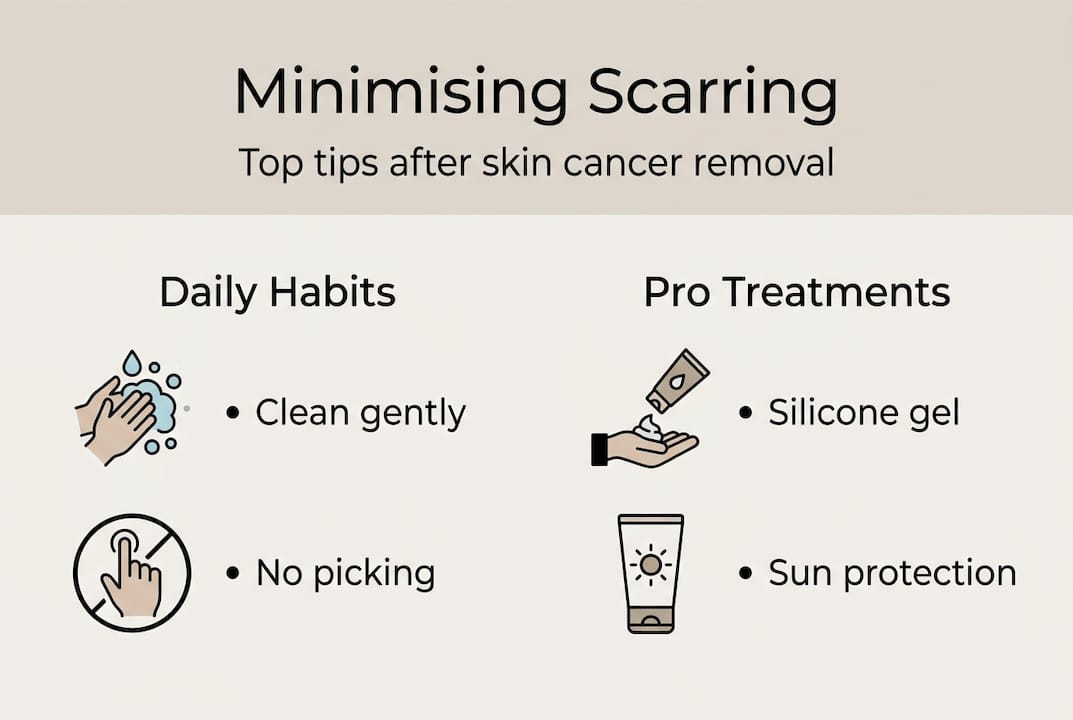
You can’t stop a scar forming after skin cancer surgery, but you can change how well it heals. Keep the wound clean and moist while it closes, start silicone gel or sheets once the scab has gone, protect the scar from the sun for at least six months and avoid smoking while you heal.
- Clean the wound gently once a day and keep it moist with a thin layer of white soft paraffin.
- Start silicone gel or sheets about two to three weeks after surgery and use them daily for at least two to three months.
- Use SPF 50 on the scar for at least six months, because sun darkens new scar tissue.
- Most scars flatten and fade over 12 to 24 months, though they rarely disappear completely.
Why do scars form after skin cancer removal?
A scar is how the body repairs any wound that goes through the skin. Once the cancer has been removed, collagen fibres build up in the wound and knit the edges together. This is normal, healthy repair, but the new tissue looks and feels different from the skin around it.
Most scars from skin cancer surgery heal flat and pale. Some become raised, red and firm, and a few sink below the surface, usually after an infection. Your genes and the site of the wound play a part, but so does how the wound is cared for.
Who is more likely to get a raised scar?
Younger people, people with darker skin and anyone with a family history of thick scars are more likely to get one. That means hypertrophic scars, which are raised and red but stay within the wound, or keloids, which spread beyond the wound edges. Other things that raise the risk are:
- previous wounds that healed badly
- a wound where the skin is under tension, such as the chest or shoulders
- infection or inflammation after surgery
If any of these apply to you, start scar care early. Early preventive measures lower the chance of a raised scar in higher-risk patients, so tell your surgeon about your history before the operation.
The nose, ears and eyelids are common sites for Mohs surgery, which removes the cancer while keeping as much healthy skin as possible. How the wound is then closed, through reconstruction after Mohs, also shapes the final scar.
How should I look after the wound in the first few weeks?
Keep it clean, moist and protected, and follow your surgical team’s instructions wherever they differ from the general steps below. What you do in these first weeks shapes how the scar heals.
- Clean the wound gently once a day with cooled boiled water or a saline solution. Don’t scrub it.
- Pat it dry with a clean, soft cloth or sterile gauze.
- Apply a thin layer of a bland ointment such as white soft paraffin to stop it drying out.
- Cover it with a dressing and change it as your surgical team has told you.
- Protect the area from knocks.
- Go to every follow-up appointment so your surgeon can check how it is healing.
Most wounds need only a simple non-stick dressing. Silicone-based dressings are gentler on facial skin, and hydrocolloid dressings hold moisture in.
After surgery on the face, sleep with your head slightly raised on an extra pillow. This keeps swelling down, which takes tension off the healing skin and helps the scar lie flatter.
Does silicone gel or sheeting help?
Yes. Silicone is the most widely recommended scar treatment you can use at home, and it is safe with few side effects. It keeps the outer layer of skin hydrated, which calms the overproduction of collagen that makes scars thick and raised.
Research on silicone gels and sheets reports that they made raised scars flatter, smoother and less red in many patients. The wider evidence for silicone is held back by the quality of some studies, but clinical guidelines still recommend it as the first non-surgical treatment to try.
Gel or sheets? Silicone gel suits facial sites and other curved areas better, because it follows the contours of the skin and is hard to see under make-up. Sheets work well on flat areas such as the chest or forearm.
Using silicone gel or sheets
- Wait until the wound has fully closed and any scab has come away on its own. This is usually two to three weeks after surgery.
- Clean the area gently and let it dry.
- Apply a thin layer of gel, or place a sheet directly over the scar.
- Keep it on for at least 12 hours a day.
- Carry on for at least two to three months, and for up to six months if the scar is slow to settle.
Using it every day matters more than which product you buy. Some people find it easiest to set a phone reminder and treat silicone like a medicine they take at the same time each day.
Why does sun protection matter for a new scar?
New scar tissue darkens easily in the sun because it lacks the pigment that protects normal skin. Once a scar has darkened, the colour can take years to fade. Put SPF 50 sunscreen on the scar for at least six months, and keep it covered with clothing or a hat when you are outdoors.
Habits that slow healing
Smoking cuts the blood flow and oxygen that reach the wound, and alcohol weakens the immune response and collagen formation. Avoiding smoking and alcohol, keeping tension off the wound and managing conditions such as diabetes all lead to better healing. If you can’t give up for good, stopping while the wound heals still helps.
High blood sugar slows the body’s repair and makes infection more likely. If you have diabetes or another long-term condition, ask your GP to help you keep it well controlled while you recover.
The most common mistakes at home are:
- washing the wound too often, which strips away the moisture it needs
- picking or scratching at scabs, which disturbs the new collagen
- using products your surgeon hasn’t suggested, such as neat tea tree oil or alcohol-based antiseptics, which can cause contact dermatitis (an itchy, inflamed skin reaction)
If anything you put on the scar stings or burns, stop using it.
What if my scar isn’t settling?
Give it time, then ask for advice if it is getting thicker or redder instead of flatter and paler. Scars keep changing as they mature, and one that looks alarming at six weeks often looks very different at 18 months.
After more complex skin cancer surgery or facial reconstruction surgery, a specialist may suggest steroid injections, laser treatment or pressure garments alongside silicone. Genes and wound site still set limits: a scar on the chest of a young person with a family history of keloids will behave differently from one on an older person’s scalp.
Talking to Miss Nayar
Miss Rakhee Nayar is a Consultant Plastic Surgeon and one of fewer than 10 women in the UK dual-trained in both plastic surgery and Mohs micrographic surgery. Her clinic offers facial reconstruction and scar management, so she can advise on a scar that isn’t healing as expected. You can read how Mohs surgery for BCC works, or contact her clinic to arrange a consultation.
Frequently asked questions
When should I start using silicone gel or sheets?
Start once the wound has fully closed and any scab has come away on its own, usually two to three weeks after surgery. Starting earlier risks damaging the fragile new skin.
Will my scar disappear completely?
Probably not, but most scars flatten and fade a great deal over 12 to 24 months. Daily silicone and sun protection give you the best chance of a scar that is hard to notice.
Can food or supplements help a scar heal?
A balanced diet with enough protein, vitamin C and zinc supports the body’s repair, but no supplement prevents scarring on its own. Eating well overall matters more than any single product.
How long before scar treatment makes a difference?
Most people notice a change after two to three months of daily silicone use. The scar usually keeps improving for a year or more.
Recommended
- Reconstruction After Mohs Surgery
- Skin Cancer Treatment & Surgery | Mohs Surgery UK
- Skin Cancer Detection – Expert Mohs Surgery | UK
- Skin Cancer on the Nose – Symptoms & Treatment – Expert Mohs Surgery | UK
- How to Boost Skin Recovery Naturally for Radiant Results
Filed under Recovery and Aftercare