TL;DR:
- Choosing a dedicated skin cancer clinic ensures access to expert surgeons, advanced diagnostics, and same-day reconstruction, leading to better outcomes. Mohs micrographic surgery offers high cure rates and tissue preservation, especially for high-risk or cosmetically sensitive areas. Early referral for complex or high-risk lesions improves detection, treatment precision, and long-term skin health.
When a suspicious lesion appears or a diagnosis lands, the question of where to seek care matters far more than most people realise. The difference between a general practice setting and a dedicated skin cancer centre is not simply one of preference. It is one of precision, expertise, and outcomes. Understanding why you should choose a specialised skin cancer clinic means looking at the technology available, the training behind the surgeon, and the coordinated care model that gives you the best chance of a clean result with the least possible impact on your appearance and quality of life.
Key takeaways
| Point | Details |
|---|---|
| Specialist expertise changes outcomes | Fellowship-trained Mohs surgeons achieve cure rates up to 99%, which general practitioners cannot replicate. |
| Dermoscopy reduces unnecessary procedures | Expert use of handheld dermatoscopes improves diagnostic accuracy and lowers the rate of avoidable biopsies. |
| Same-day reconstruction is possible | Dual-trained surgeons can remove cancer and reconstruct the site in a single visit, reducing delays. |
| Mohs surgery preserves healthy tissue | Layer-by-layer margin examination removes only cancerous cells, protecting cosmetically sensitive areas. |
| Specialist referral pathways start earlier | Clinical guidelines use dermoscopy findings to trigger earlier specialist assessment, not just visible progression. |
Why choose a specialised skin cancer clinic
The term “specialised skin cancer clinic” refers to a dedicated medical centre where the clinical focus is dermatological oncology. This includes the diagnosis, surgical treatment, and where necessary, reconstructive management of skin cancers such as basal cell carcinoma (BCC), squamous cell carcinoma (SCC), and melanoma. Within the medical community, these services often sit under the umbrella of dermatologic oncology or Mohs micrographic surgery programmes.
What separates these clinics from general dermatology or GP care is not just the list of procedures on offer. It is the concentration of experience. A GP might see one or two suspicious lesions in a week. A specialist clinic sees dozens, and that volume translates directly into diagnostic accuracy.
The clinical team at a dedicated centre typically includes:
- Fellowship-trained Mohs surgeons with specific post-residency training in skin cancer surgery
- Reconstructive plastic surgeons, sometimes the same person as the Mohs surgeon
- Specialist nurses with experience in wound care and patient support
- Access to histopathology support, often on-site or same-day
Equipment matters too. Dermoscopy and advanced imaging allow clinicians to assess lesions at a level simply not possible with the naked eye. Clinical guidelines, including those from NICE, recommend specialist referral pathways guided by dermoscopy findings and structured scoring tools rather than waiting for lesions to become visually obvious. That early-referral model only works if the receiving end has the expertise to act on it.
Mohs surgery: the gold standard in specialist care
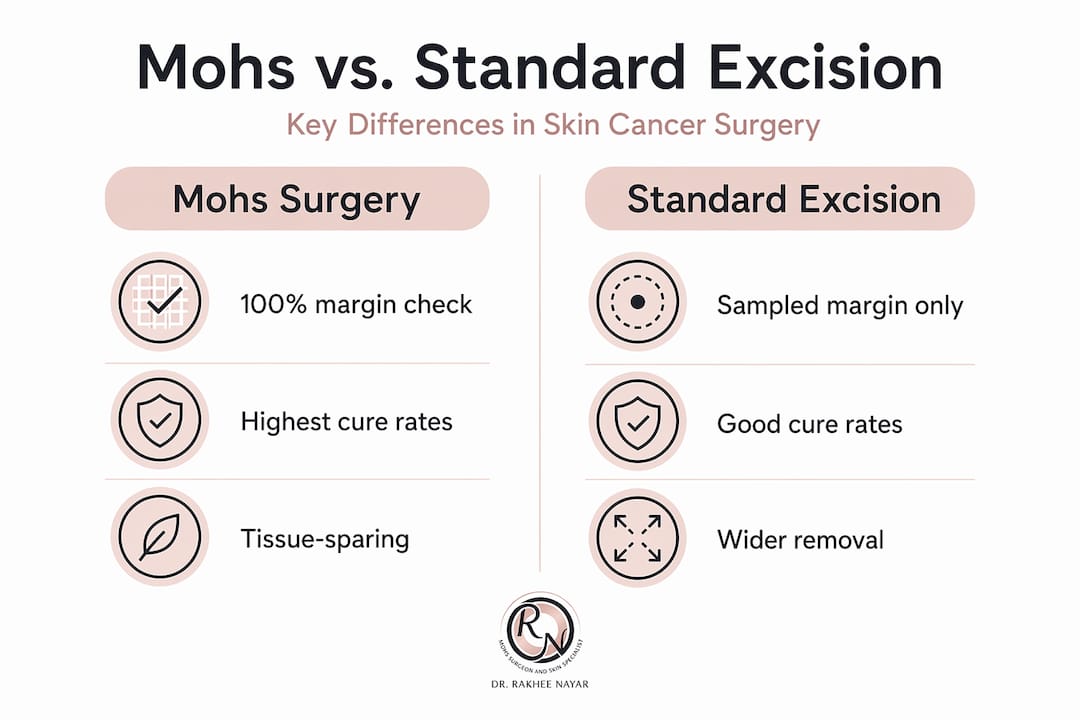
Mohs micrographic surgery is the treatment most closely associated with specialist skin cancer clinics, and for good reason. Developed by Dr Frederic Mohs and refined over decades, the technique involves removing the tumour one thin layer at a time and examining 100% of the tissue margins under a microscope before proceeding. This continues until no cancer cells remain.
The practical implication of that approach is significant. Standard surgical excision removes a margin around the tumour and sends the sample to a laboratory, with results arriving days later. Mohs examines every margin in real time. That difference in method is why Mohs delivers cure rates of up to 99% for new skin cancers, alongside meaningful tissue preservation.
| Feature | Mohs micrographic surgery | Standard surgical excision |
|---|---|---|
| Margin assessment | 100% examined in real time | Small sample sent to lab |
| Cure rate (primary tumour) | Up to 99% | Lower, particularly for complex sites |
| Tissue preservation | Maximal | Wider margins removed as standard |
| Turnaround for results | Same procedure, same day | Days to weeks for histology |
| Best suited for | Face, ears, hands, cosmetically sensitive sites | Lower-risk lesions on non-critical areas |
For high-risk squamous cell carcinoma specifically, the data is compelling. Studies show five-year disease-specific survival rates of 95.7% and local recurrence-free survival of 96.9% with Mohs surgery, outcomes that compare favourably with historical data for wide local excision. Notably, many patients in these studies achieved this without needing adjuvant radiation therapy or neck dissection, which matters considerably for quality of life.
Pro Tip: If your skin cancer is located on the face, near the eye, nose, or ear, or has recurred after previous treatment, ask specifically about Mohs surgery. These are the scenarios where the tissue-sparing precision of the technique has the greatest clinical and cosmetic impact.
Advanced diagnostics and expert monitoring
Early detection is not simply a matter of finding a lesion sooner. It is about accurately characterising what you have found, and doing so without subjecting patients to unnecessary procedures. This is where specialised clinics separate themselves through consistent, expert use of diagnostic tools.
Dermoscopy uses a handheld device with polarised lighting and optical magnification to visualise structures beneath the skin surface that are invisible to the naked eye. In trained hands, it changes the clinical picture entirely. Dermoscopy reduces unnecessary biopsies and improves diagnostic accuracy, particularly for patients with multiple atypical naevi or other melanoma risk factors.
The benefits of specialist-level monitoring go beyond a single appointment:
- The “ugly duckling” concept helps clinicians identify lesions that look different from a patient’s other naevi, even when none meets standard criteria for concern
- Structured surveillance programmes track change over time, which is far more informative than a single assessment
- Specialist dermoscopy monitoring reduces patient anxiety by giving clear, evidence-based reassurance rather than a vague “keep an eye on it”
- Early referral pathways directed by specialists reduce the time between suspicion and diagnosis
For patients who are at high risk due to personal or family history of melanoma, fair skin type, immunosuppression, or a history of extensive sun exposure, this ongoing monitoring model is not optional. It is the clinically appropriate standard of care. Expert dermatologists emphasise that regular surveillance and personalised monitoring plans are central to long-term skin health in these groups.
Integrated treatment and reconstruction in one place
One of the most underappreciated advantages of seeking specialist skin cancer care is what happens after the tumour is removed. Surgical defects on the face, scalp, or hands can be complex. The location of the wound, the structures involved, and the need to restore both function and appearance all require a specific skill set.
The steps most patients benefit from at a specialist centre are:
- Pre-operative assessment of the tumour size, depth, and relationship to nearby structures such as the eyelid margin or nasal ala
- Mohs excision with same-session margin confirmation, removing only what needs to go
- Immediate reconstructive planning based on confirmed clear margins, not an estimate
- Execution of the repair, whether primary closure, local flap, or skin graft, by a surgeon with reconstructive expertise
- Post-operative care and monitoring tailored to both the wound and the patient’s ongoing skin cancer risk
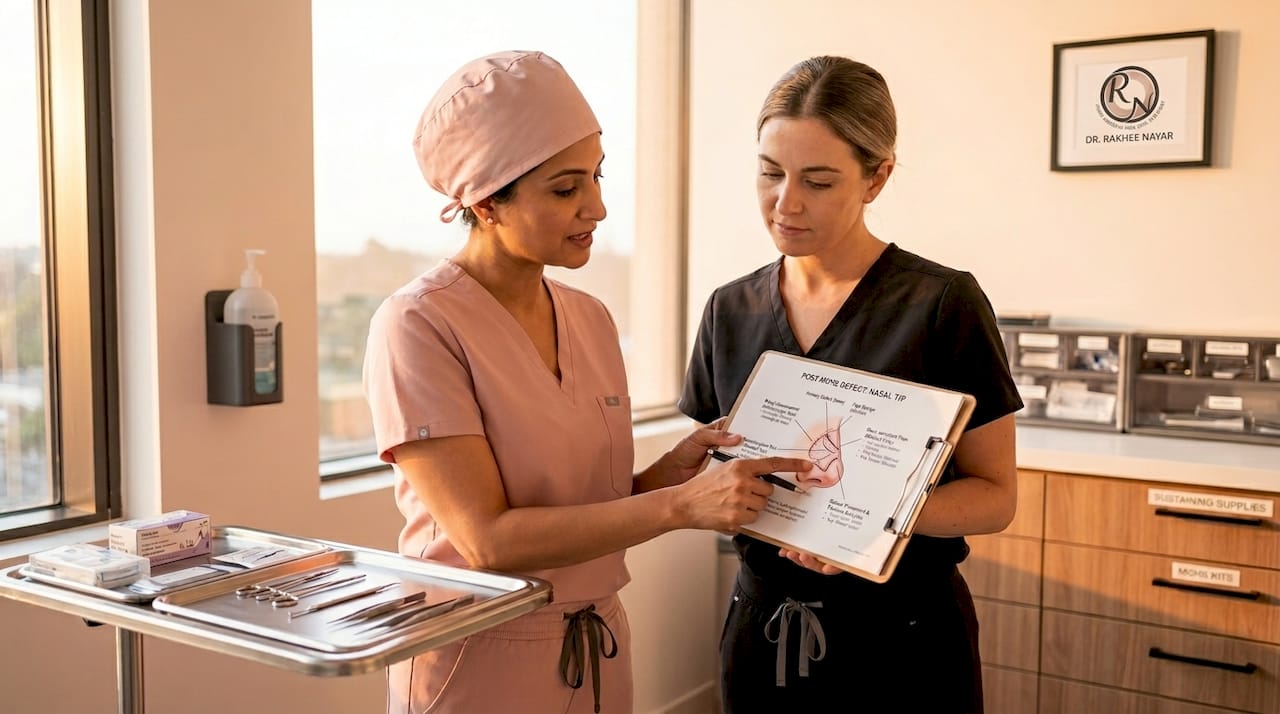
Dual-trained Mohs and plastic surgeons make this possible within a single appointment. The alternative, seeing a Mohs surgeon for removal and then being referred separately to a plastic surgeon for reconstruction, introduces delays, potential miscommunication, and a less predictable cosmetic result because the reconstructive surgeon was not present for the excision. Combined expertise in one clinician removes that gap entirely.
Pro Tip: When evaluating a specialist clinic, ask whether the surgeon performing the Mohs excision also performs the reconstruction, or whether you will be referred on. Same-day repair by the same clinician consistently produces better outcomes on cosmetically sensitive sites.
Is a specialist clinic right for you?
Not every skin lesion requires a Mohs surgeon, but several situations strongly indicate that specialist evaluation is the right starting point rather than a last resort. Asking yourself the following questions helps clarify where to seek care:
- Has a GP or general dermatologist already biopsied or attempted to remove your lesion, and are you concerned about the result?
- Is your lesion on the face, scalp, ears, hands, or feet, where tissue preservation matters most?
- Do you have a history of multiple skin cancers, suggesting a higher personal risk profile?
- Is your current or previous skin cancer a BCC or SCC with high-risk features such as perineural invasion, large size, or poorly defined borders?
- Are you immunocompromised, which increases both your risk and the complexity of management?
If you answered yes to any of these, specialist assessment is appropriate. Beyond the clinical criteria, structured follow-up and patient education at a specialist clinic give you the tools to manage your ongoing risk rather than waiting passively between appointments.
When evaluating clinics, look at surgeon credentials carefully. Fellowship training in Mohs surgery is specific and distinct from general dermatology training. Ask whether the clinic has on-site or same-day histopathology support. Ask what happens if your defect requires complex reconstruction. Access considerations such as private consultation, e-consultation, and whether international patients are accepted also vary by clinic and are worth clarifying early.
My perspective: what patients often miss
In my experience, the most common misconception I encounter is that a skin cancer diagnosis is a skin cancer diagnosis, regardless of where you go for treatment. Patients sometimes assume that as long as the lesion is removed, the details of how and by whom are secondary.
That assumption worries me. The location of a tumour on the face, the depth of invasion, and the skill of the reconstruction all influence whether you end up with a clean result or a complication that requires a second procedure. I have seen patients arrive having had a wide excision elsewhere, still with positive margins, needing Mohs to finally achieve clearance. The first operation was not a failure through negligence. It was a limitation of the method.
What patients often overlook is that choosing specialist care early is not an overreaction. A Mohs cure rate close to 99% is not a marketing figure. It reflects what happens when complete margin assessment replaces probability-based excision. And when reconstruction follows immediately from a surgeon who was present for every stage of the removal, the functional and cosmetic result is simply better.
My advice: do not wait for a second recurrence before seeking specialist evaluation. If your lesion has any high-risk feature at all, the right time to see a specialist is now.
— Rakhee
Expert skin cancer care at Rakhee Nayar – Mohs Surgeon and Skin Specialist
If you are considering your options after a skin cancer diagnosis, or simply want a thorough expert assessment, Rakhee Nayar – Mohs Surgeon and Skin Specialist offers exactly the kind of specialist-led care discussed throughout this article.
Miss Rakhee Nayar holds dual training in both Mohs micrographic surgery and plastic surgery, making her one of a small number of UK clinicians able to offer same-day facial reconstruction following Mohs excision. Whether you are newly diagnosed or managing a complex or recurrent skin cancer, the clinic offers private consultations and e-consultations for patients across the UK and internationally. Start with early detection guidance to understand what specialist assessment involves, or explore the full range of Mohs surgery services available to you.
FAQ
What makes a specialist skin cancer clinic different from a GP?
A specialist skin cancer clinic has dedicated equipment such as dermatoscopes, fellowship-trained surgeons, and on-site histopathology support that enables same-day margin assessment. GPs provide valuable initial assessment but are not equipped for surgical treatment or complex reconstruction.
Is Mohs surgery only for facial skin cancers?
Mohs surgery is most commonly used for cancers on the face, ears, scalp, hands, and feet where tissue preservation is critical, but it is also appropriate for recurrent tumours and high-risk lesions anywhere on the body.
How do I know if my skin cancer qualifies for Mohs surgery?
Key indicators include tumour location on cosmetically sensitive areas, high-risk histological features such as perineural invasion, recurrence after previous treatment, and poorly defined borders. A specialist consultation will confirm suitability.
Can I be seen at a specialist clinic without a GP referral?
Many private specialist skin cancer clinics accept self-referrals or direct bookings. Rakhee Nayar – Mohs Surgeon and Skin Specialist offers both in-person and e-consultations without requiring a GP referral for private patients.
What is the recurrence rate after Mohs surgery compared with standard excision?
For high-risk squamous cell carcinoma, Mohs surgery achieves local recurrence-free survival of 96.9% at five years, which is superior to outcomes reported historically for wide local excision.