TL;DR:
- High-risk skin cancers have a greater chance of recurrence or spread, requiring urgent specialist treatment.
- Mohs surgery offers the most precise, tissue-sparing removal with the highest cure rates for high-risk cases.
- Early expert care improves both cancer outcomes and cosmetic results, especially for face and critical areas.
Hearing the words ‘high-risk skin cancer’ can stop you in your tracks. Many patients leave their GP appointment knowing something serious has been found but feeling uncertain about what ‘high risk’ actually means for their treatment, recovery, and future. Not all skin cancers carry the same urgency or require the same approach. High-risk non-melanoma skin cancers, specifically basal cell carcinoma (BCC) and squamous cell carcinoma (SCC) with certain aggressive features, are those most likely to recur or spread. This guide explains exactly what makes a skin cancer ‘high risk’, how specialists classify these tumours, and why advanced treatments like Mohs micrographic surgery offer the best outcomes.
Key Takeaways
| Point | Details |
|---|---|
| High-risk definition | High-risk skin cancers have features increasing the chance of recurrence or spread and usually need urgent treatment. |
| Mohs surgery benefits | Mohs offers the highest cure rates of the available treatments for high-risk cases, and spares more healthy tissue on the face. |
| Specialist input | Consulting an experienced Mohs surgeon is key to balancing effective treatment with cosmetic results. |
| Prompt referral essential | UK guidelines require urgent referral and assessment for suspected high-risk skin cancers. |
What does ‘high-risk’ mean in skin cancer?
The term ‘high risk’ is used by specialists to describe skin cancers that carry a greater chance of coming back after treatment, spreading to nearby tissue or lymph nodes, or causing significant problems during healing. It does not simply mean the cancer is large or visible. A small tumour in the wrong location, or one with certain cellular features, can be far more dangerous than a larger growth elsewhere on the body.
The two most common types of high-risk skin cancer are BCC and SCC. Both fall under the umbrella of non-melanoma skin cancer (NMSC), which accounts for the vast majority of skin cancer cases in the UK. High-risk NMSC refers specifically to BCC and SCC with features that increase the risk of recurrence or metastasis, meaning spread beyond the original site.
Understanding the signs early is vital. You can read more about recognising skin cancer on our site, but in short, any persistent lesion, ulcer, or unusual growth on the skin that fails to heal within a few weeks warrants prompt assessment.
UK guidelines from the NHS and the British Association of Dermatologists (BAD) treat high-risk skin cancers with real urgency. When a GP or dermatologist suspects a high-risk lesion, patients are referred through the two-week wait pathway to ensure rapid specialist assessment.
Urgent two-week referral: UK NHS referral criteria require that patients with suspected high-risk skin cancers are seen by a specialist within two weeks of referral. This pathway exists because early, expert treatment significantly improves outcomes.
Here is a quick comparison to clarify what separates high-risk from standard-risk skin cancers:
| Feature | Standard risk | High risk |
|---|---|---|
| Size | Smaller than 2 cm | Larger than 2 cm |
| Location | Low-risk body sites | Face, ears, scalp, hands |
| Tumour edges | Well-defined | Ill-defined or infiltrative |
| Previous treatment | Primary (first occurrence) | Recurrent |
| Patient health | Immunocompetent | Immunosuppressed |
Key features that push a skin cancer into the ‘high-risk’ category include:
- Location: Tumours on the face, ears, nose, eyelids, lips, or scalp carry higher risk due to complex anatomy and proximity to vital structures.
- Recurrence: A cancer that has returned after previous treatment is significantly harder to treat.
- Ill-defined borders: When the edges of a tumour are not clearly visible, complete removal is more challenging.
- Aggressive subtypes: Certain cellular patterns, such as infiltrative BCC or poorly differentiated SCC, behave more aggressively.
- Immunosuppression: Patients on immunosuppressive medication (for example, organ transplant recipients) face a much higher risk of aggressive skin cancers.
How is high-risk skin cancer classified?
Specialists use a set of well-established criteria to classify a BCC or SCC as high risk. These criteria guide decisions about which treatment approach is most appropriate and how urgently a patient needs to be seen.
For BCC, high-risk features include infiltrative, micronodular, or basosquamous subtypes, large tumour size, recurrent disease, ill-defined edges, and location in high-risk anatomical areas such as the nose, eyelids, ears, and lips. These subtypes are more likely to extend beyond what is visible to the naked eye, making complete removal with standard surgery difficult.
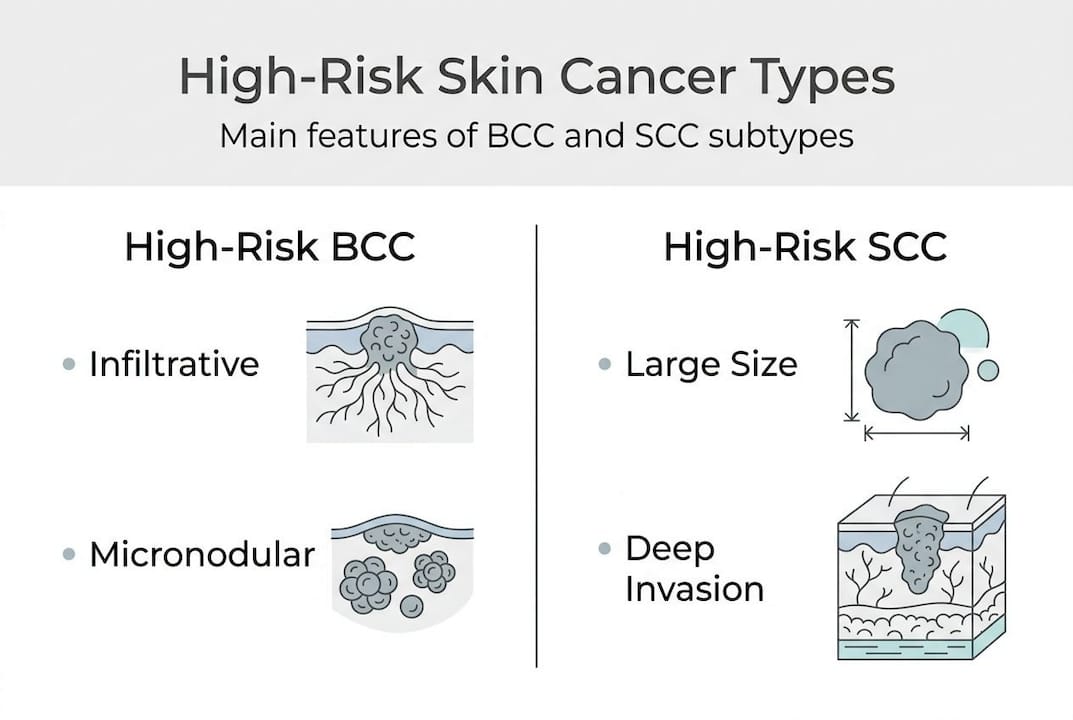
For SCC, high-risk characteristics include larger size, deeper invasion into the skin and underlying tissue, poor cellular differentiation, perineural invasion (spread along nerve pathways), recurrence, high-risk anatomical sites, and immunosuppression. SCC in particular carries a real risk of spreading to lymph nodes if not treated promptly and thoroughly.
Here is a side-by-side comparison of high-risk features for each cancer type:
| Classification factor | High-risk BCC | High-risk SCC |
|---|---|---|
| Subtype | Infiltrative, micronodular, basosquamous | Poorly differentiated |
| Size | Greater than 2 cm | Greater than 2 cm |
| Depth | Deeper than expected | Deeper than 2 mm (Clark level IV+) |
| Perineural invasion | Present | Present |
| Location | Face, ears, scalp | Face, lip, ear, genitalia |
| Recurrence | Yes | Yes |
| Immune status | Immunosuppressed | Immunosuppressed |
For patients considering their options, understanding whether your tumour meets Mohs surgery criteria for BCC or requires SCC management and reconstruction is an important early step.
The following are the key classification criteria specialists use when assessing a BCC:
- Tumour subtype (infiltrative or micronodular carries the highest risk)
- Diameter greater than 2 cm
- Location on the face, particularly the central face, ears, or scalp
- Recurrent disease following previous excision or radiotherapy
- Ill-defined clinical borders
- Immunosuppressed patient
Pro Tip: When you meet your specialist, ask directly: “What subtype is my tumour, and does it have any high-risk features?” This one question can open up a much more detailed conversation about your treatment options and expected outcomes.
Why does high-risk skin cancer need special treatment?
Once a skin cancer is classified as high risk, standard surgical excision may simply not be enough. Conventional excision removes a margin of tissue around the tumour, but it only examines a small percentage of the cut edges under the microscope. For an aggressive or ill-defined tumour, this means residual cancer cells can be left behind without anyone knowing.
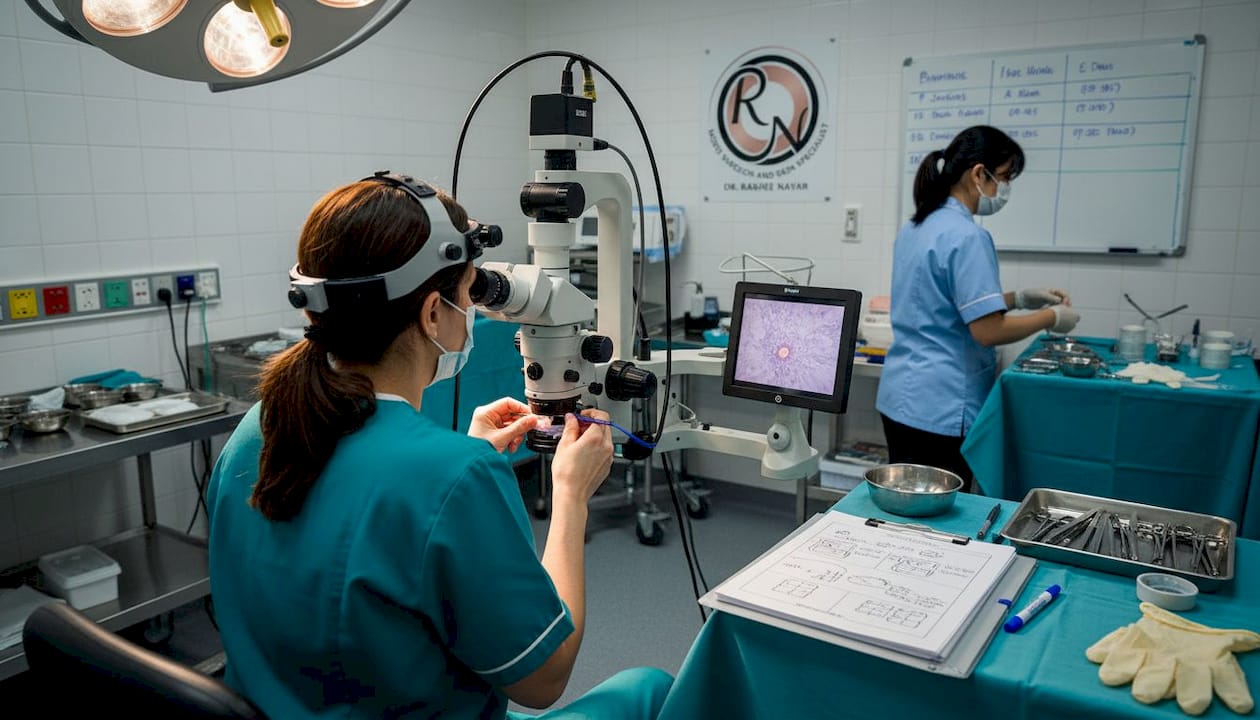
This is where Mohs micrographic surgery changes everything. Mohs surgery is superior to standard excision for tissue preservation and full margin control, making it particularly valuable for cosmetically sensitive areas like the face. Rather than guessing how far a tumour extends, Mohs examines 100% of the surgical margin in real time.
For high-risk cases, the stakes are clear. Leaving even a small cluster of cancer cells behind can mean a recurrence that is harder to treat, more disfiguring, and in the case of SCC, potentially dangerous. BMJ guidelines confirm that UK clinical guidance from the NHS, BAD, and the British Society for Dermatological Surgery prioritises Mohs surgery for high-risk NMSC in critical anatomical areas.
Reasons why conventional excision may fall short for high-risk cases:
- Incomplete margin assessment: Standard pathology examines only 1 to 2% of the excision margin, leaving the rest unchecked.
- Tissue sacrifice: Larger margins are taken to compensate for uncertainty, which matters enormously on the face.
- No real-time feedback: The surgeon does not know during the operation whether the margins are clear.
- Higher recurrence rates: For infiltrative BCC or poorly differentiated SCC, recurrence after standard excision is significantly higher than after Mohs.
To understand what Mohs surgery involves in detail, or to separate fact from fiction by reviewing Mohs myths and facts, these resources can help you feel more informed before your consultation.
Pro Tip: When discussing your treatment plan, ask your team two specific questions: “What is the expected cure rate with this approach?” and “How will my cosmetic result be managed?” Both questions are entirely reasonable and a good specialist will welcome them.
What does Mohs surgery involve?
Mohs micrographic surgery is performed as a day procedure under local anaesthetic, meaning you remain awake and comfortable throughout. The process is methodical and precise, which is exactly what high-risk tumours require.
Here is how the procedure works, step by step:
- Local anaesthetic is applied to numb the area completely before any tissue is removed.
- The visible tumour is removed along with a thin layer of surrounding tissue.
- The tissue is mapped and processed in an on-site laboratory, with colour-coded markings to track its exact orientation.
- A pathologist or the surgeon examines 100% of the tissue margins under the microscope to check for remaining cancer cells.
- If cancer cells are found, only the precise area where they remain is removed in the next layer. Healthy tissue is left untouched.
- Steps 2 to 5 are repeated until all margins are completely clear of cancer.
- Reconstruction begins once the wound is confirmed cancer-free, using the most appropriate technique for the site.
This layer-by-layer approach with immediate microscopic margin examination and 100% tissue assessment is what makes Mohs uniquely powerful for high-risk cancers. No other surgical technique offers this level of certainty.
For patients facing surgery on the face, the tissue-sparing nature of Mohs is especially important. Because only cancerous tissue is removed at each stage, the resulting wound is often smaller than it would be with conventional excision, giving the reconstructive surgeon more to work with.
Reading about reconstruction after Mohs and preparing for Mohs surgery in advance can help you feel genuinely ready for what to expect.
Pro Tip: After your Mohs procedure, ask your surgeon specifically about your reconstruction options. Techniques vary considerably, and a surgeon with dual training in both Mohs and plastic surgery can offer a much wider range of approaches to achieve the best cosmetic result.
A specialist’s insight: Why experience truly matters for high-risk skin cancers
Here is something that does not always get said plainly enough: not all Mohs surgeons are equal, and not all clinics offering skin cancer treatment have the same depth of expertise.
For straightforward, low-risk lesions, the difference in outcomes between providers may be small. But for high-risk tumours on the face, recurrent cancers, or cases involving complex reconstruction, the surgeon’s experience and training can genuinely change your result. A specialist with dual training in both Mohs surgery and plastic surgery brings something rare to the table: the ability to remove the cancer and plan the reconstruction in the same procedure.
Multidisciplinary care matters too. Complex cases benefit from input across dermatology, oncology, and reconstructive surgery. Choosing a provider who works within this kind of framework is not a luxury. For high-risk patients, it is the standard of care they deserve. You can explore Mohs expertise in the UK to understand what a genuinely specialist service looks like.
Get expert care for high-risk skin cancer
If you have been told your skin cancer is high risk, getting the right specialist involved early makes a real difference to both your cure rate and your cosmetic outcome.
At mohssurgeon.co.uk, Miss Rakhee Nayar combines specialist training in Mohs surgery with advanced plastic surgery skills, offering patients in the UK and beyond a genuinely integrated approach to high-risk skin cancer care. Whether you want to learn about Mohs before booking, or you are ready to discuss your options for cosmetic reconstruction after Mohs, the clinic provides private consultations and e-consultations to suit your needs. Do not wait to seek expert advice. Early, specialist treatment gives you the best possible chance of a complete cure and a natural-looking result.
Frequently asked questions
What types of skin cancer are considered high risk?
High-risk skin cancers are mainly specific basal cell carcinomas and squamous cell carcinomas with aggressive features such as infiltrative subtypes, large size, recurrence, or location on the face and other critical sites.
Why is Mohs surgery preferred for high-risk facial skin cancers?
Mohs surgery offers the highest cure rate and examines 100% of the surgical margin in real time, while preserving as much healthy tissue as possible, which is essential for achieving good cosmetic results on the face.
How quickly should high-risk skin cancer be treated?
UK guidelines require an urgent two-week referral for suspected high-risk skin cancers, so patients are assessed and treated by a specialist without delay.
Can all high-risk skin cancers be treated with Mohs surgery?
Most high-risk NMSCs are suitable for Mohs, but alternative treatments such as conventional excision or radiotherapy may be recommended for patients where Mohs is not appropriate due to health or tumour-specific reasons.
Recommended
- Essential follow-up steps after skin cancer treatment
- Skin Cancer Detection – Expert Mohs Surgery | UK
- Skin Cancer Treatment & Surgery | Mohs Surgery UK
- How to Spot Skin Cancer Symptoms on the Face – Expert Mohs Surgery | UK
Filed under Skin Cancer Explained


