TL;DR:
- Delaying treatment for skin cancer risks severe local tissue destruction, metastasis, and significantly lower survival rates, especially for melanoma. Early diagnosis and prompt intervention improve prognosis, reduce complexity, and prevent disfigurement or systemic spread. Recognizing suspicious lesions and seeking specialist assessment without delay is crucial for effective outcomes.
Many people discover a suspicious lesion and convince themselves it can wait. That instinct is understandable, but the risks of untreated skin cancer are serious enough to make delay genuinely dangerous. Skin cancer is not a single disease. Basal cell carcinoma, squamous cell carcinoma, and melanoma each behave differently, spread at different rates, and carry consequences that change dramatically depending on how quickly you act. This article explains what actually happens when skin cancer goes untreated, which factors raise your personal risk, and why the window for straightforward treatment closes faster than most people realise.
Key takeaways
| Point | Details |
|---|---|
| All skin cancer types carry risk | Even basal cell carcinoma can cause severe local destruction if left without treatment. |
| Melanoma survival drops sharply | Five-year survival falls from 99.6% for localised disease to 35.1% once melanoma spreads distantly. |
| High-risk locations matter | Lesions near ears, lips, and scars carry a greater likelihood of metastasis and poorer outcomes. |
| Recurrence is common | Around 25% of people with one basal cell carcinoma develop a new lesion within five years. |
| Early treatment changes everything | Prompt diagnosis and treatment improve prognosis, reduce surgical complexity, and lower complication rates significantly. |
Risks of untreated skin cancer by type
Understanding how each skin cancer type progresses when untreated is the single most useful frame for appreciating why treatment cannot be postponed indefinitely.
Basal cell carcinoma (BCC) is the most common skin cancer and is often described as “slow” or “harmless.” That framing is misleading. BCC rarely metastasises but can invade surrounding tissues deeply over time, reaching bone, cartilage, and in the worst cases the eyes, ears, mouth, or brain. What starts as a small pearly nodule can quietly track along tissue planes well beyond its visible edge. Untreated BCC lesions often extend microscopically beyond their borders, which means delayed treatment typically requires far more extensive surgery and more complex reconstruction than early treatment would have.
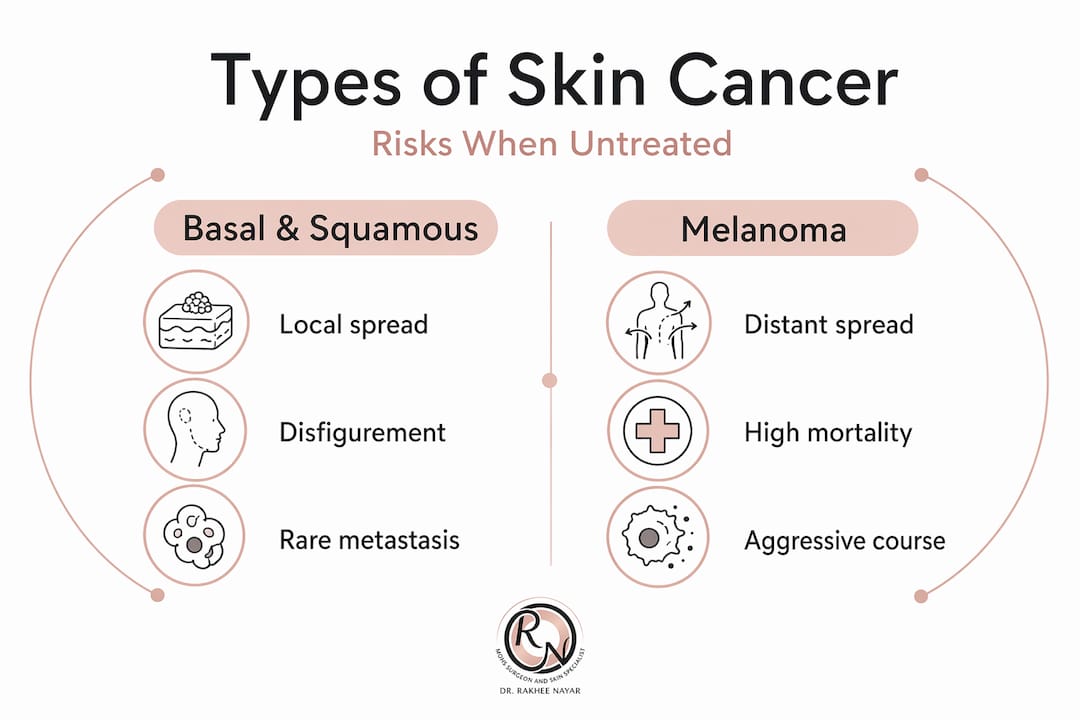
Squamous cell carcinoma (SCC) is significantly more aggressive. Unlike BCC, it carries a genuine risk of spreading to lymph nodes and distant organs. Over a ten-year period, SCC carries a 3.7% metastasis risk and a 2.1% disease-specific death rate. Those numbers rise sharply for high-risk lesions. Left untreated, SCC can grow deeply into subcutaneous tissue, invade nerves, and seed distant sites.
Melanoma operates on a different timeline altogether. It is the most dangerous of the three, capable of spreading to lymph nodes, lung, liver, and brain even when the primary lesion appears small. The contrast in outcomes tells the full story.
| Cancer type | Metastatic potential | Untreated risk level | Key concern |
|---|---|---|---|
| Basal cell carcinoma | Very low | Moderate | Local tissue destruction near vital structures |
| Squamous cell carcinoma | Low to moderate | High | Regional spread, nerve invasion, organ metastasis |
| Melanoma | High | Very high | Rapid systemic spread, low survival if advanced |
Here is what the progression commonly looks like across all three types when treatment is deferred:
- A BCC that could be removed with a small excision grows into a lesion requiring reconstructive surgery.
- An SCC that was thin and localised invades deeper tissue and spreads to a lymph node.
- A melanoma caught at stage one becomes stage three or four, requiring systemic immunotherapy rather than surgery alone.
The pattern is consistent. Time does not stand still, and neither does the tumour.
Complications from ignoring skin cancer
The physical consequences of untreated skin cancer go well beyond the lesion itself. Local tissue destruction is the first and most visible problem, particularly for cancers on the face. A tumour on the nose, eyelid, or lip that goes without treatment for months can destroy the architecture of those structures, requiring extensive facial reconstructive surgery to restore function and appearance.
Some locations carry specific dangers:
- Near the eye: Invasion of the orbit can threaten vision or require orbital exenteration in severe cases.
- Near the ear: SCC in the ear canal is notoriously high-risk because of proximity to the skull base and the parotid gland.
- At the lip vermillion border: This location is a recognised high-risk site for SCC metastasis.
- In burn scars or chronic wounds: Burn scar-related skin cancers have a recurrence rate of 13.2% and a mortality rate of 6.96%, with SCC accounting for the majority of deaths. The average latency before diagnosis in this group is 21.7 years, meaning patients often do not realise a chronic wound has undergone malignant change.
Melanoma’s complications with delayed treatment are particularly stark. Five-year survival for localised melanoma is 99.6%. Once the disease has spread to distant organs, that figure falls to 35.1%. That is not a small statistical footnote. That is the difference between cure and a fight for survival.
“Delays in melanoma care reduce the chance of cure significantly. Once systemic spread occurs, treatment becomes far more complex, requiring immunotherapy and targeted therapies, and prognosis worsens dramatically.”
The consequences of skin cancer are not limited to mortality statistics. Disfigurement, nerve damage, chronic pain, and the psychological burden of managing advanced disease are all real outcomes for people who delayed care.
Factors that affect your personal risk level
Not every untreated skin cancer follows the same course, and understanding what raises your individual risk can sharpen your sense of urgency.
-
Age and immune status. Older individuals and those who are immunosuppressed (for example, following organ transplantation or due to certain medications) develop more aggressive lesions and have reduced capacity to contain tumour spread. Risk factors including older age and immunosuppression are well established as drivers of more severe disease.
-
Skin type and UV exposure history. Fair skin, a history of significant sunburns, and cumulative UV exposure all increase the likelihood of developing aggressive or multiple lesions simultaneously.
-
Previous skin cancer diagnosis. If you have already had one BCC, around 25% of patients develop a new BCC within five years. A prior SCC places you at elevated risk of a second primary or a recurrence.
-
Tumour location and pathological features. High-risk SCC features including perineural invasion (where cancer tracks along a nerve) and location near the ears, lips, or existing scars increase the probability of metastasis substantially. A tumour on the back of the hand and a tumour on the ear canal are not equally dangerous, even if they share the same diagnosis.
-
Tumour biology. Some cancers are aggressive by nature. Certain BCC subtypes, such as morphoeic or infiltrative variants, spread subclinically more readily than nodular forms. High-risk lesion features and locations guide treatment priority and the level of post-treatment surveillance needed.
Pro Tip: If a lesion is on your face, scalp, ear, lip, or within a scar, do not apply a “wait and see” approach. These are precisely the locations where delay converts a manageable problem into a complex one.
Early detection and treatment: reducing the risks

The good news is that skin cancer is one of the most treatable cancers when caught early. Knowing what to look for and acting on it promptly is the most direct way to avoid the consequences described above.
Watch for these warning signs and consult a specialist if they are present:
- A new lesion that has not healed after four to six weeks.
- A mole that has changed in size, shape, or colour, or that bleeds without trauma.
- A firm, flesh-coloured or pearlescent nodule, particularly on sun-exposed skin.
- A scaly, red patch that crusts repeatedly but does not resolve.
- Any lesion in a scar or chronic wound that changes character.
Diagnosis typically involves a clinical assessment followed by a skin biopsy. For melanoma, staging investigations including imaging may follow. The UK guide to skin cancer symptoms from Mohssurgeon covers the full spectrum of signs worth knowing.
Treatment options depend on the cancer type, location, and stage:
- Surgical excision with clear margins is standard for most primary lesions.
- Mohs micrographic surgery is the gold standard for BCC and SCC on the face and other cosmetically sensitive or high-risk areas, offering the highest cure rates by examining all margins in real time.
- Topical therapies such as imiquimod or fluorouracil are suitable for certain superficial BCCs.
- Radiotherapy may be used where surgery is not feasible or as adjuvant treatment for high-risk SCC.
Follow-up care matters as much as the initial treatment. Surveillance appointments catch recurrences and new primaries before they progress. The steps after skin cancer treatment guide from Mohssurgeon explains what that monitoring looks like in practice.
Pro Tip: Ask your treating clinician specifically about your recurrence risk and the recommended follow-up interval. Annual skin examinations are the minimum for anyone with a prior skin cancer diagnosis.
Expert skin cancer care from Mohssurgeon
If something about a lesion concerns you, the time to act on that concern is now.

Mohssurgeon offers specialist skin cancer diagnosis and treatment led by Miss Rakhee Nayar, who holds dual training in plastic surgery and Mohs micrographic surgery. That combination is rare and genuinely significant for patients. It means that the surgeon removing your cancer is also the surgeon who will plan and perform any reconstruction needed, optimising both the cure rate and the cosmetic result in a single specialist relationship.
Whether you are dealing with a suspected BCC on your nose, an SCC near your ear, or a changing mole that needs urgent assessment, Mohssurgeon provides private consultations in North West England as well as remote e-consultations for patients across the UK and internationally. You can explore the full range of skin cancer treatments available or book directly through the site to speak with a specialist. For those who want to understand what they are looking for before they book, the early detection guide is an excellent place to start. Do not wait for a lesion to become something more complex than it needs to be.
FAQ
What happens if skin cancer is left untreated?
Untreated skin cancer can invade surrounding tissues, spread to lymph nodes and distant organs, and in some cases become fatal. The exact progression depends on the cancer type, location, and individual risk factors.
Can basal cell carcinoma be dangerous if untreated?
Yes. While BCC rarely spreads to other organs, it can cause severe local destruction, invading bone, cartilage, eyes, and ears. Without treatment, it may also extend far beyond its visible borders, making eventual surgery more complex.
How quickly does melanoma spread without treatment?
Melanoma can spread to lymph nodes and distant organs relatively quickly, even when the primary lesion is small. Five-year survival drops from approximately 99.6% for localised disease to 35.1% once distant metastasis occurs, which is why early treatment is so critical.
What are the skin cancer mortality risks for squamous cell carcinoma?
SCC carries a disease-specific death rate of approximately 2.1% over ten years, rising considerably for high-risk lesions involving perineural invasion or located near the ears, lips, or chronic scars.
How often should I have a skin check after a skin cancer diagnosis?
Annual skin examinations are recommended as a minimum after any skin cancer diagnosis. Around 25% of people who have had one basal cell carcinoma will develop a new BCC within five years, making ongoing surveillance a necessity rather than a precaution.
Recommended
- High-risk skin cancer: Expert treatment guide for UK patients
- How skin cancers form: risks, genetics and prevention
- Skin cancer symptoms and signs: the UK guide for early detection
- Essential follow-up steps after skin cancer treatment
Filed under Skin Cancer Explained