
TL;DR:
- Skin cancer rates are rising due to cumulative UV damage, environmental factors, and overdiagnosis, despite sun safety efforts. Younger generations show stabilizing or declining melanoma rates, but older adults continue to experience increases linked to past behaviors. Personal risk can be reduced through consistent sun protection, avoiding tanning beds, and prompt medical checks for suspicious lesions.
Skin cancer is now the most commonly diagnosed cancer in many Western countries, and the numbers continue to climb despite decades of sun safety campaigns. If you have been wondering why skin cancer rates are rising even as sunscreen sits on every pharmacy shelf, you are not alone. The answer is far more complicated than UV exposure alone. Decades of behavioural patterns, environmental shifts, and changes in how we detect and diagnose cancers have all converged. Understanding what is driving this trend is the first step towards doing something meaningful about it.
Key takeaways
| Point | Details |
|---|---|
| UV damage is cumulative | Sunburns in youth significantly raise melanoma risk decades later, not just in the short term. |
| Indoor tanning accelerates risk | Tanning bed use, especially in young people, is a well-documented driver of earlier melanoma onset. |
| Environment plays a growing role | Ozone depletion, climate change, and air pollution interact to amplify skin damage beyond UV alone. |
| Overdiagnosis inflates some statistics | Better screening detects more low-risk lesions, which partly explains reported rises in incidence. |
| Early detection saves lives | Spotting changes early and consulting a specialist gives the best chance of successful treatment. |
Why skin cancer rates are rising: the full picture
Skin cancer broadly falls into three categories: melanoma, basal cell carcinoma (BCC), and squamous cell carcinoma (SCC). Melanoma is the least common but most dangerous, while BCC and SCC collectively account for the vast majority of diagnoses. It matters to distinguish between them because their trends do not always move in the same direction.
Melanoma incidence more than doubled in the United States between 1982 and 2011 and rose a further 31.5% from 2011 to 2019. In the UK, melanoma diagnoses hit a record 20,980 new cases in 2022. Approximately 9 in 10 of those cases are considered avoidable through better UV exposure control.
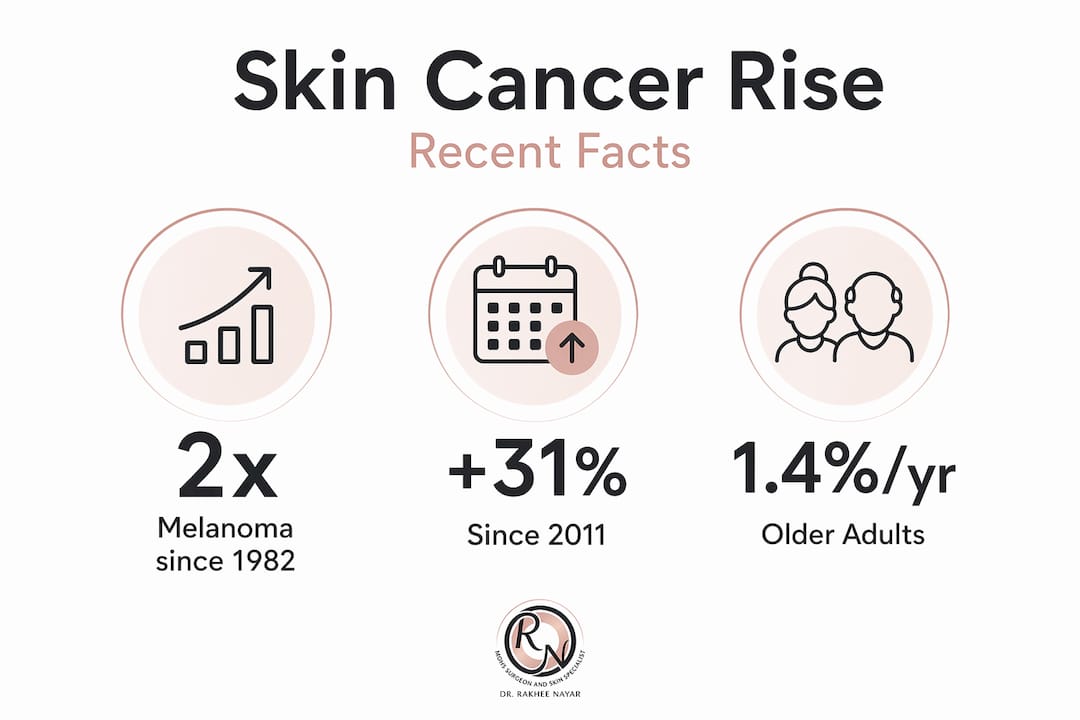
Age and sex matter here too. Older adults continue to see increases in invasive melanoma, with rates rising roughly 1.4% per year in men over 50 and 2.8% per year in women over 50. People under 50, by contrast, are showing stabilising or even declining rates. This divergence is not random. It reflects the sun behaviours and tanning culture of past decades now playing out in older cohorts. You can learn more about how different skin cancers form and the biological pathways involved on the Mohssurgeon website.
One caveat worth noting: BCC and SCC are frequently underreported in national cancer registries, which skews the broader narrative around skin cancer prevalence. The true burden of non-melanoma skin cancers is almost certainly higher than published figures suggest.
UV radiation: the primary driver
UV radiation is the single most established cause of skin cancer, and its effects are not immediate. Damage accumulates silently over years and decades before a cancer develops. This long latency is one reason why rates are still rising even as sun safety awareness has grown: we are seeing the consequences of behaviours from 30 or 40 years ago.
The five specific ways UV exposure drives rising skin cancer rates are worth understanding in sequence:
- Childhood and teenage sunburns. Five or more blistering sunburns between ages 15 and 20 increase melanoma risk by 80%. Many people now in their 50s and 60s grew up before comprehensive sun safety messaging existed.
- Tanning culture. The mid-20th century glorified tanned skin as a sign of health and status. This cultural shift led generations to deliberately seek UV exposure without protection.
- Indoor tanning beds. Indoor tanning significantly raises melanoma risk and is linked to earlier onset of the disease, particularly among young women who used tanning beds frequently during the 1990s and 2000s.
- Inadequate sunscreen use. Sunscreen was not widely used or properly applied in earlier generations. Even today, there is a well-documented paradox where sunscreen users sometimes spend longer outdoors, increasing total UV dosage if protection is inconsistent.
- Behavioural shifts across generations. Younger people who have grown up with consistent sun safety messaging are showing stabilising melanoma rates, offering real evidence that behaviour change works over time.
Pro Tip: Apply broad-spectrum SPF 30 or higher every two hours when outdoors, not just once in the morning. UV exposure accumulates throughout the day even on overcast days.
Understanding daily sunscreen habits and how to build them consistently is one of the most practical steps you can take right now.

Environmental co-factors beyond sun exposure
UV radiation does not operate in isolation. A growing body of scientific evidence points to environmental changes that are amplifying skin cancer risk across populations, even among people who take sun protection seriously.
Consider the following interconnected environmental pressures:
- Ozone layer depletion. Global UV radiation increased approximately 3% between 1979 and 2010, particularly in midlatitude regions, linked directly to ozone thinning. Even small percentage increases in UV reaching the Earth’s surface translate to measurable increases in DNA damage.
- Climate change and longer exposure seasons. Warmer temperatures and extended warm seasons mean people spend more time outdoors over more months of the year. Climate change effects such as longer warm seasons are steadily increasing the population’s total annual UV exposure time.
- Air pollution as a co-stressor. This is less well-known but increasingly supported by research. Gaseous pollutants such as NO2 and SO2 are epidemiologically associated with skin conditions including melanoma, operating through oxidative damage and disruption of the skin’s natural barrier function.
- UV and particulate matter interaction. Urban particulates combined with UV exposure can impair DNA repair mechanisms and increase damage to melanocytes, intensifying risk beyond what UV alone would cause.
“Experts highlight synergistic environmental impacts rather than single-factor causes when explaining the continued rise in skin cancer globally. The combination of increasing UV, air pollution, and heat may be working together in ways we are only beginning to quantify.” AAMC, 2024
These environmental factors also help explain regional variations in rising skin cancer statistics. Cities with higher pollution levels and greater UV intensity are seeing different patterns than rural or northern populations, adding another layer of complexity to the data.
Screening, overdiagnosis, and reading the data carefully
Rising incidence figures do not always mean cancer is genuinely becoming more common at the biological level. Some portion of the increase reflects the fact that we are looking more carefully than we used to.
| Factor | Effect on reported rates |
|---|---|
| Increased public awareness | More people attend skin checks, leading to more diagnoses |
| Improved diagnostic technology | Dermoscopy and imaging detect lesions earlier and more accurately |
| Overdiagnosis of low-risk lesions | Some thin or slow-growing melanomas may never have caused harm |
| Underreporting of BCC and SCC | Non-melanoma cancers remain poorly captured in many datasets |
Overdiagnosis partly inflates rising melanoma rates, reflecting increased detection of low-risk lesions rather than a true incidence rise alone. This is not a reason to avoid screening. It is a reason to interpret statistics with nuance and to have informed conversations with your doctor about what a diagnosis actually means in your specific case.
Pro Tip: If a GP or dermatologist recommends monitoring rather than immediate treatment for a low-risk lesion, ask questions about the rationale. Watchful waiting is sometimes the clinically appropriate choice.
The rise in awareness has real benefits too. Catching melanoma at an early stage dramatically improves outcomes. Overdiagnosis is a concern at a population level but should not translate into complacency about checking your skin.
Protecting yourself: what you can actually control
Understanding why skin cancer is increasing matters most when it leads to action. Here is where you can meaningfully reduce your personal risk.
- Use sun protection daily, not just at the beach. UV exposure accumulates through windows, on overcast days, and during short outdoor activities. Make SPF application a non-negotiable daily habit.
- Stop using tanning beds entirely. There is no safe level of indoor tanning. This applies regardless of age.
- Do monthly self-checks. Look for new moles, changes in existing moles, or lesions that bleed, itch, or fail to heal. The ABCDE criteria for melanoma (asymmetry, border, colour, diameter, evolution) are a useful framework.
- See a specialist promptly. If something on your skin concerns you, do not wait. Early detection is consistently the single most impactful factor in treatment success.
- Protect skin during midday hours. UV radiation peaks between 11am and 3pm. Seek shade, wear protective clothing, and use wide-brimmed hats during these hours.
- Be aware of your cumulative risk profile. Fair skin, a history of sunburns, a family history of melanoma, and regular outdoor work all compound your risk. Knowing your profile helps you prioritise screening.
You can also explore skin health practices for prevention aligned with current clinical guidance for a more detailed breakdown of evidence-based habits.
My perspective on this trend
I have watched the conversation around skin cancer evolve significantly over the years, and what strikes me most is that we still tend to explain it too simply. “More sun, more cancer” captures some of the truth but misses the more uncomfortable reality: we are living with the consequences of decades of behaviours that seemed harmless at the time, compounded by environmental changes that most individuals have no control over.
The patients I see are often surprised that a cancer appearing in their 60s may trace back to teenage summers spent without sun protection. That long latency is genuinely difficult for people to internalise. Our brains are not wired to connect current consequences with behaviours from 40 years ago. This is precisely why education matters at every age, not just for children.
What I also find underappreciated is the air pollution piece. Most people still think of skin cancer as a sun-only problem. The emerging science on pollutant interactions with UV damage deserves far more public attention than it currently receives.
My honest view is that the overdiagnosis debate, while scientifically valid, risks being weaponised as a reason not to check your skin. That would be a mistake. Catching a genuine melanoma at stage one versus stage three is the difference between a minor procedure and a fight for your life. The statistics may be complicated. The clinical stakes are not.
— Gregg
Concerned about a spot? Expert skin cancer care in the UK

If reading about the causes of rising skin cancer rates has prompted you to think about a mole or lesion you have been watching, acting on that instinct is the right call. Mohssurgeon offers expert skin cancer assessment and treatment led by Miss Rakhee Nayar, who holds dual training in plastic surgery and Mohs micrographic surgery. For UK patients seeking precision removal with the best possible cosmetic outcomes, this is specialist care at the highest level. Start with our UK skin cancer symptoms guide to understand what to look for, or go straight to our skin cancer detection service to book an assessment.
FAQ
What is the main cause of rising skin cancer rates?
UV radiation exposure remains the primary driver, but the increase reflects decades of cumulative sun damage, historical tanning culture, and indoor tanning bed use rather than recent behaviours alone.
Are younger people getting more skin cancer than before?
No. Age-specific data shows that invasive melanoma rates in people under 50 are stabilising or declining, while older adults continue to see increases, consistent with generational differences in sun behaviour.
Does air pollution increase skin cancer risk?
Research increasingly supports a link. Pollutants such as NO2 interacting with UV can impair the skin’s DNA repair capacity and amplify melanocyte damage beyond what UV exposure alone causes.
Is the rise in skin cancer cases partly explained by better screening?
Yes. Improved screening and greater public awareness have led to more diagnoses, and some of the reported increase reflects detection of low-risk lesions that may not progress. This is sometimes called overdiagnosis.
How can I reduce my skin cancer risk?
Daily broad-spectrum sunscreen use, avoiding tanning beds, wearing protective clothing during peak UV hours, and attending regular skin checks are the most evidence-supported steps available to individuals.