TL;DR:
- Early detection of skin cancer significantly increases survival rates and reduces treatment complexity.
- Self-checks using the ABCDE rule and prompt GP or private assessments are essential for early diagnosis.
- AI and dermoscopy are improving triage accuracy, aiding faster, more precise skin cancer detection.
Early-stage skin cancer diagnosis costs the NHS an average of £11,200 per patient compared to £23,800 at a late stage — more than double. Yet the financial difference is almost secondary to what those numbers represent in human terms: the difference between a short, straightforward procedure under local anaesthetic and months of complex treatment, wide surgical margins, reconstructive work, and far greater emotional strain. Many people assume either that skin cancer is always obvious or that it is always minor. Neither is true. This article walks you through what early detection actually means in practice, how the UK system supports it, and how specialist surgery amplifies the advantage when you act promptly.
Key Takeaways
| Point | Details |
|---|---|
| Early detection saves lives | Spotting skin cancer early makes curative treatment simpler and more successful. |
| Lower cost, less complexity | Treating early-stage skin cancer costs less and usually avoids invasive procedures. |
| Technology accelerates care | AI and teledermatology get more people quickly to the right specialists. |
| Mohs surgery maximises cure | When cancer is caught early, Mohs surgery delivers tissue-saving, high-cure results for complicated cases. |
Why early detection changes everything
Knowing early detection matters is one thing. Understanding precisely what it changes, in clinical and practical terms, is another.
When a basal cell carcinoma (BCC) or squamous cell carcinoma (SCC) is identified in its earliest stage, it is typically small, localised, and has not invaded deep tissues or spread to lymph nodes. That means simpler surgical options become available, including Mohs micrographic surgery or simple excision, rather than more aggressive systemic therapies. Patients recover faster, scarring is minimal, and the likelihood of recurrence drops substantially.
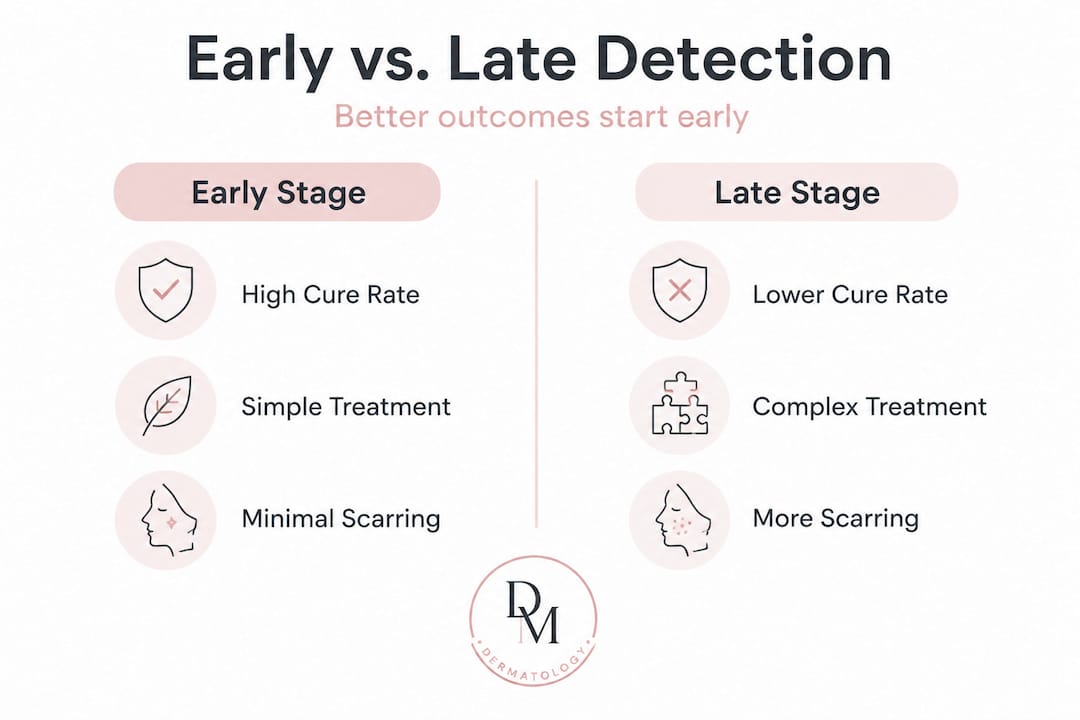
The difference in care pathways is striking. Explore the full range of skin cancer types and treatments to understand why staging matters so much at the point of first diagnosis.
What early detection delivers
- Higher survival rates: Melanoma caught at stage one has a five-year survival rate above 98%. At stage four, this drops to under 20%.
- Less invasive procedures: Early lesions rarely require radiotherapy, immunotherapy, or lymph node removal.
- Lower NHS and personal costs: Cost savings are significant when cancers are managed early rather than late.
- Preserved quality of life: Patients avoid prolonged treatment regimens, extended sick leave, and the psychological burden of advanced disease.
- Greater surgical choice: Early referral opens the door to tissue-sparing techniques like Mohs surgery.
Cost and outcome comparison
| Factor | Early-stage detection | Late-stage detection |
|---|---|---|
| Average NHS cost per patient | £11,200 | £23,800 |
| Typical surgical complexity | Low to moderate | High |
| Need for systemic therapy | Rare | Common |
| Likelihood of reconstruction | Low | High |
| Five-year survival (melanoma, stage 1 vs 4) | 98%+ | Under 20% |
“When skin cancer is detected early, the clinical and financial burden on both the patient and the NHS is dramatically reduced. Early intervention is the most effective tool we have.”
Learning to use the right early skin cancer detection methods is therefore not simply good health practice — it is one of the most consequential things you can do for your long-term wellbeing.
How can skin cancer be detected early in the UK?
Having understood why early detection makes such a difference, let’s see the practical ways it can happen for you.
Unlike cervical or bowel cancer, there is currently no national screening programme specifically for non-melanoma skin cancers in the UK. That places a significant responsibility on individuals to monitor their own skin and seek professional assessment promptly when something changes. Fortunately, the tools and pathways available are well established.
Five steps to earlier detection
- Learn the ABCDE rule: Originally developed for melanoma, the ABCDE rule (Asymmetry, Border, Colour, Diameter, Evolution) is a practical self-check framework. Any lesion that is asymmetrical, has an irregular border, shows multiple or changing colours, measures more than 6mm across, or has evolved recently warrants professional review.
- Perform monthly skin checks: Examine all sun-exposed areas including your face, scalp, neck, forearms, and hands at least once a month. Use a mirror for hard-to-see areas or ask a partner to help.
- Visit your GP promptly: Do not wait months to see whether something changes further. If you spot a new or changing lesion, book a GP appointment within days, not weeks. GPs are trained to assess skin lesions and can refer urgently when needed.
- Use the NHS two-week wait pathway: The NHS urgent referral system operates a two-week wait pathway for patients whose GP suspects cancer. This gets you in front of a specialist quickly. Understand how this process works via the NHS pathway guide.
- Consider private assessment if speed is essential: Private clinics can often offer a specialist appointment within days. This can be particularly valuable if your NHS waiting list is long or if you have multiple concerning lesions.
Pro Tip: Photograph any suspicious lesion with a ruler beside it and a neutral background. This lets you and your GP track evolution over time with objective evidence rather than memory.
NHS vs private detection pathways
| Pathway | Typical wait time | Cost to patient | Specialist access |
|---|---|---|---|
| NHS GP referral (two-week wait) | 2 weeks (urgent) | Free at point of care | Dermatologist or surgeon |
| NHS routine referral | 6 to 18 weeks | Free at point of care | Dermatologist |
| Private consultation | 1 to 5 days | £150 to £400+ | Specialist of your choice |
| Teledermatology (private) | Same day to 48 hours | £50 to £200+ | Remote specialist review |
Understanding the range of skin cancer types that exist helps you contextualise what you find during a self-check and communicate it accurately to your GP.
Cutting-edge tools: AI and dermoscopy in early diagnosis
Beyond the basics, technology is transforming how early detection actually happens.
Artificial intelligence (AI) is no longer a distant concept in dermatology. Right now, AI-based triage systems are actively reducing unnecessary referrals and speeding up diagnosis across parts of the NHS. One of the most prominent examples is DERM, an AI system that received conditional approval from the National Institute for Health and Care Excellence (NICE) for NHS use. By analysing clinical images of skin lesions, DERM helps primary care clinicians determine which patients need urgent specialist review and which can be safely monitored.
The implications are significant. Under conventional NHS pressures, dermatology waitlists have grown considerably. AI triage systems help redirect finite specialist time towards genuinely urgent cases, meaning those with real early-stage cancers get seen faster.
What AI and dermoscopy bring to the table
- Speed: AI tools can provide a triage decision within seconds from a clinical photograph.
- Accuracy: Current systems achieve sensitivity and specificity of approximately 84%, though further validation is needed — particularly for darker and more diverse skin tones.
- Teledermatology: Remote review of lesion images allows patients in rural or under-served areas to receive faster specialist input without travelling to a centre.
- Dermoscopy: When used by a trained specialist, a handheld dermoscope (a specialised magnifying device with polarised lighting) dramatically improves the naked-eye accuracy of lesion diagnosis. Structures invisible to the unaided eye become interpretable, allowing earlier and more confident identification of melanoma and non-melanoma skin cancers.
- Reduced unnecessary anxiety: When AI or teledermatology confirms a lesion is low risk, patients avoid unnecessary worry and invasive procedures.
Statistic: AI-based triage for skin lesions halves unnecessary referrals to secondary care in early evaluations, freeing specialist capacity for confirmed or high-risk cases.
Pro Tip: When visiting a private clinic, ask specifically whether the clinician uses dermoscopy. A specialist who photographs and examines your lesion with a dermoscope is providing a substantially more thorough assessment than a visual inspection alone.
It is important to stay realistic about what AI skin cancer detection can and cannot do. These tools are excellent at triage but they do not replace the nuanced clinical judgement of a trained specialist. If a suspicious lesion is identified, in-person specialist assessment remains essential.
Early detection and Mohs surgery: How they work together
Once a cancer is detected early, the next step is ensuring optimal removal and cure — most commonly through Mohs surgery in appropriate cases.
Mohs micrographic surgery is a specialised surgical technique in which a tumour is removed layer by layer, with each layer immediately examined under a microscope for remaining cancer cells. The surgeon only stops removing tissue once all margins are confirmed clear. This makes Mohs surgery extraordinarily precise, preserving as much healthy tissue as possible while ensuring complete cancer removal.
How Mohs surgery works step by step
- Local anaesthetic is administered: The area around the tumour is numbed. Mohs is performed as a day procedure in most cases, without general anaesthetic.
- The first layer is removed: A thin disc of tissue including the visible tumour is excised.
- Immediate histological analysis: The tissue is processed and examined under a microscope while you wait. This can take one to two hours per stage.
- Any remaining cancer is mapped precisely: If cancer cells remain at any margin, that exact location is marked on a map of the wound.
- Further layers are removed only where needed: The surgeon removes tissue from only the areas where cancer cells were detected, not the entire wound margin.
- Confirmation of clear margins: The process repeats until no cancer remains, then reconstruction of the wound begins.
The cure rate for Mohs surgery for primary BCC is approximately 99%, and for recurrent BCC around 94%. These are among the highest cure rates of any skin cancer treatment available.
“Mohs micrographic surgery offers the highest cure rates for high-risk basal cell and squamous cell carcinomas, while preserving the maximum amount of healthy tissue. It is particularly valuable for cancers on the face, ears, nose, and eyelids.”
Early detection is what makes Mohs surgery most effective. A smaller tumour detected promptly requires fewer stages, results in a smaller wound, and typically allows for simpler reconstruction. Conversely, a large or neglected tumour may require multiple Mohs stages, significant tissue removal, and complex reconstructive procedures. If you are wondering whether Mohs is appropriate for your situation, the detailed guide on choosing Mohs for facial cancers is a useful starting point.
The real reason early action matters: Facts most overlook
After all the evidence, here is what clinical experience truly highlights — and what many patients and even some GPs underestimate.
The assumption that minor-looking lesions are harmless is one of the most dangerous beliefs in skin health. A lesion the size of a grain of rice, slightly pink, slightly crusty, present for three months — this is the description of scores of early BCCs that go unchecked because the person thought it was just a dry patch or a minor irritation. By the time the same lesion has grown to a centimetre and begun to ulcerate, the surgical complexity has multiplied significantly.
The patients who most commonly present with advanced skin cancer are not those who ignored a dramatic, alarming growth. They are people who noticed something subtle and convinced themselves it was nothing. That psychological hurdle — the discomfort of taking something seriously that feels minor — is where early detection most often fails.
Self-checks and prompt GP reviews should not be reserved for people with obvious risk factors like very fair skin, a history of sunburn, or outdoor occupational exposure. Many BCCs occur in people who would not consider themselves high risk. Routine vigilance is for everyone.
The NHS system is genuinely robust once you enter it at the right point. Delays in seeking care make simple cures less likely and place a greater burden on the system that ultimately tries to help you. The most effective patients are those who act promptly, describe their concerns clearly, push for urgent referral if they feel it is warranted, and seek expert guidance for high-risk cases without apologising for doing so.
In clinical practice, we rarely hear patients say they wish they had waited longer. The regret almost universally runs the other way.
Ready for expert early detection and Mohs surgery advice?
If you or someone you know may be facing a suspicious skin lesion or a recent skin cancer diagnosis, getting specialist input early is genuinely the most important step you can take.
At mohssurgeon.co.uk, Miss Rakhee Nayar brings rare dual training in both plastic surgery and Mohs micrographic surgery. That means you receive not just expert cancer removal but considered attention to reconstruction and aesthetic outcome from the same specialist. Whether you are seeking clarity on a new lesion or considering your surgical options after a diagnosis, the team of skin cancer detection experts can guide you through every step. You can also learn more about what the procedure involves via the full Mohs surgery overview. Private consultations and e-consultations are available, with fast access for patients across the UK and internationally.
Frequently asked questions
How often should I check my skin for signs of cancer?
Check all your skin, especially sun-exposed areas, every one to two months using the ABCDE rule. Any new or changing lesion should prompt a GP visit within days rather than weeks.
Can AI or apps fully replace a dermatologist for skin cancer diagnosis?
AI tools help triage suspicious lesions and reduce unnecessary referrals, but AI-based systems do not replace specialist clinical assessment where cancer is genuinely suspected. Always seek in-person review for lesions that concern you.
Is Mohs surgery always the best option for skin cancer?
Mohs micrographic surgery is recommended for high-risk, recurrent, or cosmetically sensitive skin cancers, particularly on the face, but not every lesion requires it. Your specialist will assess which approach is most appropriate for your specific case.
Are all suspicious skin lesions referred urgently on the NHS?
Lesions that raise a reasonable suspicion of cancer are referred via the two-week wait pathway under NHS guidelines. If your GP does not offer an urgent referral and you remain concerned, you are entitled to ask for one or seek a private second opinion.