TL;DR:
- Mohs micrographic surgery offers high cure rates of 97–99% for skin cancers like BCC and SCC but carries a small recurrence risk, especially within two to five years after treatment. Regular follow-up and vigilant monitoring for signs of recurrence are essential, as microscopic residual cells can cause cancer to return despite precise surgical techniques. Recognizing risk factors such as tumor location, size, and previous recurrence helps tailor surveillance and improve long-term outcomes.
Mohs micrographic surgery is widely regarded as the most precise technique for removing basal cell carcinoma (BCC) and squamous cell carcinoma (SCC), achieving 97–99% cure rates for these common skin cancers. Yet many patients leave the operating theatre believing their cancer is gone for ever. That assumption, while understandable, can lead to a dangerous complacency. A small but real possibility of recurrence exists even after technically flawless surgery, and understanding that risk is one of the most important things you can do for your long-term health. This article explains exactly what recurrence means, who faces the greatest risk, and what your options are if cancer returns.
Key Takeaways
| Point | Details |
|---|---|
| Recurrence is possible | Even with expert surgery, some skin cancers can return—vigilance is key. |
| Mohs offers high cure rates | Mohs surgery provides the best chances against recurrence for most patients. |
| Risk varies by patient | Factors like immune status, tumour location, and cancer type affect recurrence risk. |
| Early action matters | Spotting and reporting changes early means the best chance for successful treatment. |
| Follow-up is essential | Regular checks with your specialist are vital to catch any recurrence early. |
What does skin cancer recurrence mean?
Recurrence, in simple terms, means cancer has come back after it was treated. For skin cancers like BCC and SCC, this usually means new tumour growth at or very close to the site of your original surgery. It is not the same as a brand-new, unrelated skin cancer appearing elsewhere on your body, though that is also a possibility you need to monitor for separately.
There are two broad types of recurrence worth knowing about:
- Local recurrence: Cancer grows back at or immediately adjacent to the original surgical site, often because a small number of cancerous cells survived treatment.
- Regional or distant recurrence: Cancerous cells spread to nearby lymph nodes or, in rare cases, distant organs. This is far less common with BCC and SCC but is a recognised risk with more aggressive tumour subtypes.
One of the most persistent misconceptions patients carry is that a clean margin report means zero future risk. A clear margin report is genuinely excellent news, but it reflects the state of the tissue at a single moment in time. Microscopic clusters of cells can occasionally lie just beyond the sampled tissue, or small islands of tumour may exist deeper in the skin than the surgery reached.
“Most recurrences in skin cancer occur within two to five years of treatment, though some patients experience recurrence up to ten years later.”
This timeline matters enormously. It means your follow-up appointments are not simply a formality. They are your primary safety net during the period when recurrence is statistically most likely to show up.
How common is recurrence after Mohs surgery?
Mohs surgery is considered the gold standard for treating BCC and SCC precisely because of its exceptional success rates. The procedure involves removing tissue in thin layers, immediately examining each layer under a microscope, and continuing until no cancerous cells remain. This real-time tissue mapping makes it far more thorough than standard excision.
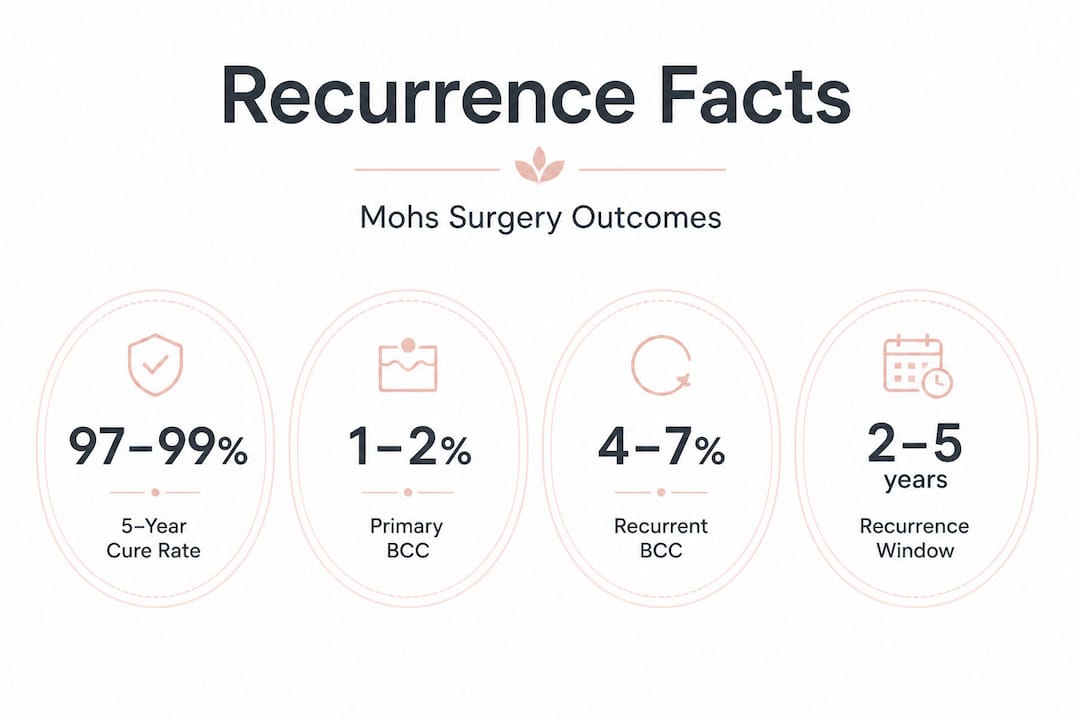
The numbers are genuinely reassuring. Five-year cure rates for BCC and SCC with Mohs consistently sit between 97% and 99%. To put that another way, out of 100 patients treated with Mohs for a primary (never previously treated) BCC, only one or two are likely to experience recurrence within five years.
Mohs surgery vs standard excision: recurrence rates
| Tumour type | Mohs surgery recurrence rate | Standard excision recurrence rate |
|---|---|---|
| Primary BCC | 1–2% | 5–8% |
| Recurrent BCC | 5–6% | 17–19% |
| Primary SCC | 3–5% | 8–10% |
| Recurrent SCC | 10–15% | Up to 23% |
The table above illustrates something critical: recurrence rates are notably higher when treating tumours that have already come back once. This is precisely why your first treatment decision matters so much. Choosing the most effective surgical approach from the outset gives you the best possible odds.
Most recurrences appear within two to five years of surgery, with the highest concentration in the first three years. This does not mean you can relax entirely after year five, but it does mean that your early post-surgical follow-up appointments carry the greatest diagnostic weight.

Pro Tip: Even if your Mohs surgery was entirely successful, commit to every follow-up appointment without exception. The small window between early recurrence and a more advanced return of disease is where regular surveillance makes an enormous difference. Read our Mohs surgery recovery tips to understand what to monitor at home between clinic visits.
Risk factors for cancer coming back
Understanding how frequently recurrences happen leads naturally to recognising the risk factors that make some situations more challenging than others. Not every patient carries the same level of risk after Mohs surgery, and being aware of what places you in a higher-risk category helps you and your care team make smarter surveillance decisions.
Factors that increase recurrence risk include:
- Tumour location: Cancers on the face, particularly around the nose, eyes, ears, and lips, sit in anatomically complex areas. These sites carry a greater risk of incomplete removal and, consequently, recurrence. If you had facial skin cancer removed, understanding why Mohs is favoured for these locations is genuinely valuable context.
- Tumour size: Larger tumours, particularly those over 2cm, are associated with a higher likelihood of recurrence, partly because they may have sent microscopic extensions further into surrounding tissue.
- Tumour depth and subtype: Morphoeic (also called infiltrative or sclerosing) BCC and poorly differentiated SCC behave more aggressively and are harder to clear fully, even with Mohs.
- Margin status: If previous surgery used standard excision and achieved only narrowly clear or uncertain margins, residual cells may persist. The difference between Mohs and standard surgical excision in this regard is substantial.
- Previous recurrence: A tumour that has already recurred once is biologically more difficult to treat. The recurrence rates for previously treated BCC and SCC are significantly higher than for primary lesions, as the table above demonstrates.
“Meta-analyses confirm that Mohs is superior to standard excision for high-risk skin cancers, yet immunosuppressed patients face elevated recurrence rates even after Mohs surgery due to impaired immune surveillance.”
This point about immune status deserves particular attention. Patients who take long-term immunosuppressive medication following organ transplantation, those living with HIV, or those receiving chemotherapy face a meaningfully higher risk of both new skin cancers and recurrence. Their immune systems are less able to recognise and destroy residual cancer cells.
Pro Tip: If you are immunosuppressed or had a tumour on a cosmetically sensitive area of the face, discuss an individualised surveillance plan with your specialist rather than relying on standard follow-up intervals. The one-size-fits-all approach is genuinely insufficient for high-risk patients.
What to expect if your skin cancer returns
Armed with an understanding of the risks, let us look at what happens if recurrence does occur, and how to tackle it with clarity and confidence rather than panic.
Signs of recurrence to watch for near your scar:
- A new lump, nodule, or thickening within or around the scar tissue
- Persistent redness, scaling, or crusting that does not heal within three to four weeks
- A sore or ulcer that bleeds easily or refuses to close
- Visible changes in the texture of the scar itself, including areas that feel unusually firm or irregular
- Itching, burning, or tenderness at the original site without an obvious cause
If you notice any of these, do not wait for your next scheduled appointment. Contact your specialist promptly. Earlier detection consistently leads to simpler, less extensive treatment and better cosmetic outcomes, particularly on the face.
The diagnostic process typically involves a clinical examination, followed by a biopsy of any suspicious tissue. The biopsy result determines whether recurrence has occurred and, if so, what type of tissue is involved. This information directly shapes the treatment plan.
Treatment options for recurrent skin cancer include:
- Repeat Mohs surgery: This remains the first-choice treatment for most recurrent BCC and SCC cases, particularly on the face and other complex sites. Recurrent tumours treated with Mohs still achieve meaningfully better outcomes than those treated with simple re-excision.
- Wide local excision: For tumours in areas where the cosmetic and functional risks of Mohs are lower, this remains a viable option, particularly when combined with careful histological analysis of margins.
- Radiotherapy: Used when surgery is not suitable, either because of the patient’s general health, or because the tumour is in a location where further surgery would cause unacceptable functional loss.
- Systemic or targeted therapies: For advanced or metastatic cases of SCC, immunotherapy agents such as cemiplimab have shown significant effectiveness. Hedgehog pathway inhibitors are used for advanced BCC that is not suitable for surgery or radiotherapy.
It is also worth acknowledging the emotional dimension of a recurrence. Many patients describe feelings of shock, frustration, and anxiety when cancer returns, even if they were intellectually aware of the possibility. These responses are entirely valid. Connecting with practical support resources and speaking openly with your care team about your concerns are both important steps in navigating this well.
66% of recurrences appear within the first three years post-treatment, which underscores why the early surveillance period is so critical. Knowing this, rather than fearing it, puts you in a far stronger position.
A specialist’s view: what most guides don’t tell you about recurrence
Most articles on this subject stop at statistics and risk factors. What they rarely address is the psychological pattern that clinical experience reveals repeatedly: patients who receive a clear margin report often disengage from follow-up precisely at the moment when ongoing surveillance matters most.
This is understandable. The relief that follows successful surgery is enormous, and returning to clinic feels like revisiting an anxiety most people would rather leave behind. But this is exactly the kind of false sense of security that allows early recurrences to become more advanced ones.
There is another uncomfortable truth worth stating clearly. No surgical technique, however precise, can guarantee zero recurrence. Mohs surgery removes everything that is visible and microscopically identifiable at the time of the procedure. What it cannot do is account for every microscopic cell that might exist beyond that moment. This is not a flaw in the technique; it is a biological reality of cancer. The myths surrounding Mohs often include the idea that it is an absolute guarantee, and dispelling that myth is an act of care, not pessimism.
What genuinely changes outcomes is not a single perfect surgery but the sustained relationship between a patient and their specialist over years. Patients who ask questions, report changes promptly, and attend every review appointment consistently achieve better outcomes than those who do not, regardless of their initial surgical result. Open, ongoing communication with your clinical team is, in practical terms, the most powerful tool you have after surgery.
The goal is informed vigilance, not fear. Understanding what to watch for, knowing who to contact, and trusting that early-detected recurrences are almost always treatable transforms recurrence from a source of dread into something far more manageable.
How Mohs surgery expertise supports your journey
With a clearer understanding of recurrence, you may wish to explore what true specialist-led care can offer at every stage, from initial diagnosis through to long-term surveillance.

Miss Rakhee Nayar combines dual expertise in plastic surgery and Mohs micrographic surgery to deliver precisely the kind of personalised, high-quality care that complex skin cancers demand. Whether you are seeking a detailed explanation of what Mohs involves, exploring specialist Mohs services for the first time, or looking for guidance after a recurrence, this clinic provides evidence-based assessment and treatment tailored to your specific circumstances. For a step-by-step understanding of what your treatment journey may look like, the basal cell removal guide is an excellent starting point. Private consultations and e-consultations are available for patients across the UK and internationally.
Frequently asked questions
How do I know if my skin cancer has come back?
Watch for new lumps, persistent redness, non-healing sores, or changes in texture near the original scar, and contact your specialist promptly if you notice anything unusual rather than waiting for a routine appointment.
What is the chance of recurrence after Mohs surgery?
The risk is low, typically around 1–3% within the first five years, but it varies according to tumour type, location, and individual patient factors. Five-year cure rates with Mohs for BCC and SCC consistently reach 97–99%.
How soon does recurrence usually occur?
Most recurrences appear within two to five years of treatment, with the majority in the first three years, though occasional late recurrences can appear up to ten years afterwards.
Can a recurrence always be treated with Mohs surgery again?
Repeat Mohs surgery is suitable for most recurrent cases, particularly on the face and other high-risk sites, though the final decision depends on cancer type, location, and the specifics of your previous treatment.
Does a recurrence mean my cancer is more dangerous?
Not necessarily. Many recurrences are identified at an early stage and treated very successfully, especially when patients maintain consistent follow-up and report any changes to their skin promptly.