
TL;DR:
- Not all skin cancer surgeries are equally effective, with Mohs offering more precise margin control than standard excision. Mohs involves staged, same-day microscopic examination, leading to higher cure rates and smaller scars, especially for high-risk or facial tumors. Selecting the appropriate procedure depends on tumor location, risk factors, and individual priorities, making personalized consultation crucial.
Not all skin cancer surgeries are the same, and assuming they are could cost you in ways you won’t see coming until it’s too late. If you’ve been diagnosed with a basal cell carcinoma (BCC) or squamous cell carcinoma (SCC), the surgical route your team recommends will directly affect your cure rate, the size of your scar, and how quickly you get that all-important confirmation that the cancer is gone. This article breaks down the real differences between Mohs micrographic surgery and standard excision, so you can walk into your next consultation informed, confident, and ready to ask the right questions.
Key Takeaways
| Point | Details |
|---|---|
| Margin control | Mohs surgery checks tissue edges during the operation, offering same-day margin certainty and reducing need for repeat procedures. |
| When Mohs is needed | Mohs is reserved for high-risk, recurrent, or cosmetically and functionally sensitive skin cancers where precision matters most. |
| Recurrence rates | Studies indicate Mohs has lower recurrence rates in high-risk cases, but both methods are effective when correctly indicated. |
| Cosmetic outcomes | Mohs is generally more tissue-sparing, leading to smaller scars in sensitive sites, yet standard excision can also produce good aesthetic results. |
| Practical considerations | Mohs typically takes longer and may have longer waiting lists than standard excision, requiring careful planning. |
How Mohs and standard excision actually work
To begin, let’s break down what actually happens during each type of surgery, because the mechanical differences explain almost everything else that follows.
Mohs micrographic surgery differs from standard excision mainly in how surgical margins are assessed during the operation. In plain terms, a Mohs surgeon removes a thin layer of tissue, maps it precisely, and then immediately examines 100% of the cut edges under a microscope while you wait in the clinic. If cancer cells remain, another targeted layer is taken, only from the area where the cells were found. This continues, stage by stage, until the margins are clear. Because Mohs is best understood as an intraoperative, stage-by-stage tumour mapping process, you receive same-day confirmation that the cancer is fully removed.
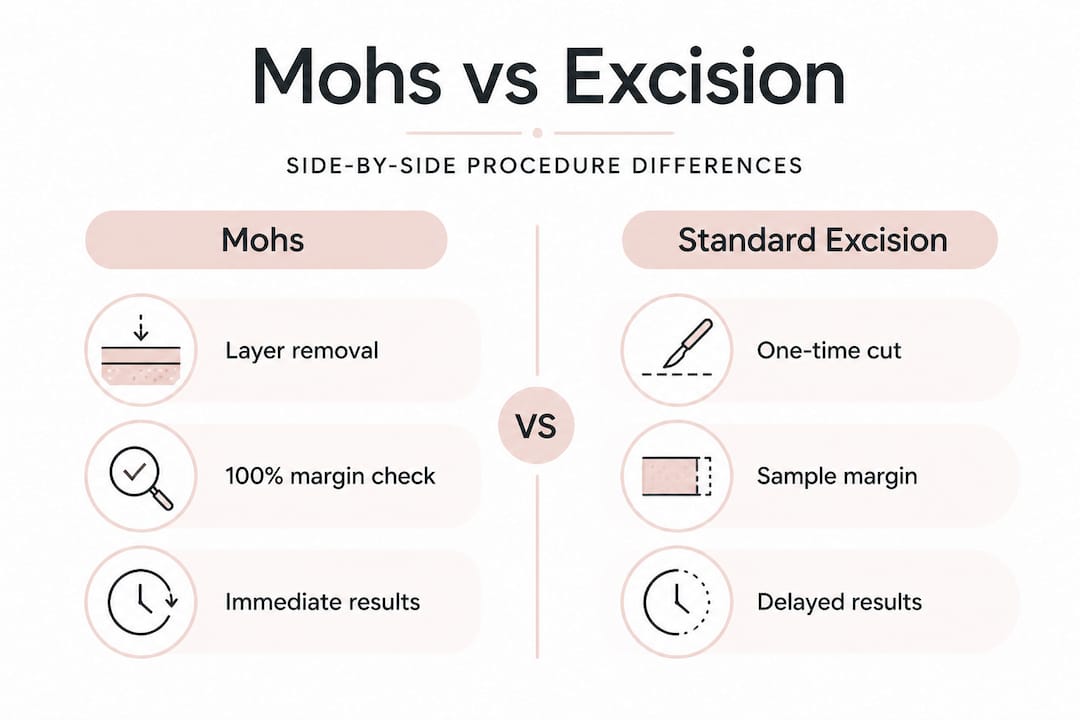
Standard excision works quite differently. The surgeon removes the visible tumour along with a predetermined margin of healthy tissue around it, typically two to four millimetres for low-risk lesions and wider for higher-risk ones. That tissue is then sent to a pathology laboratory for analysis, which usually takes several days. Only after those results return will you know whether the margins were clear or whether a second operation is needed. You can read more about the surgical excision details to understand how this process is managed in practice.
What patients typically experience with each approach:
- Mohs surgery: Arrive in the morning, have an initial layer removed under local anaesthetic, wait while the tissue is processed (often one to two hours), receive results and, if needed, have further layers removed. Reconstruction of the wound happens the same day once clear margins are confirmed.
- Standard excision: Shorter appointment, wound closed on the day, no same-day microscopy. Wait several days for pathology. If margins are involved, a return visit and further surgery is needed.
| Feature | Mohs surgery | Standard excision |
|---|---|---|
| Margin checking | 100% intraoperative | Selected sample, post-op lab |
| Result timing | Same day | Several days later |
| Session length | Half a day or more | Often 30 to 90 minutes |
| Tissue removed | Minimal (only affected areas) | Fixed predetermined margin |
| Number of stages | Variable, as needed | Typically one stage |
| Wound closure | Same day after clear margins | Same day (before results) |
The key insight here is precision. Standard excision uses a “bread loaf” sampling method in the lab, meaning only cross-sections of the specimen edges are examined, not every millimetre of margin. Mohs examines the entire peripheral and deep margin, making it far harder for even a small cluster of stray cancer cells to slip through undetected.
When Mohs is recommended over standard excision
Understanding the procedures, let’s examine when each is genuinely recommended and when not, because the choice is rarely arbitrary.
Mohs is commonly recommended for cases where standard excision can be less reliable, for example ill-defined borders, higher-risk or recurrent tumours, or sites where tissue preservation is important. Guidelines emphasise that Mohs is reserved for tumours where tissue-sparing or precise margin control is genuinely crucial to the outcome, not for every skin cancer presenting in clinic.
Key clinical criteria that tend to favour Mohs over standard excision:
- Location on the face or scalp — particularly around the eyes, nose, lips, and ears, where removing extra tissue has a visible and functional cost.
- Ill-defined tumour borders — when you cannot clearly see where the cancer ends and healthy skin begins under normal examination.
- Recurrent tumours — a BCC or SCC that has returned after a previous treatment carries a higher risk of spread along scar tissue planes.
- Aggressive tumour subtypes — morphoeic or infiltrative BCCs, for example, tend to send microscopic extensions well beyond their visible edge.
- Large tumours — where the extent of spread is uncertain before surgery begins.
- Immunocompromised patients — people on immunosuppressive medication or with conditions affecting immune function face higher risk if residual cancer remains.
- Tumours near critical structures — such as nerves, tendons, or the eyelid margin, where every millimetre of preserved tissue matters for function.
In contrast, a small, well-defined BCC on the back or a low-risk SCC on the arm is typically treated well with standard excision. The cure rates in those cases are very good and the added complexity of Mohs is not warranted. For more guidance on the particular challenges of Mohs for facial tumours or understanding what constitutes a high-risk skin cancer case, those resources go into further detail.
Pro Tip: Before your consultation, write down three things: where your tumour is located, whether it has been treated before, and which outcome matters most to you — cure certainty, cosmetic result, or speed of treatment. This gives your surgeon a clearer picture and prompts a more focused conversation about which approach fits your specific situation.
Consider two real-world patient scenarios to illustrate this. A person with a recurrent BCC on the nose tip has a tumour in a high-risk location with a history of incomplete removal, making Mohs the evidence-based choice. By contrast, a patient with a straightforward, small, well-defined nodular BCC on the upper arm is an excellent candidate for standard excision, with a swift appointment, good cosmesis, and no added benefit from Mohs-level precision.
Outcomes: cure rates, recurrence, and cosmetic results
Once you know which approach suits your diagnosis, it’s vital to consider how each stacks up for cure and long-term results.

Mohs often reports lower recurrence with non-melanoma skin cancer and has cosmetic results similar or superior to standard excision. For primary BCCs, five-year recurrence rates with Mohs are consistently reported below two percent, while standard excision sits around five to ten percent depending on tumour type and location. For recurrent BCCs, that gap widens further.
| Outcome measure | Mohs surgery | Standard excision |
|---|---|---|
| 5-year recurrence (primary BCC) | Under 2% | 5–10% |
| 5-year recurrence (recurrent BCC) | Around 5% | Up to 20% |
| Margin assessment completeness | 100% of margin | Sampled cross-sections only |
| Cosmetic outcome (facial) | Comparable or better | Good for low-risk sites |
| Same-day clearance confirmed | Yes | No |
These figures matter enormously for patients considering what Mohs surgery involves and how it differs from a routine excision in terms of long-term peace of mind. For cosmetic results, the picture is more nuanced than many assume.
Because Mohs removes the minimum necessary tissue to achieve clear margins, wounds tend to be smaller than they might be with a standard excision using a fixed wide margin. A smaller wound means a smaller reconstruction, and that generally means a better scar. However, cosmetic outcomes ultimately depend on the skill and experience of the surgeon who closes or reconstructs the wound. The best results arise when a surgeon with dual training in both Mohs and plastic surgery performs the procedure from start to finish, as this is where plastic surgery and Mohs outcomes become inseparable rather than sequential.
For tumours in cosmetically neutral sites such as the back, the two approaches often produce comparable visual results, and that is an important part of the clinical decision.
Practicalities: time, recovery, and access
Now let’s turn to what happens outside the operating theatre — the experience of actually receiving and recovering from each approach.
Mohs typically takes longer and may have longer waiting lists; standard excision is often less time-consuming and more readily available. Mohs requires a specialist with dual laboratory and surgical training, meaning fewer surgeons can offer it and clinic slots fill quickly. Standard excision is performed by a wider range of surgeons across NHS dermatology and plastic surgery departments, making it generally more accessible.
Practical comparison of what to expect:
- Mohs surgery: Plan for a half-day appointment, sometimes longer. Bring reading material, a charged phone, and something to eat. Local anaesthetic keeps you comfortable throughout. Wear loose clothing over the area being treated.
- Mohs recovery: Wound is closed on the day. Expect some swelling and bruising, particularly for facial procedures. Most patients return to desk-based work within a few days, with strenuous activity limited for two to three weeks.
- Standard excision: Appointments are typically shorter, often 30 to 90 minutes. Recovery is similar in duration but may involve a second procedure if margins are unclear.
- Standard excision recovery: Results take several days to come back, which many patients find emotionally taxing. If re-excision is needed, recovery effectively restarts.
Pro Tip: Use the waiting time before either procedure productively. Arrange any post-operative help you may need at home, prepare your workspace for a few days away from heavy lifting, and familiarise yourself with common myths versus facts about Mohs surgery so you arrive with realistic expectations rather than anxiety-driven assumptions. A thorough step-by-step guide to preparing for Mohs surgery can also take much of the guesswork out of the day itself.
“The most important thing is that patients receive surgery appropriate to their specific tumour, not simply the most technically sophisticated option available. Choosing the right procedure for the right lesion, in the right location, by a surgeon with the right expertise, is what produces the best outcomes.”
Recovery time across both approaches is broadly similar for straightforward cases. The emotional experience, however, differs considerably. Knowing your margins are clear before you leave the clinic is a significant advantage that many Mohs patients describe as transformative for their peace of mind.
A fresh perspective: choosing Mohs is not always a simple upgrade
Reflecting on the facts, let’s revisit what the research and experience truly suggest about decision-making, because the narrative that Mohs is simply a “better version” of standard excision misses something important.
Most studies indicate Mohs offers superior oncologic outcomes versus standard excision, but they also caution that standard excision remains effective for many lower-risk tumours and that the choice should be individualised rather than universally Mohs-for-all. This is a point that often gets lost when patients arrive having read enthusiastic online accounts of Mohs surgery.
From our perspective, the real danger lies in either extreme. Insisting on Mohs for a simple lesion that would do perfectly well with excision creates unnecessary demand on specialist services and may delay access for patients who genuinely need it. Conversely, using standard excision for a morphoeic BCC near the eye because it’s quicker or easier to access is a false economy that can result in a second, more complex surgery, more tissue loss, and a worse cosmetic outcome.
True personalised care means having an honest conversation about your specific tumour characteristics, your personal priorities, and the realistic capabilities of each surgical route. It also means recognising that combining Mohs with plastic surgical reconstruction — rather than treating them as separate specialties — consistently delivers the best functional and aesthetic results. Learning more about combining Mohs and plastic surgery helps patients understand why integrated expertise matters.
The most empowered patients are not those who arrive demanding one particular procedure. They are those who arrive with a clear understanding of what each method offers and the confidence to ask why one has been chosen over the other for their individual case.
Explore expert-led Mohs and standard excision care
If you’re ready to take the next steps or want expert guidance, these resources will help you feel confident in your choices.
Understanding the differences between procedures is only the first step. Getting the right treatment in the right hands makes all the difference for cure rates and how you look and feel afterwards.

Miss Rakhee Nayar combines specialist Mohs surgery training with reconstructive plastic surgery expertise, offering a uniquely integrated approach to skin cancer care in North West England. Whether you need a detailed Mohs explainer before committing to treatment, want to book a Mohs consultation to discuss your specific case, or are exploring your facial reconstruction options following skin cancer removal, expert, patient-centred support is available. Both in-person and e-consultations are offered, making specialist advice accessible whether you are based locally or further afield.
Frequently asked questions
Does Mohs surgery always result in a better cosmetic outcome?
Mohs often preserves more healthy tissue, which is beneficial for cosmetic results, but standard excision achieves good outcomes for many skin cancers, particularly those in non-facial or cosmetically straightforward sites.
Why is Mohs not used for all skin cancers?
Many skin cancers do very well with standard excision, and Mohs is specifically reserved for cases requiring extra precision, such as ill-defined, recurrent, or high-risk tumours where standard margins would be inadequate.
Is Mohs surgery more time-consuming for patients?
Yes. Mohs surgery can take half a day or longer per session, with waiting lists often longer than for standard excision because fewer specialists can offer it and fewer cases can be completed in a single day.
How quickly can I know if the cancer is fully removed with each method?
With Mohs, the cut edges are checked under a microscope the same day, whereas with standard excision, tissue is sent to a pathology laboratory and results typically take several days to return.
Are recurrence rates definitely lower with Mohs?
For high-risk or complex tumours, most studies show Mohs is more favourable for recurrence-free survival, though both methods perform well for the appropriate patient with the right tumour characteristics and location.
Recommended
- Why choose Mohs surgery for facial skin cancer removal?
- Step-by-step basal cell removal: your Mohs surgery guide
- Surgical excision for skin cancer: treatment & reconstruction
- Mohs surgery myths vs facts: what patients need to know
Filed under Mohs Surgery