TL;DR:
- Reconstruction after skin cancer removal restores facial function, appearance, and psychological well-being.
- Skilled reconstruction begins immediately post-Mohs surgery, tailored to defect size, location, and patient needs.
- Proper aftercare and realistic expectations are essential for optimal healing and long-term results.
Getting a skin cancer diagnosis and undergoing removal can feel like crossing the finish line. But for many patients, particularly those treated on the face, the journey is far from over. Reconstruction after Mohs surgery is not a cosmetic luxury. It is a vital part of restoring the face you recognise, the functions you rely on, and the confidence that cancer treatment can quietly erode. This guide walks you through why reconstruction matters, what your options are, and what healing actually looks like so you can make truly informed decisions at every stage.
Key Takeaways
| Point | Details |
|---|---|
| Restoration is vital | Reconstruction after skin cancer is crucial for restoring function and appearance, especially for facial areas. |
| Options are tailored | Surgical techniques are chosen based on your individual needs, defect size, and facial location. |
| Recovery involves support | Emotional and physical recovery is a process—specialist care and guidance make a significant difference. |
| Preparation matters | Discussing reconstructive plans early leads to the best possible outcome for healing and confidence. |
Why reconstruction is essential after skin cancer removal
Skin cancer does not respect boundaries. It appears most frequently on the face, scalp, nose, ears, and lips because these areas receive the highest cumulative sun exposure across a lifetime. When reconstruction after cancer surgery guidance is overlooked, the results can go well beyond a visible scar. Skin cancer removal can leave facial defects that affect both appearance and vital functions, including breathing, blinking, eating, and speaking.
Think about what the face actually does. It is not just about looking in the mirror. Eyelids protect your eyes from infection. The nose shapes your airflow. Lips form words and control how you eat. A surgical defect in any of these areas, left without reconstruction, can lead to functional problems that worsen over time as the wound heals with natural contraction.
The psychological dimension is just as real. Research consistently shows that visible facial changes following cancer treatment are among the leading drivers of anxiety, social withdrawal, and reduced quality of life in patients. Minimising scarring after removal through skilled reconstruction is not vanity. It is sound clinical practice.
Here is what most people miss about post-surgical healing:
- Wounds left to heal on their own often contract, potentially distorting surrounding tissue
- Scar tissue behaves differently from healthy skin and can tighten over months
- Without reconstruction, facial asymmetry can develop gradually and become harder to correct later
- Emotional distress from visible facial changes can significantly delay overall recovery
| Factor | Without reconstruction | With expert reconstruction |
|---|---|---|
| Functional risk | High (especially near eyes, nose, lips) | Substantially reduced |
| Scarring | Often irregular, contracted | Planned, minimised |
| Emotional recovery | Slower, more complicated | Supported by improved appearance |
| Long-term correction | More complex and costly | Often avoided with early action |
Pro Tip: Ask your surgeon about reconstruction before the cancer removal procedure. The two are often planned together, and understanding your options in advance reduces anxiety on the day.
Learning about Mohs micrographic surgery before your procedure helps you ask the right questions at your consultation and arrive prepared.
How reconstructive surgery works after Mohs micrographic surgery
Mohs micrographic surgery offers clear margin control but often necessitates reconstructive closure, because its precision means surgeons remove only what is diseased, leaving a wound that needs careful repair. This is actually a significant advantage. Unlike wide excision, Mohs preserves as much healthy tissue as possible, giving the reconstructive surgeon the best possible starting material to work with.
Understanding the patient journey helps remove uncertainty:
- Pre-operative consultation: Your surgeon discusses likely defect size, location, and which reconstruction method best suits your anatomy and lifestyle
- Cancer removal: Mohs layers are removed and checked under the microscope while you wait, ensuring complete clearance before closure
- Reconstructive planning: Once margins are confirmed clear, the reconstruction is planned based on the final defect
- Closure or reconstruction: This may happen the same day or at a planned follow-up, depending on complexity
- Post-operative recovery: Wound care, follow-up appointments, and scar management begin
- Long-term review: Scar maturation takes up to 18 months, and your surgeon monitors progress throughout
The NHS Mohs surgery service provides a useful overview of what the removal process involves, though reconstructive options vary widely between providers.
| Reconstruction method | Best for | Healing time |
|---|---|---|
| Primary closure | Small defects with flexible surrounding skin | 1 to 2 weeks |
| Local skin flap | Medium defects on the face | 2 to 4 weeks |
| Skin graft | Larger or awkward-shaped defects | 3 to 6 weeks |
| Secondary intention | Small, well-positioned defects | 4 to 8 weeks |
Reviewing the full treatment and reconstruction steps helps you understand how seamlessly removal and reconstruction can connect when managed by a surgeon trained in both disciplines.
Pro Tip: Ask specifically whether your surgeon has dual training in both cancer removal and plastic reconstruction. A surgeon who performs both steps in one session can make real-time decisions that optimise your aesthetic result while ensuring oncological safety.
Do also review the essential follow-up steps after your procedure so you know what to expect at each stage.
Comparing reconstructive options: Flaps, grafts, and more
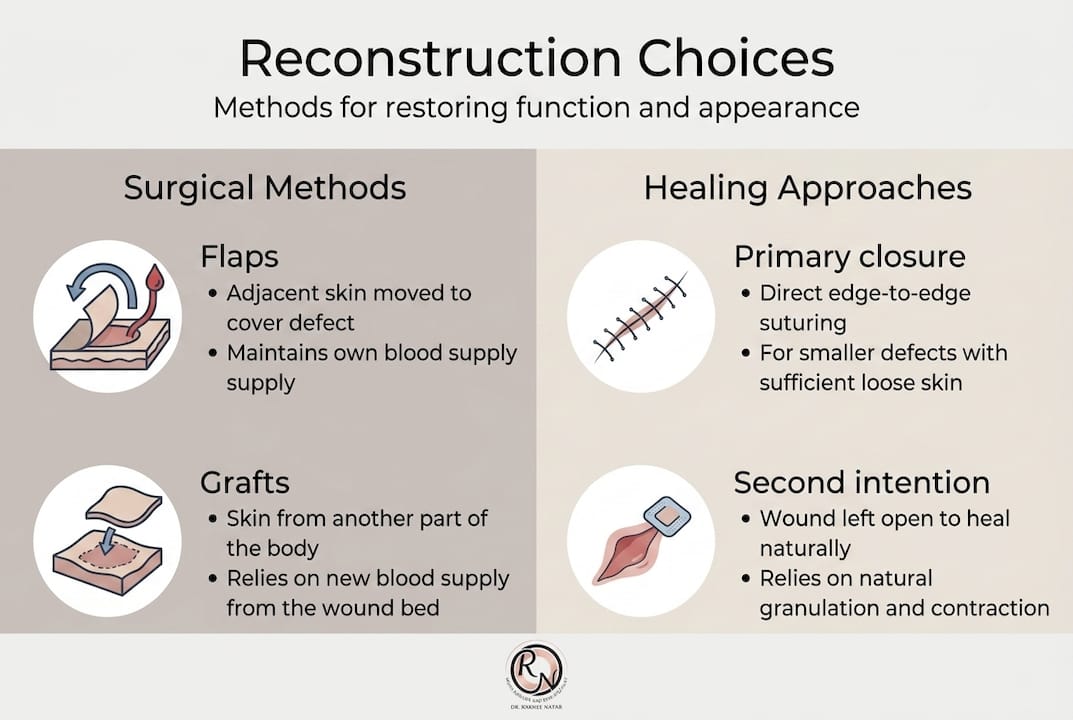
Choice of reconstructive technique depends on the size and location of the defect, along with the patient’s general health, skin quality, and personal priorities. There is no single best method. Understanding the key options helps you have a more productive conversation with your surgeon.
Local skin flaps involve moving nearby skin and its underlying blood supply to cover the wound. Because the tissue comes from an adjacent area, it tends to match the colour and texture of the treated site well. This makes flaps particularly well suited to facial reconstruction, where matching skin tone matters enormously. The trade-off is a slightly more complex procedure with additional incisions, though these are typically planned within natural skin creases to minimise visibility.
Skin grafts use skin taken from a donor site elsewhere on the body, often behind the ear or on the upper arm, and placed over the wound. Grafts are particularly useful for larger or awkwardly shaped defects where there is not enough adjacent tissue for a flap. They are reliable and effective, though the colour match is sometimes less precise than a flap, and the donor site requires its own healing.
Healing by secondary intention means allowing the wound to close naturally without surgical closure. This is appropriate only for small defects in specific locations, such as certain areas of the nose or temple, where natural healing tends to produce a good result. It requires diligent wound care and patience, but avoids additional surgical procedures.
For a thorough explanation of each approach, the flaps and grafts patient information from the British Association of Dermatologists is an excellent resource.
| Method | Colour match | Complexity | Ideal location |
|---|---|---|---|
| Local flap | Excellent | Moderate to high | Most facial areas |
| Skin graft | Good to fair | Moderate | Large or complex defects |
| Secondary intention | Variable | Low | Selected small sites |
| Primary closure | Excellent | Low | Small, flexible-skin areas |
Key considerations your surgeon will weigh include:
- Defect size and depth
- Proximity to functional structures such as eyelids, nostrils, or the mouth
- Your skin’s elasticity and overall health
- Your healing history, including any tendency to form thickened scars
Review your guide to reconstruction options to see illustrated examples and read about typical outcomes for different facial areas.
What to expect: Healing, outcomes, and life after reconstruction
Proper aftercare and realistic expectations help patients achieve the best surgical and emotional outcome. Knowing what is normal versus what needs attention makes recovery far less stressful.

In the first two weeks, swelling, bruising, and mild discomfort are entirely typical. Wounds may look worse before they look better, which surprises many patients who expect immediate improvement. Stitches are usually removed between five and fourteen days, depending on the site. The area may feel tight or itchy as new tissue forms beneath the surface.
Over the following months, scar maturation occurs gradually. Most scars reach their final appearance between twelve and eighteen months after surgery. During this period, the scar typically softens, flattens, and fades. Modern silicone gels, sun protection, and massage techniques all contribute to better long-term results.
“Reconstruction after skin cancer gave me back more than my appearance. It gave me back my confidence to face people again.” Patient perspective shared with clinical permission.
Key tips for the best possible outcome:
- Keep the wound clean and moist during the early healing phase
- Protect the scar from sun exposure for at least 12 months using SPF50 sunscreen
- Attend all follow-up appointments so your surgeon can monitor healing
- Avoid smoking, which significantly impairs wound healing and scar quality
- Seek help early if you notice any signs of wound breakdown or infection
Useful recovery tips cover the practical side of post-operative care in detail. For emotional support throughout the process, Macmillan’s reconstruction guidance is a compassionate and practical resource. You should also familiarise yourself with the recommended follow-up steps to stay on track throughout recovery.
A fresh perspective: Why reconstruction is more than just cosmetic
There is a stubborn misconception that reconstruction after skin cancer is about vanity. Patients sometimes feel they should simply be grateful the cancer is gone and not worry about how they look. That view, however well-intentioned, underestimates what the face means to a person’s sense of self, their ability to engage with the world, and their long-term wellbeing.
Clinically, reconstruction protects function. Personally, it restores identity. The two are inseparable. Patients who decline reconstruction out of a sense of obligation to minimalism often face compounding difficulties later, from functional problems caused by wound contracture to psychological struggles that are harder to address once entrenched.
The conversation around expert insight on facial reconstruction has matured enormously. We now understand that asking for reconstruction is not self-indulgence. It is self-advocacy. A healed face, one that looks and works as it should, is the foundation on which everything else in recovery is built. You deserve that foundation.
Expert support and your next steps
If you are facing reconstruction after Mohs surgery, expert guidance makes an enormous difference to the outcome you achieve. Knowing which technique is right for your specific defect, anatomy, and lifestyle takes experience and dual training in both oncological removal and plastic repair.

At mohssurgeon.co.uk, Miss Rakhee Nayar brings precisely that combination to every patient she sees. You can explore facial reconstruction options in detail, read about advanced facial treatments available at the clinic, and review reconstruction patient stories to understand what others have experienced. Private consultations and e-consultations are available across the UK and for international patients. Taking that next step is straightforward, and the conversation is always focused on what is best for you.
Frequently asked questions
Is reconstructive surgery always required after skin cancer removal?
Not every case requires reconstruction, but procedures on the face or larger areas often benefit from it to restore both function and appearance. Choice depends on location and size of the defect, which your surgeon will assess carefully.
How soon after Mohs surgery can reconstruction be performed?
Reconstruction is typically completed immediately after cancer removal, sometimes within the same surgical session. Mohs facilitates immediate closure once clear margins are confirmed, making same-day reconstruction both safe and common.
Will there be visible scarring after reconstruction?
Most patients experience some scarring, but skilled technique and good aftercare significantly minimise its appearance. Proper techniques help reduce scars and modern scar management options continue to improve outcomes over time.
Does reconstructive surgery affect cancer recurrence?
No, reconstruction does not increase recurrence risk when cancer margins are confirmed clear before closure. Safety is ensured by the margin-controlled nature of Mohs surgery, which verifies complete removal before any reconstruction begins.
Recommended
- Reconstruction After Mohs Surgery | Natural Results
- Surgical excision for skin cancer: treatment & reconstruction
- How to minimise scarring after skin cancer removal
- Essential follow-up steps after skin cancer treatment
Filed under Facial Reconstruction