TL;DR:
- Mohs surgery provides real-time microscopic examination ensuring complete cancer removal before wound closure.
- It preserves maximum healthy tissue, leading to better functional and cosmetic outcomes on the face.
- Ideal for high-risk, recurrent, or ill-defined facial tumors, offering high cure rates and precise reconstruction.
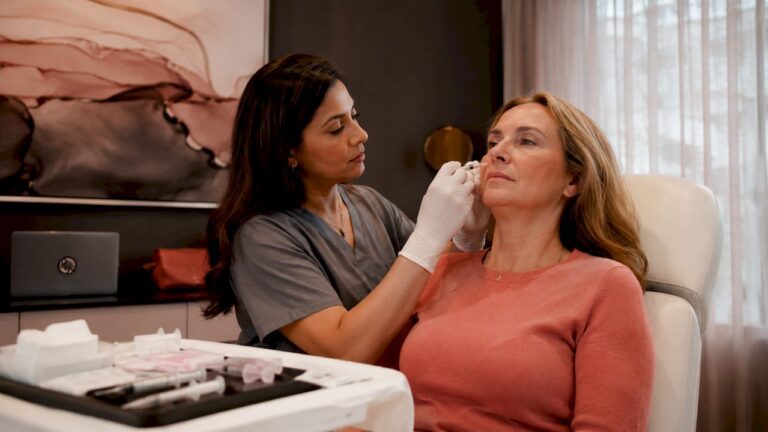
Most people facing a facial skin cancer diagnosis assume the surgeon will simply cut it out and close the wound. The reality is far more nuanced. Mohs micrographic surgery is a technically distinct procedure that examines every margin of removed tissue in real time, achieving something standard excision simply cannot guarantee: confirmation that every last cancer cell is gone before you leave the operating table. For facial tumours near the nose, eyes, lips, or ears, this distinction matters enormously. As the British Association of Dermatologists notes, the technique preserves maximum healthy tissue, which is crucial for cosmetically and functionally sensitive facial areas, minimising scarring and distortion.
Key Takeaways
| Point | Details |
|---|---|
| Precision for the face | Mohs surgery targets only cancerous cells, minimising cosmetic impact especially on delicate facial areas. |
| High cure rates | Mohs offers the best long-term outcomes for complex or high-risk facial skin cancers such as BCC and SCC. |
| Best for high-risk cases | It is strongly recommended for recurrent, aggressive, or poorly defined tumours on the face. |
| Personalised care matters | Results depend not just on the procedure but also the surgeon’s expertise and thorough aftercare. |
What is Mohs surgery and how does it work?
After understanding that not all facial skin cancer treatment methods are the same, let’s clarify how Mohs surgery sets itself apart from conventional approaches.
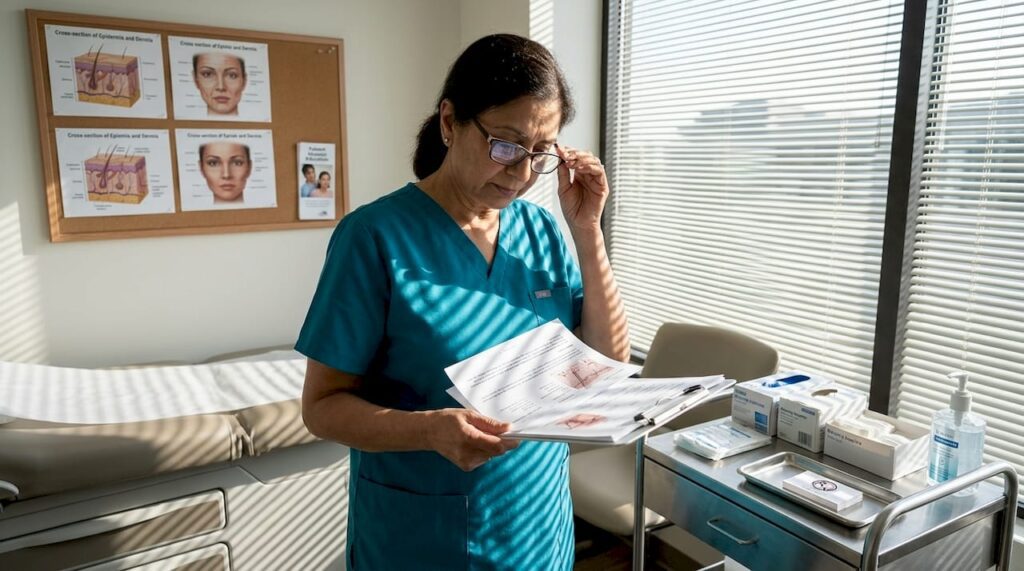
Mohs micrographic surgery was developed in the 1930s by Dr Frederic Mohs and has since become the gold standard for treating skin cancers in high-risk or cosmetically sensitive locations. The procedure works in a methodical, stepwise fashion that gives it a significant accuracy advantage over standard excision.
Here is what happens during a typical Mohs procedure:
- Local anaesthetic is administered to numb the treatment area completely, so you remain comfortable throughout.
- A thin layer of visible tumour is removed by the surgeon using careful margins.
- The tissue is immediately processed in an on-site laboratory, where a technician creates frozen sections for microscopic examination.
- The surgeon examines 100% of the tissue margins under a microscope, mapping exactly where, if any, cancer cells remain.
- If cancer cells are detected, the surgeon removes only the precise area where they were found, leaving uninvolved skin completely intact.
- Steps 3 to 5 are repeated until all margins are clear, confirming complete removal.
- Wound repair or reconstruction is then planned and carried out, often on the same day.
This real-time, layer-by-layer approach is what makes Mohs unique. Standard excision sends tissue to a pathology laboratory after surgery, meaning results may take days. By that point, the wound is already closed. Mohs eliminates this uncertainty entirely.
Because the surgeon examines tissue directly, the technique achieves unmatched precision. Healthy skin is spared, and removal is targeted only where cancer genuinely exists. For full details on what Mohs surgery involves, including how the reconstruction stage works, it is worth reviewing the procedure in depth before your consultation.
The technique’s precision is why the BAD highlights that it preserves maximum healthy tissue, vital for the nose, eyelids, lips, and ears where even a few millimetres matter.
Pro Tip: Always ask whether your surgeon performs both the Mohs excision and the reconstruction. A specialist with dual training in Mohs and plastic surgery delivers a far more cohesive outcome than a two-stage referral process.
Why Mohs surgery is preferred for facial skin cancer
Having covered the step-by-step process, let’s explore why Mohs is the top choice for treating facial skin cancer specifically.
The face is not just cosmetically important. It is functionally critical. Your ability to blink, breathe through your nose, speak clearly, and eat comfortably all depend on the precise anatomical structures of the face. When a tumour is located near the eyelid or the corner of the mouth, every millimetre of healthy tissue that can be preserved directly affects your quality of life after treatment.
Mohs surgery excels here for several reasons:
- Highest cure rates available: For primary basal cell carcinoma, Mohs achieves cure rates of up to 99%, and around 94% for recurrent cases.
- Tissue preservation: Because only confirmed cancerous tissue is removed, healthy skin is spared. This directly reduces the size of the wound and the complexity of reconstruction.
- Better cosmetic outcomes: Smaller defects mean less minimising scarring and more options for natural-looking repair.
- Same-day confirmation: You leave knowing the cancer has been fully removed, with no waiting for laboratory reports.
- Reconstruction planning: With the defect fully mapped, post-surgery reconstruction can be planned immediately and precisely.
“Mohs micrographic surgery preserves maximum healthy tissue, crucial for cosmetically and functionally sensitive facial areas like the nose, eyes, lips, and ears, minimising scarring and distortion.” British Association of Dermatologists
Consider the eyelid. A tumour there might be only 5mm across, but it sits millimetres from the lacrimal duct, the muscle that closes the eye, and delicate skin that, if removed unnecessarily, would require complex repair. Mohs allows the surgeon to trace the cancer’s true outline under the microscope rather than estimating margins by eye. The result is a smaller wound and a more functional repair.
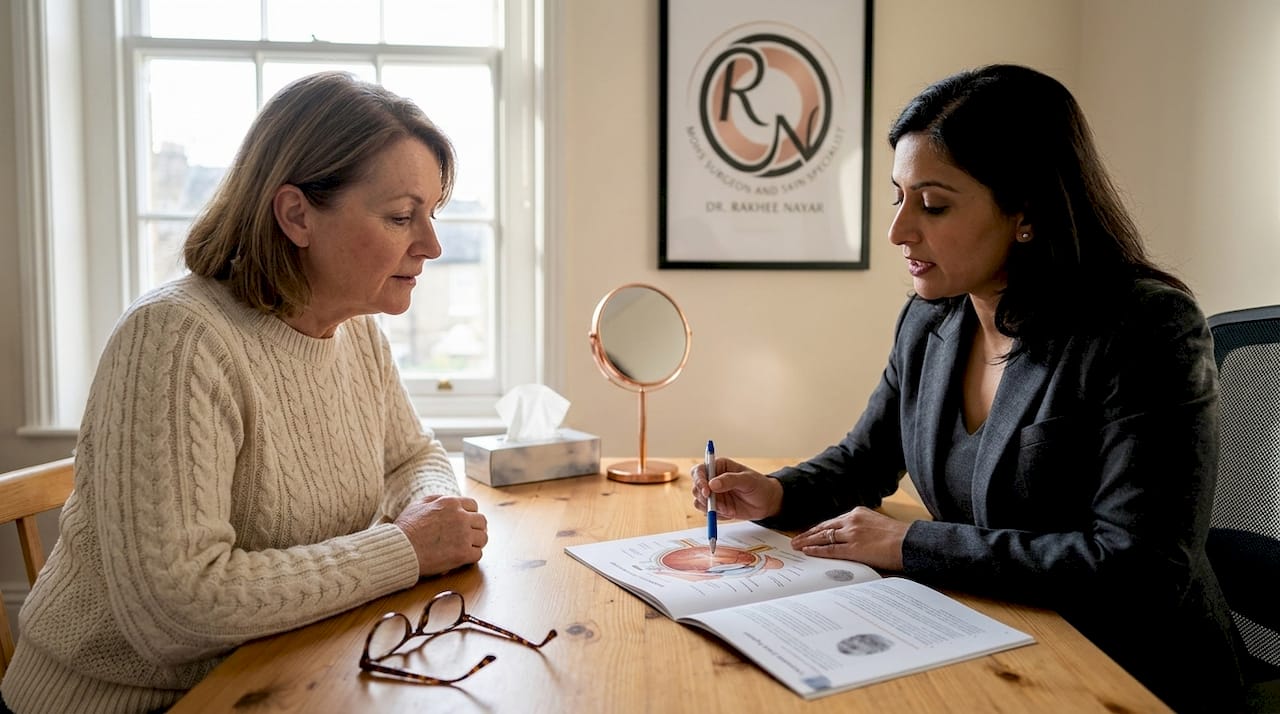
For patients who rely on their face professionally, or who are simply worried about how they will look and feel after treatment, this level of precision is not a luxury. It is the correct clinical approach.
Who is Mohs surgery for? High-risk tumours and special cases
Understanding the benefits, it’s helpful to know exactly who should consider Mohs surgery on the face.
Mohs is not prescribed for every skin cancer. It is recommended specifically for situations where precision and margin control offer a clear clinical advantage. According to StatPearls, Mohs is indicated for high-risk cases involving recurrent or aggressive tumours, morpheaform basal cell carcinoma, ill-defined edges, and large tumours on the face.
You are likely a strong candidate for Mohs if your tumour has any of these features:
- Recurrent tumour: A cancer that has already been treated and returned is harder to define and more likely to have irregular margins.
- Aggressive subtypes: Morpheaform or infiltrating BCC, and poorly differentiated SCC, spread in unpredictable patterns that standard excision may miss.
- Ill-defined clinical borders: When it is difficult to see clearly where the cancer ends and normal skin begins.
- Location in a high-risk facial zone: The central face, including the nose, lips, eyelids, and ears, are areas where tissue loss has a significant functional or cosmetic impact.
- Perineural invasion: When cancer has grown along nerve pathways, it tends to track in directions that require microscopic mapping to detect.
- Younger patients: With decades of potential recurrence ahead, achieving a complete first removal is especially important.
For a detailed overview of high-risk skin cancer cases and when Mohs is most appropriate, it is worth reading further before attending your consultation. Whether you are dealing with Mohs for facial BCC or Mohs for facial SCC, the indications differ in nuance.
Mohs is not always the first choice for superficial basal cell carcinoma on the trunk, or for very thick, bulky SCCs where other treatment modalities may achieve better overall results.
Pro Tip: Before agreeing to any treatment plan, ask your surgeon specifically how many complex facial Mohs cases they perform each year. Experience with difficult reconstructions is just as important as the surgical technique itself.
Mohs versus standard excision: A comparison for facial cases
Having identified who benefits most, it’s important to contrast Mohs surgery with standard excision, as the choice can affect both cure and appearance.
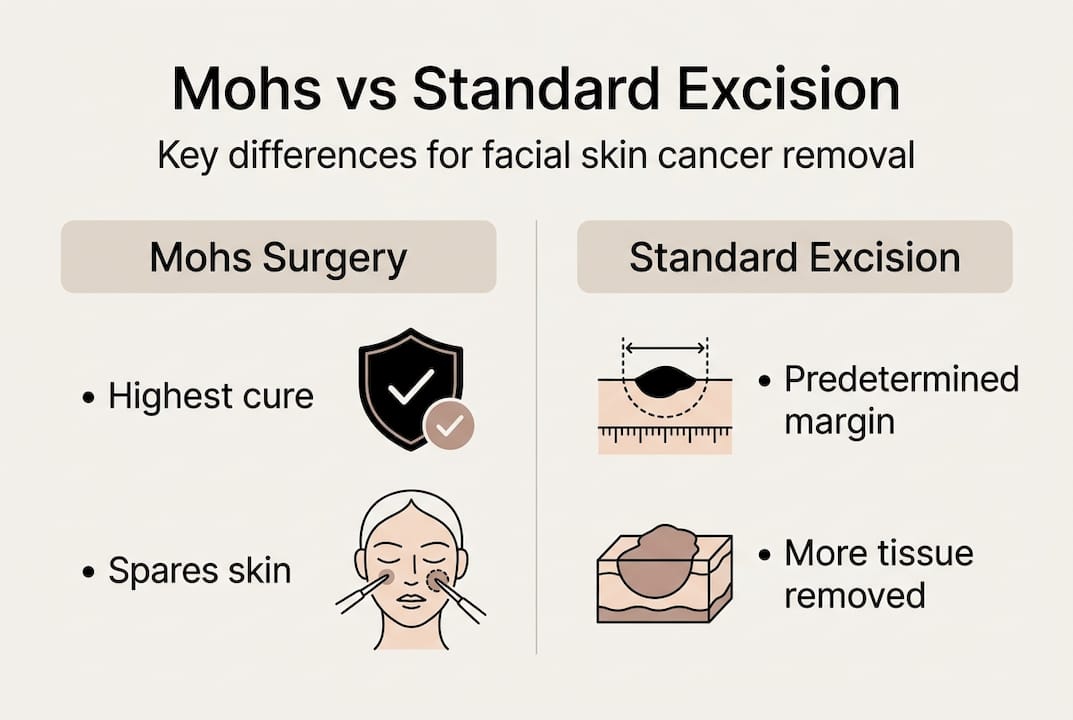
| Feature | Mohs surgery | Standard excision |
|---|---|---|
| Cure rate (primary BCC) | Up to 99% | Around 90 to 95% |
| Tissue preserved | Maximum possible | Fixed safety margin removed |
| Margin confirmation | Real-time, same day | Days later via pathology |
| Cosmetic outcome (face) | Optimised | Variable |
| Appointments required | Usually one | May require second procedure |
| Best suited for | Face, high-risk, recurrent tumours | Low-risk, well-defined, body sites |
Standard excision removes the tumour with a predetermined margin of healthy tissue around it. This is effective for well-defined, low-risk tumours in areas where tissue is plentiful. It is a perfectly sound treatment in the right context. However, on the face, where margins matter both clinically and cosmetically, the inability to confirm complete removal in real time is a genuine limitation. You can explore more about standard surgical excision and its appropriate applications if you want a fuller picture.
The BAD confirms that Mohs preserves maximum healthy tissue, crucial for sensitive facial areas, which is the core reason the comparison so often favours Mohs for the face. There are also many Mohs myths and facts worth reviewing if you have heard conflicting information.
If you are preparing to discuss your options with a specialist, consider these practical steps:
- Write down your tumour’s location, size, and any previous treatments you have had.
- Ask your clinician to explain why a particular technique is being recommended for your specific case.
- Request information on the surgeon’s experience with both excision and Mohs, and with facial reconstruction.
- Ask about recovery after Mohs so you can plan realistically around your treatment.
A realistic perspective: What most guides don’t tell you about Mohs on the face
Most articles about Mohs surgery focus on statistics and technique. Cure rates. Layer counts. Margin confirmation. These are all important. But in our experience working with patients who have facial skin cancer, the numbers rarely capture what the journey actually feels like.
Here is something worth saying plainly: even with Mohs, the cosmetic result is not guaranteed to be invisible. A scar on the nose or near the eye will be visible for months. Full healing, softening of scar tissue, and proper colour-matching can take up to a year. This is not a failure of the technique. It is the reality of any surgery to the face, and patients who understand this from the outset tend to report far greater satisfaction.
The second thing many guides gloss over is that the quality of facial reconstruction after Mohs matters as much as the excision itself. A surgeon who removes the cancer precisely but then closes the wound poorly has only done half the job. The two stages must be considered together, which is why choosing a surgeon with dual training in Mohs and reconstructive plastic surgery changes outcomes in a meaningful way.
Finally, do not underestimate the emotional side. A diagnosis of facial skin cancer is frightening, and surgery on the face feels very personal. Ask questions. Understand your options. The decision is yours to make with confidence.
Next steps: Expert help for facial Mohs surgery in the UK
With a clear understanding of your options, here’s how to take practical steps towards expert-led care.
If you have been diagnosed with facial skin cancer or have concerns about a suspicious lesion, getting advice from an accredited specialist is the most important next step you can take.
Miss Rakhee Nayar holds dual training in Mohs micrographic surgery and plastic surgery, offering a genuinely integrated approach to both Mohs surgery expertise and facial reconstruction. From initial skin cancer detection through to your full recovery, every stage of care is planned with your appearance and function in mind. Whether you are exploring your options or ready to book, you can access private consultations and e-consultations across the UK. Visit the site to learn more about facial reconstruction options and to take a confident first step.
Frequently asked questions
Is Mohs surgery painful on the face?
Mohs surgery is performed under local anaesthetic, so pain is minimal during the procedure; mild discomfort and swelling may occur in the days afterwards but is usually well managed with simple pain relief.
How does Mohs surgery minimise facial scarring?
By removing only confirmed cancerous tissue and sparing all surrounding healthy skin, Mohs leaves the smallest possible defect, directly reducing the size and visibility of the resulting scar. The BAD confirms this tissue-preserving approach is especially important for sensitive facial areas.
Who should not have Mohs surgery?
Mohs is not usually necessary for superficial basal cell carcinoma located on the trunk or limbs, or for very thick SCCs where other treatment approaches may be clinically more appropriate. Your specialist will advise based on your specific tumour characteristics.
What is the recovery time for Mohs surgery on the face?
Initial wound healing typically takes one to two weeks, but full cosmetic settling, including scar softening and colour normalisation, can take six to twelve months depending on the extent of reconstruction required.
Are the results of facial Mohs surgery permanent?
When cancer is fully removed under Mohs, recurrence is rare. As StatPearls documents, Mohs is particularly recommended for high-risk and recurrent facial tumours precisely because complete removal at the first attempt offers the best long-term outcome.
Recommended
- Surgical excision for skin cancer: treatment & reconstruction
- Mohs surgery myths vs facts: what patients need to know
- SCC: Diagnosis, Mohs surgery and facial reconstruction
- What is Mohs Micrographic Surgery? | Miss Rakhee Nayar
Filed under Mohs Surgery