Direct closure, sometimes called primary closure, is the simplest way to repair the wound left after Mohs micrographic surgery. The edges of the defect are brought together and stitched in a fine line, following the natural creases and tension lines of the face wherever possible.
Because Miss Rakhee Nayar is dual-trained in Mohs surgery and plastic surgery, the same consultant who removes the cancer also plans and performs the repair. That matters for direct closure in particular, where the position and direction of the final scar is decided in the moment, with the whole face in mind rather than just the wound.
When direct closure is the right choice
Direct closure suits defects that are small to moderate in size and sit in an area where there is enough loose, mobile skin nearby to close the gap without distorting anything. It is often the preferred repair on the cheek, forehead, temple, neck and trunk.
- The defect can be closed without pulling on a free edge such as the eyelid, lip or nostril rim.
- There is enough skin laxity in the surrounding area.
- The resulting scar can be hidden inside a natural crease, wrinkle or hairline.
- The skin colour and texture on both sides of the wound are a close match.
Where these conditions are not met, a local flap or a full-thickness skin graft will usually give a better result.
What the procedure involves
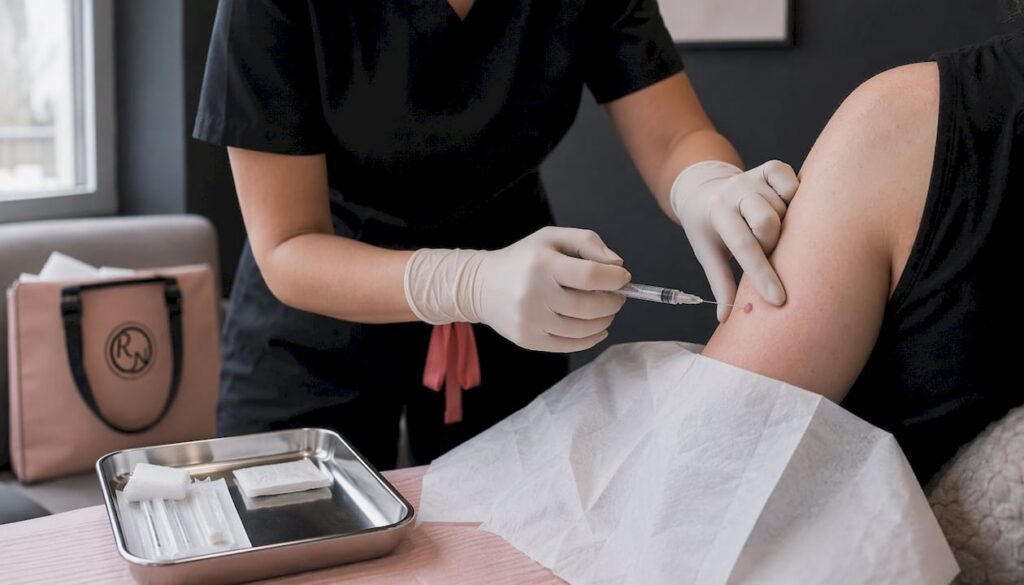
Direct closure is carried out under local anaesthetic in the same visit as the Mohs surgery, once the microscope has confirmed that all the cancer has been removed. The wound is usually converted into a narrow ellipse so the edges sit together without bunching, then closed in layers: deep stitches to take the tension off the skin, and fine surface stitches to align the edges precisely.
The repair itself typically takes twenty to forty minutes. Most patients go home the same day with a simple dressing.
Healing week by week
- Days 1 to 3. Some swelling and bruising is normal, particularly around the eyes if the surgery was on the upper face. The dressing stays dry.
- Days 5 to 14. Surface stitches are removed, earlier on the face and later on the body. The line looks red and slightly raised.
- Weeks 3 to 8. Redness begins to fade. The scar may feel firm or lumpy underneath as the deep tissue remodels. This is expected.
- Months 3 to 12. The scar continues to soften, flatten and pale. Most of the final appearance is settled by twelve months.
Scars after direct closure
Every skin cancer operation leaves a scar. The aim of direct closure is a single fine line that follows the natural architecture of the face, so the eye reads it as a crease rather than a mark. Sun protection, gentle massage once the wound has fully sealed, and time all improve the final result.
Book a consultation
To discuss Mohs surgery and reconstruction with Miss Nayar, please use the contact form or call the clinic directly.
Book a consultation
If you are facing Mohs surgery and want to understand how your wound would be repaired, this is exactly what a consultation covers. Bring your referral letter or biopsy result if you have one.