Key Takeaways:
- There’s no fixed size that triggers “full” reconstruction. Three things decide it: how much of the surrounding facial region is affected, how deep the defect goes, and exactly where it sits.
- Facial skin is divided into aesthetic units, the forehead, nose, eyelids, cheeks, lips, and so on. Losing more than roughly half of one unit usually means treating the whole unit as a single reconstruction rather than patching just the hole.
- Surgeons work up what’s known as the reconstructive ladder, starting from the simplest technique that will safely and naturally close the wound, and only climbing to a graft or flap when a simpler option genuinely won’t do the job.
- A small defect in a tight, functionally important spot, the eyelid margin, the rim of a nostril, the edge of the lip, can need more complex reconstruction than a larger one somewhere with more spare skin.
There’s no single measurement, no “over 2cm means full reconstruction” rule, that answers this on its own. Whether a defect needs a straightforward stitched closure or a more involved graft or flap comes down to a combination of factors, not any one number.
Facial Reconstruction Surgery covers the full range of techniques Miss Rakhee Nayar uses; this article focuses specifically on how she and other specialists actually decide which one a given defect needs.
The three variables that actually decide the answer
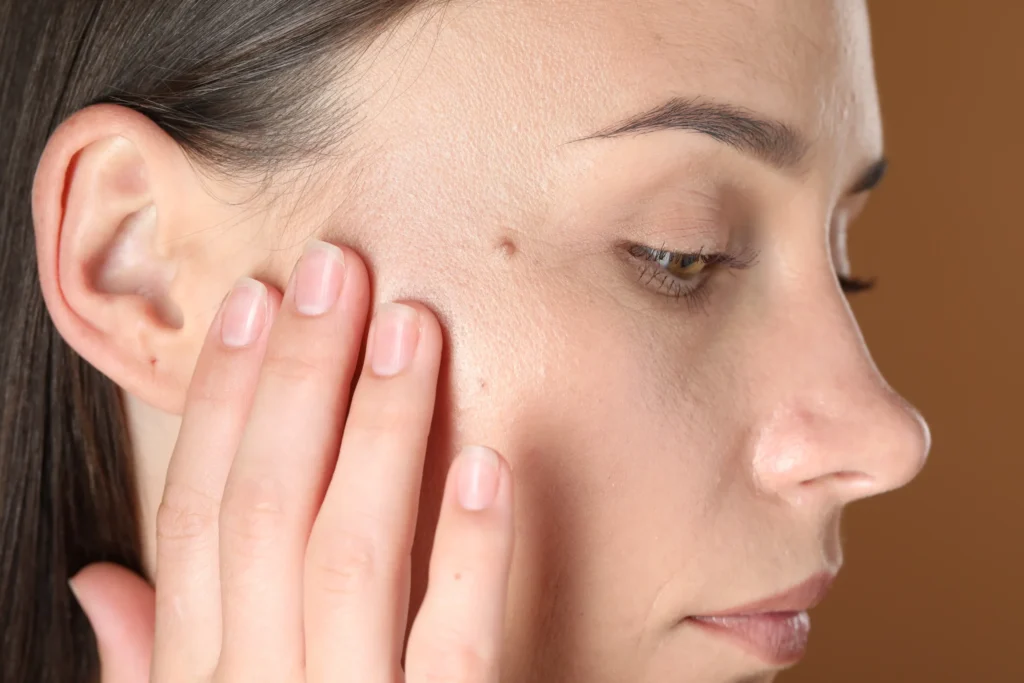
Surgical decision-making for any facial defect weighs three things together, not in isolation: the size of the defect relative to the surrounding tissue, how deep it goes, and precisely where it’s located. A resource on reconstructive technique selection from The Plastics Fella sets this out clearly: larger defects need progressively more complex techniques, deeper wounds involving multiple tissue layers usually rule out a simple closure, and location changes both the aesthetic goals and the functional stakes involved.
Patient-specific factors matter too, age, general health, smoking history, and how previous treatment in the area has healed. None of these override the other three, but they can push a decision toward a more cautious, more robust technique even for a moderate-sized defect.
Why location matters more than raw size
The face isn’t a uniform sheet of skin. It’s divided into what surgeons call aesthetic units, the forehead, nose, eyelids, cheeks, lips, chin, each with its own skin colour, texture, thickness and mobility. A peer-reviewed overview of facial reconstruction according to aesthetic units explains why this matters: each unit affects how the ones around it look, so a repair that ignores those natural boundaries tends to look patched, even when it’s technically well healed.
In practice, this means a defect covering more than roughly half of a single aesthetic unit is often treated by reconstructing the whole unit, rather than just filling the gap, because hiding the repair scar along the unit’s natural border gives a far more natural result than a patch in the middle of it.
It’s also why the nose gets treated with particular care. It isn’t one aesthetic unit but several, the bridge, tip, sidewalls, wings and columella, each behaving slightly differently, which is part of why nasal reconstruction is often more involved than a similarly sized defect elsewhere on the face.
The reconstructive ladder: starting simple, going further only when needed
Surgeons think about reconstruction options as a ladder, running from the least to the most complex. The aim is always to use the lowest rung that will genuinely do the job safely and well, not to default to the most impressive-sounding technique.
- Healing by secondary intention: the wound is dressed and left to close on its own, suited to small, shallow defects in areas that heal well this way
- Direct closure: the edges are stitched together where there’s enough spare skin nearby
- Skin grafting, split-thickness or full-thickness: skin is taken from elsewhere on the body to cover the defect
- Local flap reconstruction: nearby skin, complete with its own blood supply, is moved into place, including specific patterns like the nasolabial flap
- Regional flaps, such as the forehead flap used for larger nasal defects
- Free tissue transfer: reserved for the largest or most complex defects, involving microsurgical reconnection of blood vessels
“Full” reconstruction, in the sense most patients mean it, generally starts around the local flap rung and above, once direct closure or a simple graft genuinely isn’t going to give a safe, natural-looking, functioning result.
When a straightforward closure is genuinely enough
Plenty of facial defects don’t need anything beyond direct closure. A small, well-defined defect in an area with reasonable skin laxity, the cheek or forehead are common examples, can often be stitched directly with a good cosmetic result and a short recovery.
Mohs vs standard excision covers a related point: the surgical technique used to remove the cancer and the reconstruction technique used to close the resulting defect are separate decisions, and a straightforward excision doesn’t automatically mean a straightforward closure, or the reverse.
When you’re moving into full reconstruction territory
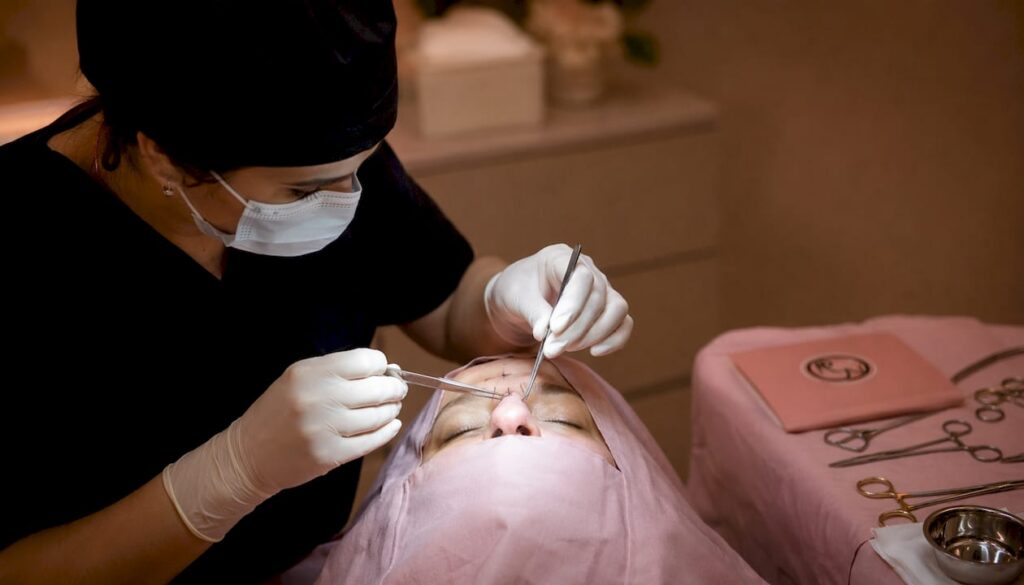
A few patterns reliably push a defect up the ladder toward flap or graft territory:
- The defect covers more than about half of a single aesthetic unit
- It sits on or crosses a functional structure, the eyelid margin, the edge of the lip, the rim of a nostril or ear, where simply pulling the edges together would distort or restrict movement
- It’s deep enough to involve muscle, cartilage, or bone, not just skin
- There isn’t enough surrounding skin laxity to close it without creating visible tension or pulling on a nearby structure
Reconstruction After Mohs or BCC Surgery goes into more detail on what can go wrong if a defect in one of these tight, functionally important areas is closed under too much tension, including ectropion, nasal distortion, and changes to how the lip moves and seals.
Why a small defect can still need a complex repair
It’s a common assumption that a bigger cancer or a bigger defect automatically means bigger surgery, but location often overrides size. A relatively small defect right on the nasal rim, at the lip’s edge, or on the eyelid margin can need a local flap, where a defect twice its size on the cheek or forehead would close directly without issue.
That’s part of why an accurate answer for your own case can only come after the defect has actually been assessed. How much facial reconstruction costs in the UK covers the related point that pricing follows the same logic, technique and complexity, not tumour size, drive the number.
| Defect scenario | Likely approach | Why |
|---|---|---|
| Small, shallow defect on the cheek or forehead | Direct closure | Enough surrounding skin laxity to stitch without tension |
| Defect covering roughly half an aesthetic unit | Reconstruction of the whole unit | Hides the repair along a natural boundary rather than mid-unit |
| Small defect on the nasal rim, lip edge, or eyelid margin | Local flap | Direct closure would distort or restrict a functional structure |
| Larger or deeper defect involving muscle or cartilage | Regional flap | More tissue and blood supply needed than a local flap provides |
| Extensive defect, or complex prior surgery in the area | Free tissue transfer | Reserved for the largest or most difficult reconstructions |
Miss Rakhee Nayar, a Consultant Plastic Surgeon and Mohs Micrographic Surgeon, assesses the defect and confirms the reconstruction plan as part of the same consultation, since technique and cancer removal are planned together rather than handed off separately. Get in touch via the contact page to discuss what’s likely to apply to your own case.
FAQ
Is there a size cutoff for needing full facial reconstruction?
No single measurement decides it. Size relative to the surrounding facial unit, depth, and location together determine whether a defect needs more than a straightforward closure.
Why do small defects on the nose or eyelid need complex reconstruction?
These areas have very little spare skin and sit close to functional structures. Even a small defect can distort the eyelid margin or a nostril rim if it’s simply stitched closed, so a flap is often needed even when the defect itself is modest.
What is the reconstructive ladder?
It’s the framework surgeons use to choose a technique, running from the simplest option, healing on its own, through direct closure, skin grafts, and flaps, up to free tissue transfer. The aim is always to use the least complex technique that will safely and effectively close the defect.
What are facial aesthetic units?
They’re the natural regions the face is divided into for reconstruction purposes, the forehead, nose, eyelids, cheeks, lips and chin among them. Each has its own skin characteristics, and losing a large portion of one often means reconstructing the whole unit rather than just the gap.
Can I know in advance whether I’ll need full reconstruction?
Not precisely. The defect’s exact size, depth and location aren’t known until the cancer has actually been removed, so the reconstruction plan is generally confirmed at that point, though your surgeon can usually give you a realistic sense of the likely range beforehand.
Recommended
- Facial Reconstruction Surgery
- Reconstruction After Mohs or BCC Surgery.
- How Much Does Facial Reconstruction Surgery Cost in the UK?
- Mohs vs standard excision: what matters for your care
Filed under Facial Reconstruction