
What do real Mohs surgery results actually look like? Genuinely, it depends more on your individual case, the site treated and how it’s closed than on any single photo you’ll find online. Searching for “before and after” images is a completely natural way to prepare, but it’s worth knowing how to read them honestly before you draw conclusions about your own likely outcome.
Miss Rakhee Nayar, a Consultant Plastic Surgeon and Mohs Micrographic Surgeon, talks through realistic outcomes with every patient at consultation, using examples relevant to their specific site and skin cancer rather than generic imagery.
Key takeaways
| Point | Detail |
|---|---|
| Photos can mislead | Many published galleries show selected, best-case results rather than typical ones. |
| What shapes your result | Tumour size and site, closure method, skin type and age matter more than any photo. |
| Early results look worse | A wound at two weeks looks nothing like the mature scar at twelve months. |
| Closure method matters | Flap and graft repairs tend to blend in differently than a simple stitched closure. |
| Best source of truth | A consultation discussing cases genuinely similar to your own. |
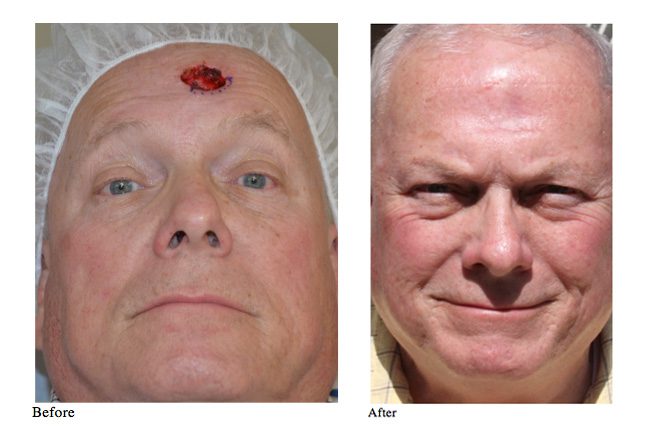
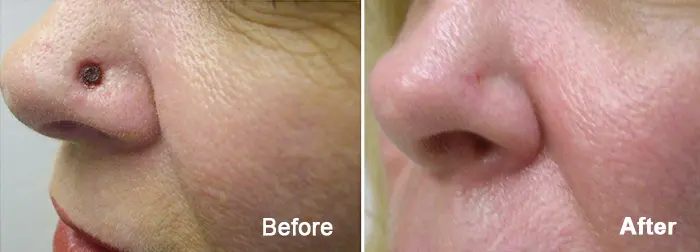
Why before-and-after photos can be misleading
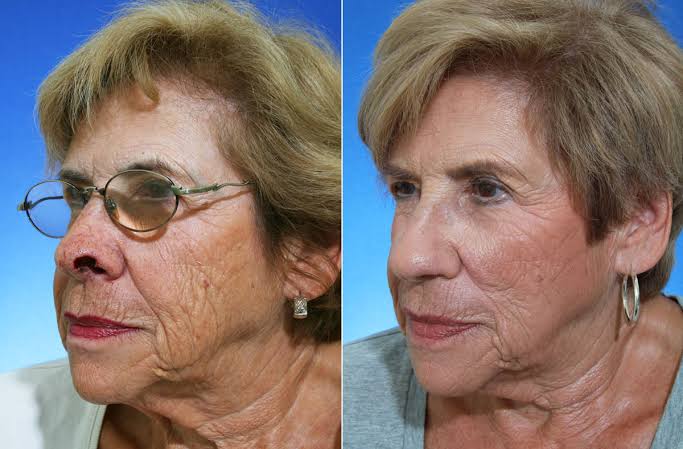
Not every “before and after” gallery you’ll find represents typical results. The UK’s Advertising Standards Authority requires before-and-after photos in medical and cosmetic advertising to be genuine, unmanipulated and representative of results a patient could actually expect, precisely because this area has a documented history of misleading imagery, from flattering lighting and angles to images that simply weren’t genuine before-and-after pairs at all.
That doesn’t mean every gallery is dishonest. It means a single photo, stripped of context about the tumour size, site, skin type and time since surgery, tells you far less than it appears to. A dramatic “after” photo taken in good light at twelve months isn’t a fair comparison for what your own two-week healing will look like.
What actually determines how your result looks
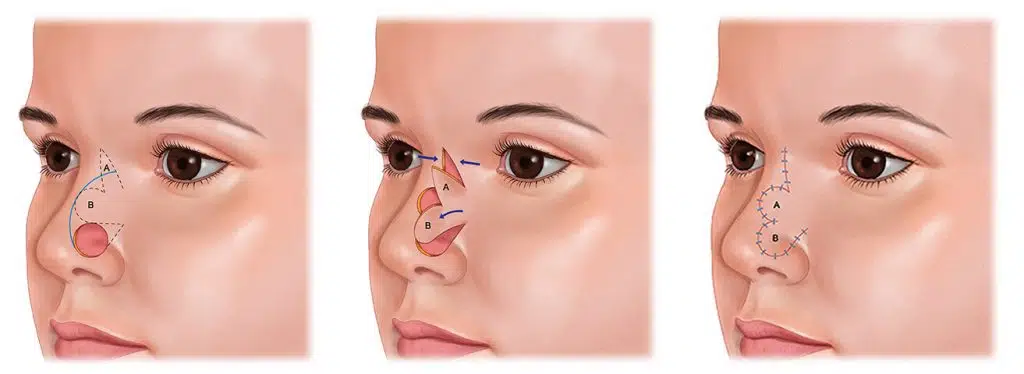
Your own outcome depends on a specific combination of factors rather than a generic average. The size and location of your skin cancer, the closure method used to repair the wound, your skin type and age, and how closely you follow aftercare guidance all shape the final result more than any single “typical” example can capture.
Our detailed guide on what shapes aesthetic outcomes in facial surgery covers each of these factors in depth, including why flap reconstruction tends to blend in better than a straight stitched closure on the nose, and why older skin with more natural laxity often heals more discreetly than younger, tighter skin.
What results typically look like, stage by stage
Every result looks more dramatic in the early weeks than it will months later, which is exactly where photos taken at the wrong stage become misleading. In the first one to two weeks, redness, swelling and a visible wound or fresh scar line are completely normal. By two to three months, the area is usually pink and slightly raised. Most of the meaningful fading and flattening happens between three and twelve months.
Our full guide to scarring after Mohs surgery breaks this timeline down in detail, including what’s normal to see and feel at each stage and when to flag something to your surgical team.
A note on real case photos from this practice
We’re in the process of building a gallery of real, consented case photos from Miss Nayar’s own patients, shown at genuine stages of healing rather than only best-case final results. Patient consent for clinical photography follows General Medical Council guidance on using patient images, which is why this takes time to do properly rather than sourcing generic stock imagery.
In the meantime, the most useful equivalent is asking to see real examples relevant to your own case directly at consultation, which is covered below.
What to ask to see at your consultation
Rather than relying on a website gallery, it’s entirely reasonable to ask your surgeon directly to discuss cases similar to your own, including the site, size and closure method most relevant to your situation. A surgeon confident in their results should be comfortable talking you through what to realistically expect, including the less flattering early stages, not just the finished outcome.
It’s also worth asking specifically how many similar cases your surgeon has treated. Experience with your particular site, whether that’s the nose, ear or eyelid area, genuinely affects both the surgical outcome and how well the reconstruction is planned.
Talking to your surgeon about your own likely result
The honest answer to “what will my result look like” is always specific to you, not to a photo found online. Understanding the factors that genuinely shape your outcome, and the realistic timeline for seeing your final result, tends to be far more useful preparation than searching for reassurance in someone else’s photos.
If you’d like to discuss what to expect for your own skin cancer and its likely closure method, Miss Rakhee Nayar and her team are happy to talk this through in detail at consultation.
FAQ
Can I see real before-and-after photos of Mohs surgery?
We’re building a gallery of real, consented patient photos, which takes time to do properly under GMC guidance on patient imagery. In the meantime, ask to see examples relevant to your case at consultation.
Why do before-and-after photos vary so much online?
Published galleries aren’t always representative. UK advertising standards require genuine, unmanipulated photos, but lighting, timing and case selection can still make results look more dramatic or more modest than typical.
How long until I see my final result?
Most of the meaningful fading and flattening of a scar happens between three and twelve months. Early results, in the first few weeks, always look more dramatic than the eventual outcome.
Does the type of wound closure affect how visible my scar will be?
Yes. Flap reconstruction tends to blend in more naturally than a straight stitched closure, particularly on the nose, because the resulting scar line follows natural contours rather than a straight edge.
What’s the best way to know what my own result will look like?
A consultation where your surgeon can discuss cases genuinely similar to your site, size and skin type gives a far more accurate picture than any generic online gallery.
Recommended
- What is Mohs Micrographic Surgery? | Miss Rakhee Nayar
- Reconstruction After Mohs Surgery
- Scarring after Mohs surgery: what patients should expect
- Aesthetic outcomes in facial surgery: what shapes your results
Filed under Mohs Surgery