Key Takeaways:
- The cancer removal itself, Mohs micrographic surgery, works the same way regardless of location. What changes dramatically between the nose, ear, eyelid and lip is the repair, because each protects a different function.
- Reconstruction is planned within “cosmetic units,” the natural zones the face is already divided into by skin type and boundary, rather than by the shape of the defect alone.
- The eyelid needs a flap for even small defects to avoid the lid turning outward. The lip needs its vermilion border realigned precisely. The ear has almost no spare skin to work with. The nose needs its internal airway protected.
- Because the four areas need such different techniques, having one surgeon who is genuinely experienced across all of them, rather than mostly familiar with one, matters more here than almost anywhere else on the body.
Skin cancer surgery on the nose, ear, eyelid or lip uses the same underlying technique, Mohs micrographic surgery, to remove the cancer. What differs sharply between these four areas is what happens next. Each one protects a different function, and that’s what actually drives the surgical approach, not just how visible the area is.
Miss Rakhee Nayar, a Consultant Plastic Surgeon and Mohs Micrographic Surgeon, adapts her reconstruction technique to exactly where the tumour sits. This article sets out why, and what that means in practice for each of the four areas.
Why the same cancer removal leads to such different repairs
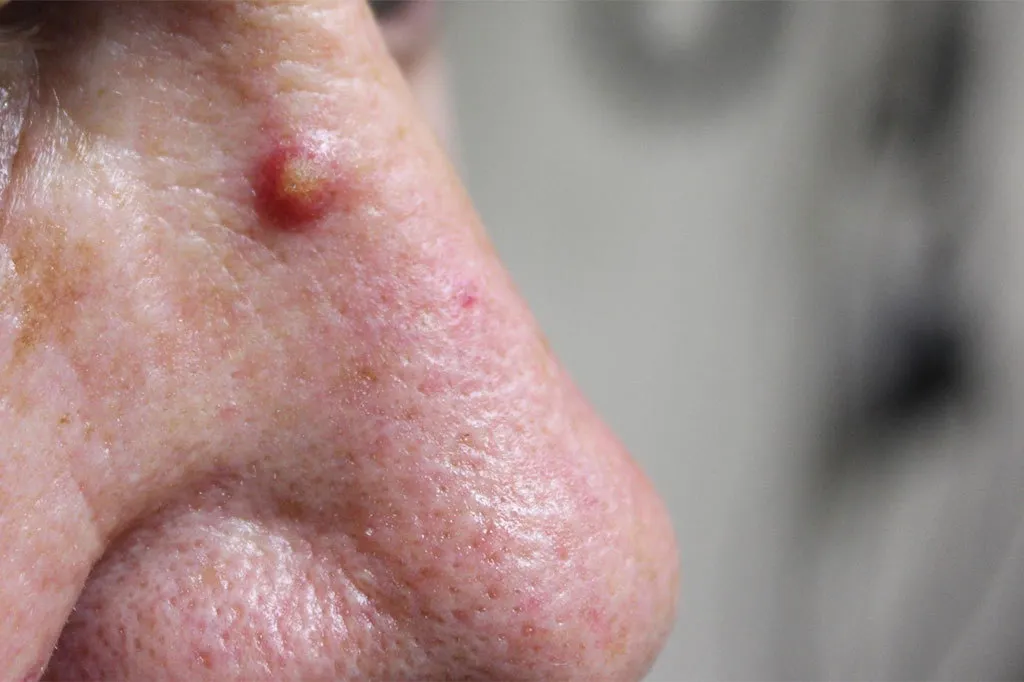
Facial reconstruction follows what’s known as the cosmetic unit principle. Rather than treating the face as one continuous surface, surgeons plan repairs within the natural zones already defined by skin thickness, colour, texture and movement, the nose, the eyelids, the lips, the ears, the cheeks, each treated as its own unit.
A peer-reviewed review of reconstruction techniques by facial cosmetic unit puts it plainly: a repair should generally be designed within the limits of the unit where the defect sits, since borrowing tissue across a unit boundary is more likely to look and move differently from its surroundings.
The nose, preserving the airway and symmetry
The nose is a common site for skin cancer because it sits at the centre of the face, constantly exposed to sun, and it has very little spare skin to work with. Even a small amount of extra tissue removed can pull a nostril or unbalance the bridge.
The repair also depends on exactly where on the nose the defect sits. The dorsum, the sides, the ala and the tip each tend to call for a different local flap, since skin thickness and mobility vary across the nose more than most people expect. Mohs surgery on the nose covers this in more detail, and every reconstruction is planned to keep the internal nasal valves open, since breathing function matters as much as appearance.
The eyelid, function comes before appearance
The eyelid is the most functionally sensitive of the four areas, because it protects the eye itself. Even a defect that looks small can need a formal flap repair rather than simple stitching, since a lower lid closed under too much tension can turn outward, a complication called ectropion, and stop the lid protecting and lubricating the eye properly.
Larger lower-lid defects are sometimes repaired in two stages rather than one, closing the eye temporarily between them. Mohs surgery on the eyelid explains what that staged approach actually involves and why it’s sometimes the safer option over a single, more tension-heavy repair.
The lip, preserving the vermilion border and oral competence
The lip’s three layers, skin, muscle and the moist inner lining, all need restoring for it to close, speak and eat properly afterwards. The vermilion border, the precise line where the lip meets the surrounding skin, is one of the most visible landmarks on the face, so realigning it accurately is what makes a lip repair look natural rather than obviously repaired.
How much of the lip is affected changes the options considerably. Smaller defects can often be closed directly or with an Abbe or Estlander flap, borrowing tissue from the opposite lip. Larger defects, more than around two-thirds of the lip, need techniques that carry a genuine risk of a smaller mouth opening afterwards, which is exactly the kind of trade-off worth discussing in detail before surgery. Mohs surgery on the lip goes into the specific options for different defect sizes.
The ear, working with cartilage and almost no spare skin
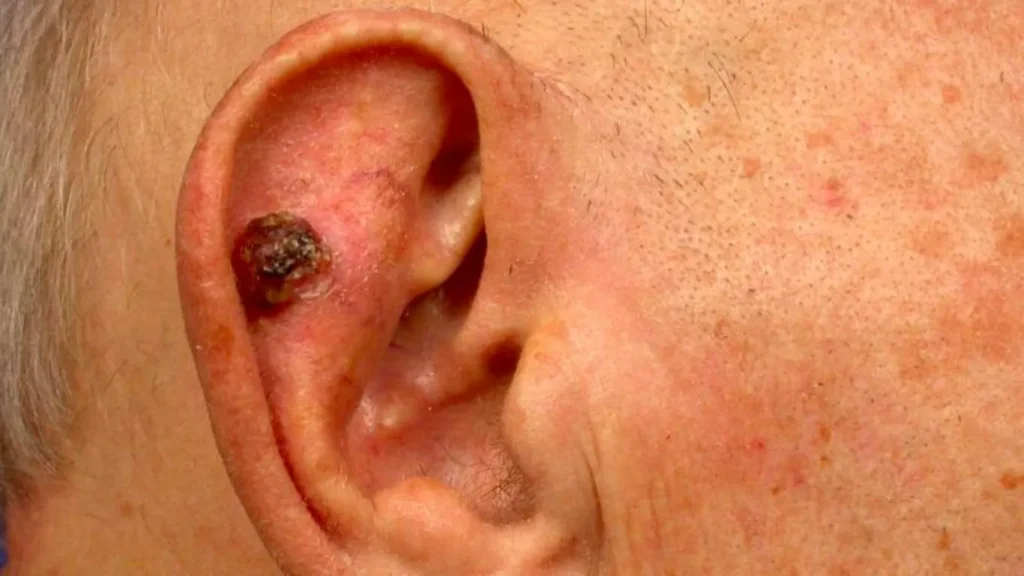
The ear’s shape comes from cartilage, not soft tissue, and the skin covering it is thin with very little laxity. That combination makes it one of the more technically demanding sites for reconstruction, since there’s rarely enough spare skin nearby to simply stretch over a defect.
Depending on which part of the ear is affected, the helix, the antihelix or the concha, the repair can range from a direct wedge closure to a cartilage graft or a staged flap. Mohs surgery on the ear covers what determines which approach suits a given defect, and confirms that surgery on the outer ear doesn’t affect hearing.
Comparing the four areas
| Area | Main functional priority | Typical repair options |
|---|---|---|
| Nose | Preserving the airway and facial symmetry | Local flaps varying by sub-site (dorsum, ala, tip), skin grafts for smaller defects |
| Eyelid | Protecting the eye and preventing ectropion | Flap repair even for small defects, sometimes staged over two operations |
| Lip | Preserving oral competence and the vermilion border | Direct closure or cross-lip flaps for smaller defects, more complex repair for larger ones |
| Ear | Working within limited, cartilage-backed tissue | Wedge closure, cartilage grafts, or staged flaps depending on the sub-site |
What this means when choosing a surgeon
Because these four areas call for such different techniques, genuine day-to-day experience across all of them matters more here than in most other facial reconstruction. A surgeon who is dual-trained in Mohs surgery and plastic surgery plans the repair with full knowledge of exactly what the cancer removal has left behind, rather than reviewing someone else’s excision after the fact.
Facial Reconstruction Surgery covers the full range of techniques used across the face, and it’s worth asking directly how often a prospective surgeon treats the specific area your cancer is in, not just the face in general.
FAQ
Does Mohs surgery itself work differently on these areas?
No, the cancer removal technique, checking each layer under the microscope before deciding whether to remove more, is the same everywhere. What differs is the reconstruction afterwards, which is planned around the specific function of each area.
Why does a small eyelid defect sometimes need a flap, not just stitches?
Because the lower eyelid is easily pulled out of shape under tension. Even a modest defect closed with simple stitches can risk the lid turning outward and no longer protecting the eye properly, so a flap that borrows tissue without that tension is often the safer choice.
Will surgery on my lip affect my speech or eating long-term?
For smaller defects, usually not once healing is complete. Larger defects carry a genuine risk of a smaller mouth opening or some initial tightness, which is why the size of the defect is discussed openly before deciding on a reconstruction technique.
Do I need different specialists for different facial areas?
Not necessarily. A surgeon experienced across the nose, ear, eyelid and lip can treat all four, though it’s reasonable to ask how much of their practice is in the specific area affecting you.
Recommended
- Facial Reconstruction Surgery
- When Is Full Facial Reconstruction Necessary?
- Individual guidance by area is covered on the eyelid, lip and ear Mohs surgery pages
- About Dr Nayar
Filed under Facial Reconstruction