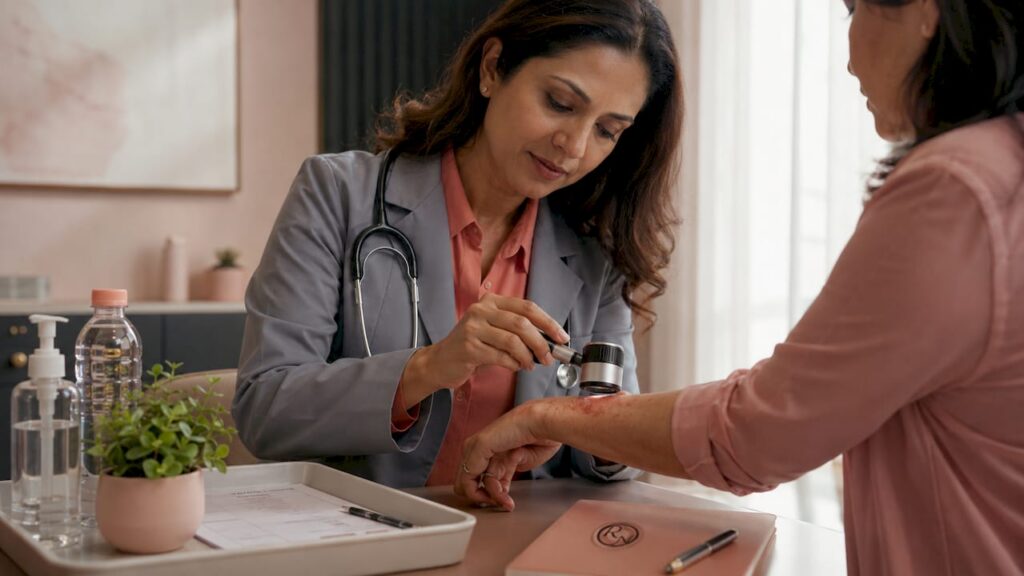
Early stage skin cancer is defined as cancerous change confined to the skin’s surface or immediately beneath it, before spread to lymph nodes or distant organs has occurred. When detected at this point, the prognosis is excellent. 5-year survival rates exceed 99% for localised melanoma, and nonmelanoma types including basal cell carcinoma (BCC) and squamous cell carcinoma (SCC) are routinely cured with minor surgery. The clinical term for the earliest detectable stage is in situ, meaning the abnormal cells remain within their tissue of origin. Understanding what to look for, which treatment fits your situation, and what recovery involves gives you the clearest possible starting point after a diagnosis.
1. What are the common symptoms of early stage skin cancer?
Recognising skin cancer in its early stages depends on knowing what changes to look for and where. The three most common types present differently, so it helps to understand each one.
Basal cell carcinoma is the most frequently diagnosed skin cancer in the UK. It typically appears as a shiny, pearlescent bump or a flat, scar-like lesion on sun-exposed skin, most often the face, scalp, ears, and neck. It may bleed with minimal trauma or develop a central crust that repeatedly heals and reopens.
Squamous cell carcinoma often begins as a rough, scaly patch or a firm, raised nodule. It can develop within an existing actinic keratosis, which is a pre-cancerous lesion caused by cumulative sun damage. SCC in situ, also called Bowen’s disease, presents as a persistent red, scaly plaque that does not resolve with standard moisturisers or topical steroids.
Melanoma demands particular attention because it carries the highest risk of spread if missed. Dermatologists use the ABCDE rule to guide assessment:
- Asymmetry: one half of the lesion does not mirror the other
- Border: edges are irregular, notched, or blurred
- Colour: variation within a single lesion, including shades of brown, black, red, or white
- Diameter: larger than 6 mm, roughly the size of a pencil eraser
- Evolving: any change in size, shape, colour, or new symptoms such as bleeding or itching
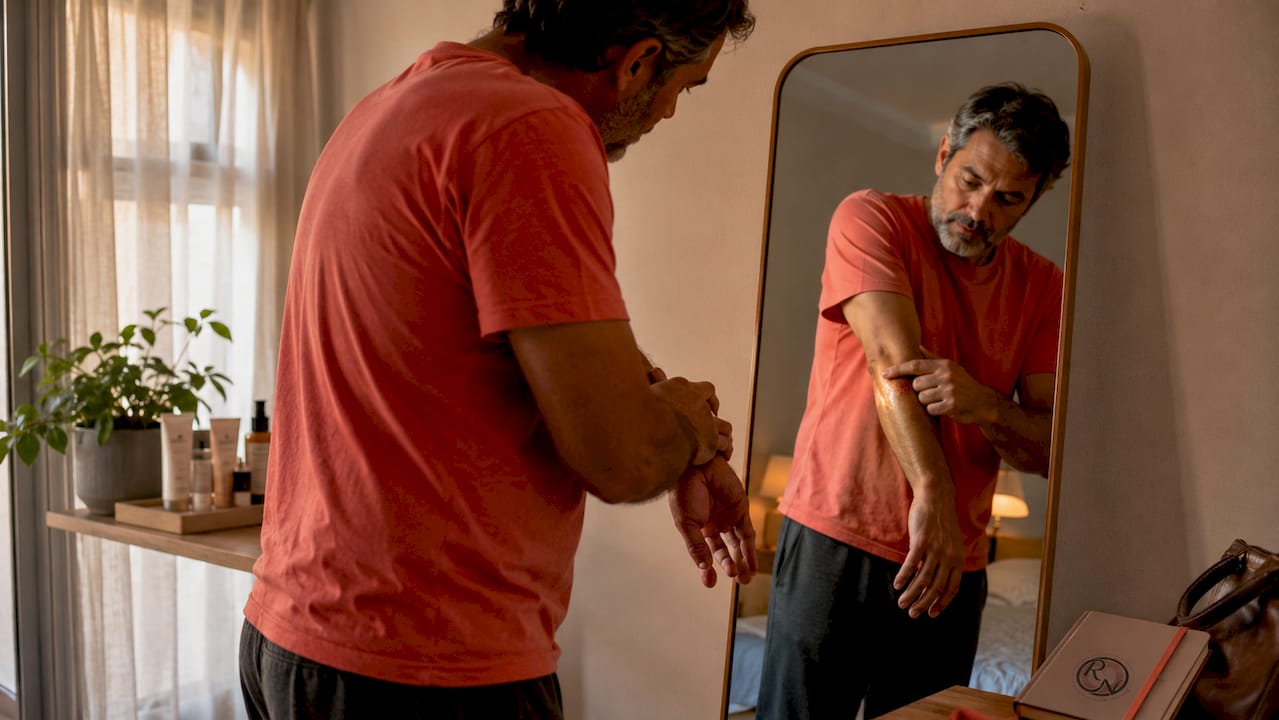
Dermatologists recommend monthly self-examination of all skin surfaces, with particular attention to sun-exposed areas. This means checking the scalp, ears, lips, soles of the feet, and between the toes. A partner or handheld mirror is useful for areas that are difficult to see directly.
Pro Tip: Keep a photographic diary of any lesions you are monitoring. Take a photograph in consistent lighting once a month and compare images side by side. This makes subtle changes far easier to detect and gives your clinician useful objective evidence at your appointment.
The early detection benefits of catching these changes before they progress cannot be overstated. A lesion that is 5 mm and confined to the epidermis requires a far simpler intervention than one that has grown into deeper tissue.
2. What are the main treatment options for early skin cancer?
Treatment selection depends on the cancer type, its size, its location on the body, and your general health. No single approach suits every patient, and a confirmed biopsy is essential before any treatment plan is finalised. An excisional biopsy that captures the full dermal depth and margin gives the most accurate staging information.
Surgical options
Surgery is the first-line treatment for most early stage skin cancers. The main surgical approaches are:
- Mohs micrographic surgery: the tumour is removed in thin layers, with each layer examined under a microscope before the next is taken. This continues until no cancer cells remain at the margins. It is preferred for cosmetically sensitive areas such as the face, nose, eyelids, and ears.
- Standard surgical excision: the tumour is removed with a defined margin of surrounding healthy tissue. This is appropriate for many low-risk lesions on the trunk and limbs. Details on excision and reconstruction are worth reviewing if this option is being considered.
- Electrodesiccation and curettage (ED&C): the lesion is scraped away with a curette and the base is treated with an electric current to destroy remaining cells. Meta-analyses report pooled cure rates of 95% to 97% for small, well-demarcated, low-risk lesions in areas without terminal hair. It is cost-efficient but leaves a flat, pale scar.
Non-surgical and topical options
For superficial lesions, particularly SCC in situ and some BCCs, non-surgical approaches are clinically appropriate. Squamous cell carcinoma in situ is treated using cryosurgery, topical 5-fluorouracil, imiquimod cream, or photodynamic therapy (PDT). PDT involves applying a photosensitising agent to the lesion and activating it with a specific wavelength of light, which selectively destroys abnormal cells while sparing surrounding tissue.
Cryosurgery uses liquid nitrogen to freeze and destroy superficial lesions. It is quick, does not require a surgical incision, and is well tolerated, though it may require repeat treatments and is less suitable for thicker or nodular lesions.
Radiation therapy is occasionally used when surgery is not possible due to patient age, comorbidities, or lesion location. It is not a first-line choice for early stage disease but remains a valid option in specific circumstances.
| Treatment | Best suited for | Typical cure rate |
|---|---|---|
| Mohs surgery | Facial, high-risk, or recurrent lesions | Up to 99% for primary BCC |
| Standard excision | Low-risk lesions on trunk and limbs | 90–95% with adequate margins |
| ED&C | Small, well-demarcated low-risk lesions | 95–97% |
| Cryosurgery | Superficial SCC in situ, thin BCCs | Variable; repeat treatments common |
| Photodynamic therapy | Superficial BCC, Bowen’s disease | 80–90% for superficial lesions |
Pro Tip: For any lesion on the nose, eyelid, lip, or ear, ask specifically about Mohs surgery before accepting a standard excision. These areas have limited tissue to spare, and the margin control that Mohs provides makes a significant difference to both cure rates and the cosmetic result.
3. How does Mohs surgery compare with other surgical techniques?
Mohs micrographic surgery is the gold standard for treating skin cancers in anatomically critical or cosmetically sensitive areas. Understanding how it differs from standard excision helps you ask the right questions at your consultation.
In standard excision, the surgeon removes the visible tumour plus a pre-set margin, typically 4 mm for a low-risk BCC. The specimen is sent to a laboratory, and results return within several days. If margins are involved, a second operation is required. This approach works well for straightforward lesions on the trunk or limbs, where taking a wider margin carries little functional or cosmetic consequence.
Mohs surgery removes the tumour incrementally, with the operating surgeon also acting as the pathologist. Each layer is mapped, colour-coded, and examined in full before the next stage proceeds. This means 100% of the surgical margin is assessed, compared with the sampling approach used in standard histopathology. The result is the highest possible confidence that all cancer cells have been removed before the wound is closed or reconstructed.
The tissue-sparing nature of Mohs is particularly relevant on the face. A standard excision on the nose or eyelid may remove more healthy tissue than necessary to achieve a clear margin, whereas Mohs removes only what is confirmed to contain cancer. This directly affects the complexity of any reconstruction needed and the final appearance of the scar.
| Technique | Margin assessment | Tissue preservation | Typical setting | Recurrence rate (primary BCC) |
|---|---|---|---|---|
| Mohs surgery | 100% of margin | Maximum | Day case, single visit | Less than 1% |
| Standard excision | Sampled sections only | Moderate | Day case or theatre | 1–10% depending on margins |
| ED&C | None (no specimen) | Good for small lesions | Outpatient | 5–15% for low-risk lesions |
Miss Nayar’s dual training in both Mohs surgery and plastic surgery means that tumour removal and reconstruction are planned together from the outset. For patients with lesions on the face or other sensitive sites, this integrated approach reduces the number of procedures required and optimises the final outcome.
4. What to expect during recovery and follow-up
Recovery after treatment for early stage skin cancer is generally straightforward, but the detail of what is required depends on the procedure you have had. Surgical wounds from Mohs or standard excision typically heal within two to four weeks for smaller defects, though larger reconstructions may take longer. Sutures are usually removed between seven and fourteen days post-operatively, depending on the site.
Wound care in the first week involves keeping the area clean and dry, applying a thin layer of white soft paraffin or a prescribed ointment, and covering with a non-adherent dressing. Avoid submerging the wound in water, including baths and swimming pools, until the skin has fully closed. Sun exposure to the healing area should be avoided entirely for at least three months, as new skin is particularly vulnerable to UV damage.
Follow-up appointments are not optional. They serve two purposes: confirming that the treated site has healed correctly and checking for any sign of recurrence or new lesion development. Post-treatment surveillance should focus not only on the treated site but also on the rest of your sun-exposed skin, since patients who have had one skin cancer carry a meaningfully higher risk of developing another.
Key steps for ongoing skin health after treatment include:
- Monthly self-examination of all skin surfaces, using the ABCDE criteria for any new or changing lesion
- Annual or biannual clinical skin checks with your dermatologist or surgeon, depending on your individual risk profile
- Daily use of SPF 30+ sunscreen with broad-spectrum UVA and UVB protection, seeking shade between 11 am and 3 pm, and wearing protective clothing
- Avoiding sunbeds entirely, as UV radiation from artificial sources carries the same carcinogenic risk as natural sunlight
Pro Tip: Before each follow-up appointment, write down any new lesions, changes you have noticed, or questions about your scar. Clinicians work through a lot of information in a short appointment, and a written list means nothing important is overlooked. A structured aftercare approach also helps you stay consistent between appointments.
Structured follow-up steps after treatment provide a clear framework for what to monitor and when to seek advice. Patients who engage actively with surveillance consistently achieve better long-term outcomes.
Key takeaways
Early stage skin cancer is highly treatable when diagnosed promptly, with the choice of treatment determined by tumour type, location, and individual patient factors.
| Point | Details |
|---|---|
| Survival rates are excellent | Localised melanoma carries a 5-year survival rate exceeding 99% when treated early. |
| Biopsy confirms diagnosis | An excisional biopsy is required before any treatment plan is finalised or begun. |
| Mohs surgery leads on the face | Complete margin assessment and tissue preservation make Mohs the preferred choice for facial lesions. |
| Non-surgical options exist | Cryosurgery, PDT, and topical treatments are appropriate for superficial or in situ lesions. |
| Surveillance is lifelong | Monthly self-examination and regular clinical checks reduce the risk of recurrence and new cancers. |
Expert skin cancer care with Miss Rakhee Nayar

Miss Rakhee Nayar is a GMC-registered Consultant Plastic Surgeon with dual training in Mohs micrographic surgery and plastic and reconstructive surgery, practising at Circle Cheshire in North West England. If you have received a diagnosis of early stage skin cancer or have a lesion that requires assessment, a private consultation provides a thorough clinical evaluation, biopsy review, and a personalised treatment plan. For lesions on the face or other cosmetically sensitive areas, Mohs micrographic surgery offers the highest cure rates alongside tissue preservation and same-day reconstruction. To discuss your options or book a consultation, visit mohssurgeon.co.uk. This article is for educational purposes only and does not constitute medical advice. Please consult a GMC-registered specialist for assessment and treatment.
FAQ
What is early stage skin cancer?
Early stage skin cancer refers to cancerous change confined to the skin’s surface or a localised area, before spread to lymph nodes or other organs. The in situ stage, where abnormal cells remain within their tissue of origin, represents the earliest and most treatable form.
How is early stage skin cancer diagnosed?
Diagnosis is confirmed by biopsy. An excisional biopsy that captures the full depth of the lesion and its margins is preferred, as it provides the most accurate information for staging and treatment planning.
Is early stage skin cancer curable?
For most patients, yes. Localised melanoma carries a 5-year survival rate exceeding 99%, and nonmelanoma types such as BCC and SCC in situ are routinely cured with appropriate surgical or non-surgical treatment.
What is the difference between Mohs surgery and standard excision?
Mohs surgery examines 100% of the surgical margin in real time during the procedure, allowing complete confirmation of clear margins before the wound is closed. Standard excision uses sampled sections examined after the operation, which means a second procedure may be needed if margins are involved.
How often should I have skin checks after treatment?
Most patients are advised to attend clinical skin checks annually or every six months, depending on their individual risk profile, alongside monthly self-examination at home. Your treating clinician will recommend a schedule based on your cancer type, treatment received, and skin type.
Recommended
- Skin cancer symptoms and signs: the UK guide for early detection
- Top skin health practices for cancer prevention and recovery
- Essential follow-up steps after skin cancer treatment
- Early detection benefits for skin cancer explained
Filed under Skin Cancer Explained


