TL;DR:
- Mohs micrographic surgery offers the highest cure rates and tissue preservation by real-time, full-margin examination. It is especially advantageous for high-risk or sensitive areas, reducing recurrence and optimizing cosmetic outcomes. However, clinical judgment and individual circumstances should guide the decision between Mohs and standard excision.
Not all skin cancer operations are the same, and assuming they are could cost you both your cure rate and your appearance. Many patients arrive at their first consultation believing that surgery is surgery, and that as long as the cancer is “cut out,” the outcome will be fine. In reality, the technique your surgeon uses determines how completely the tumour is removed, how much healthy tissue is sacrificed, and what your skin looks like afterwards. Mohs micrographic surgery was designed to solve all three of these problems simultaneously, and understanding why it works so well will help you make a far more informed decision about your care.
Key Takeaways
| Point | Details |
|---|---|
| Mohs ensures complete removal | This technique checks tissue margins during surgery so that only cancerous tissue is taken away. |
| Best for sensitive areas | Mohs is especially useful where preserving appearance and function is vital, such as the face and hands. |
| Not always the only choice | Mohs isn’t necessary for every case; other methods suit many straightforward skin cancers. |
| Balance cure and cosmetics | The gold standard label means Mohs aims for the highest cure rates with the best cosmetic results. |
What does ‘gold standard’ mean in skin cancer surgery?
To understand why Mohs stands out, we first need to define what a ‘gold standard’ treatment actually involves. In medicine, calling something a gold standard is not a marketing phrase. It means the intervention consistently produces the best measurable outcomes across a broad range of patients and clinical situations, has been validated by repeated study, and sets the benchmark by which newer approaches are judged.
In skin cancer surgery specifically, a gold standard technique must satisfy several demanding criteria:
- Highest possible cure rates, including for aggressive or recurrent tumours
- Minimal removal of healthy tissue, reducing the size of the wound and the complexity of reconstruction
- Superior cosmetic and functional results, particularly where tissue loss would affect movement or appearance
- Adaptability, meaning the approach works for tumours in awkward anatomical positions or with unpredictable growth patterns
- Reliable real-time margin assessment, so the surgeon knows at the time of the operation whether any cancer cells remain
Recurrence rates are one of the most telling indicators of surgical quality. The lower the rate at which a cancer returns after treatment, the more confidently we can say the technique achieves complete clearance. Staged excision with immediate microscopic examination allows repeat removal only where cancer persists, directly supporting optimal cosmetic and functional outcomes in sensitive anatomical sites. This is what separates Mohs from conventional surgery in measurable terms, not opinion.
When you hear the phrase ‘gold standard’ applied to what is Mohs surgery, it reflects decades of clinical evidence pointing to fewer recurrences, smaller defects, and better-preserved function compared to standard excision performed without on-site microscopic analysis.
How Mohs surgery achieves complete cancer clearance
Having clarified what we mean by gold standard, let’s examine what sets Mohs apart from other surgical approaches at a practical, technical level.
The Mohs process follows a carefully structured sequence that is fundamentally different from taking out a tumour and sending the specimen to an external laboratory:
- Initial removal: The surgeon removes the visible tumour along with a thin margin of surrounding tissue, keeping the excision as conservative as possible.
- Margin mapping: The tissue is divided into sections and mapped precisely, so that every edge of the specimen corresponds to a known location on the patient’s skin.
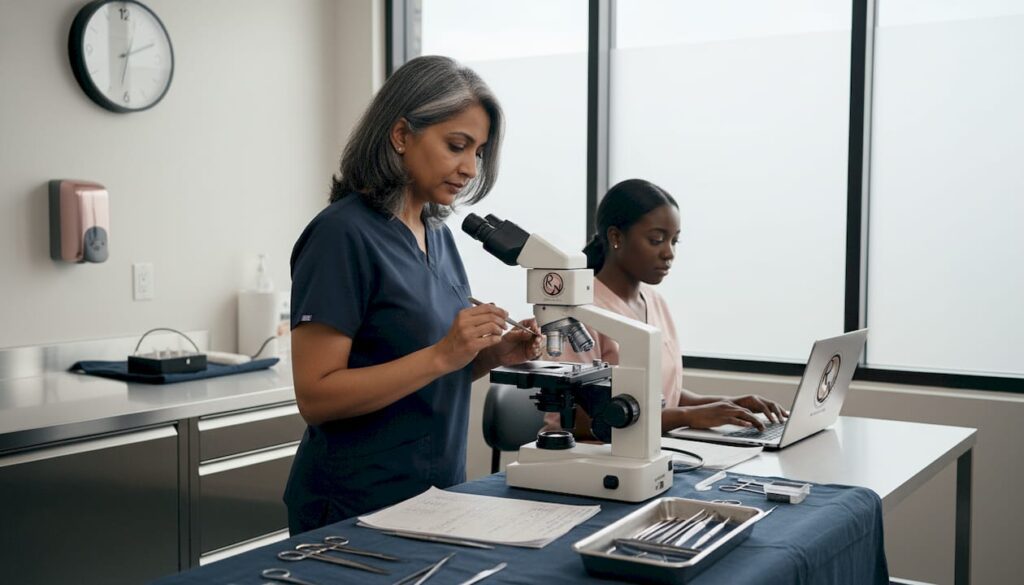
- On-site microscopy: A pathology technician processes the specimen in the operating suite or adjacent laboratory, and the surgeon personally examines the tissue under a microscope.
- Targeted re-excision: If cancer cells appear at any margin, only that precise zone is removed. Healthy areas are completely untouched.
- Repetition until clear: Stages continue until all margins are confirmed cancer-free, at which point reconstruction begins.
This is why the margin-mapping workflow earns Mohs its gold standard status. Staged excision combined with on-microscope margin examination allows complete cancer clearance with maximal tissue preservation, something a single-stage operation sent to an offsite lab simply cannot guarantee with the same precision.
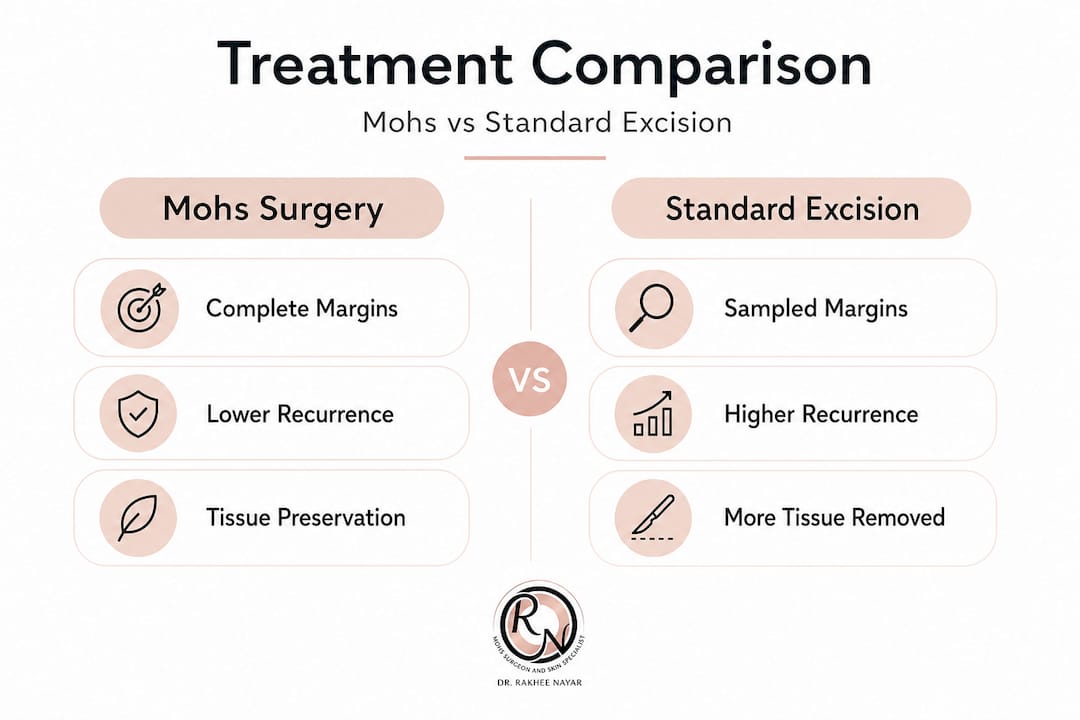
The table below shows how Mohs compares to standard excision across the key performance measures that matter most to patients:
| Feature | Standard excision | Mohs micrographic surgery |
|---|---|---|
| Margin assessment | Sample only (not full margin) | 100% of margin examined |
| Cure rate (primary BCC) | Approx. 90 to 95% | Up to 99% |
| Tissue preservation | Conservative but not optimised | Maximised by staged approach |
| Real-time feedback | No (days to result) | Yes (same day) |
| Suitability for complex sites | Limited | Excellent |
| Reconstruction timing | Usually immediate | Same-day when clear |
The difference in margin assessment is especially important. Standard excision typically examines only a small percentage of the cut edges. If cancer cells happen to be present at a section that was not sampled, neither the surgeon nor the pathologist will know. Mohs removes this uncertainty entirely.
You can read a detailed walkthrough of the procedure in this basal cell removal guide, which also covers what to expect at each stage of your surgical day.
Pro Tip: When speaking to a surgeon about Mohs, ask specifically how margin assessment is performed. True Mohs surgery means the entire circumferential and deep margin is examined, not just representative sections. Some clinics describe “Mohs-like” approaches that do not include full mapping, so it is worth clarifying before you commit.
Understanding the anatomy of your tumour is also part of effective planning. Skin cancer mapping before surgery gives both you and your surgeon a clearer picture of how the tumour is growing and why its edges may not be predictable from what is visible on the surface.
Why Mohs is preferred for sensitive and high-stakes sites
This method is especially valuable in certain locations. Let’s see why Mohs is the technique of choice when tumour position raises the stakes considerably.
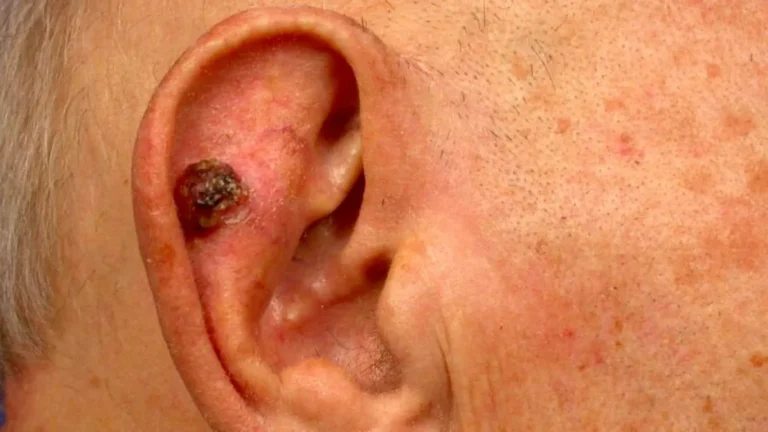
Skin cancer does not choose its location based on surgical convenience. A basal cell carcinoma sitting on the nose, the inner corner of an eye, the ear canal, the lip, or the back of the hand creates an entirely different clinical challenge compared to a small lesion on the upper back. In those high-stakes positions, every millimetre of healthy tissue that can be preserved directly affects what you will look like, how you will breathe through your nose, or whether your eyelid closes properly.

Mohs is recommended for aggressive infiltrating tumours or tumours in cosmetically and functionally sensitive areas, including the head and neck, hands and feet, and genitalia. This recommendation exists because the consequences of incomplete clearance or excessive tissue sacrifice in these regions are disproportionately severe.
The benefits in sensitive anatomical sites include:
- Less scarring: By removing only what is demonstrably cancerous, the resulting wound is as small as it can possibly be, making reconstruction simpler and results more natural
- Maintained movement and sensation: Structures like muscles, nerves, and cartilage are exposed only where necessary
- Tailored reconstruction: Because the defect is precisely defined after the final stage, reconstruction after Mohs surgery can be planned to achieve the best possible cosmetic and functional result
- Lower risk of recurrence near critical structures: Re-excision of a recurrent tumour near the eye or nose becomes progressively more difficult and disfiguring, so complete clearance at the first attempt is essential
The table below contrasts expected outcomes for Mohs versus standard excision depending on tumour site:
| Tumour location | Standard excision outcome | Mohs outcome |
|---|---|---|
| Face (nose, eyelids, lips) | Higher recurrence risk, larger margin needed | Precise clearance, minimal tissue loss |
| Ears and scalp | Adequate for low-risk lesions | Preferred for morphoeic or aggressive types |
| Hands and feet | Functional impairment risk from wide margins | Tissue-sparing, function better preserved |
| Trunk and upper limbs | Often appropriate and cost-effective | Usually reserved for high-risk histology only |
For a more detailed discussion of why Mohs for facial skin cancer is so frequently recommended, including how it compares to other methods in real clinical decision-making, you will find a focused explanation that helps put your own situation into context.
Are there limitations or drawbacks to Mohs?
While the advantages of Mohs are clear, it is important to consider the full picture, including its limitations.
Mohs is not the automatic right answer for every skin cancer diagnosis. The technique requires a specialist surgeon trained specifically in the procedure, an on-site histopathology service, and typically a longer procedure day than a standard excision under local anaesthetic. For many patients, particularly those with small, well-defined, low-risk cancers on non-cosmetically sensitive areas, standard excision performed by an experienced surgeon produces excellent results at a lower cost and with less complexity.
Situations where standard excision may be the more appropriate choice include:
- Small, nodular basal cell carcinomas on the trunk or limbs where the borders are clear and the risk of aggressive infiltration is low
- Patients with limited access to a Mohs-trained surgeon in their region, where the delay in receiving Mohs care would itself pose a clinical risk
- Squamous cell carcinomas in very low-risk anatomical sites with no evidence of perineural invasion or other aggressive features
- Patients where the procedure time would be clinically hazardous due to complicating health factors
From a financial perspective, cost-effectiveness analyses do not always favour Mohs over standard excision depending on context and the assumptions applied, even when the clinical performance in terms of margin control and cure rates is strong. This does not diminish the value of Mohs for appropriate candidates, but it does underline why the decision should be made with expert guidance rather than assumed.
You can find a direct comparison of the two approaches in this Mohs vs standard excision guide, which covers the clinical and practical factors that influence the recommendation. If you have come across conflicting information or feel uncertain about what you have been told, the Mohs myths and facts resource addresses the most common misconceptions directly.
Pro Tip: The question to ask your specialist is not simply “Is Mohs better?” but “Is Mohs better for my specific tumour, in my specific location, given my health and priorities?” That nuance is where genuine clinical expertise earns its value.
Why the gold standard label truly matters — our perspective
The phrase ‘gold standard’ risks becoming background noise if it is applied too liberally. We hear it attached to everything from dietary supplements to dental implants. What keeps it meaningful in the context of Mohs surgery is that it is earned through verifiable performance, not marketing.
In practice, we see what this means for real patients every week. A patient with a morphoeic basal cell carcinoma on the nasal tip will have a tumour whose surface appearance dramatically understates its true extent beneath the skin. Standard excision guided by visible margins alone would either leave residual cancer behind or remove far more tissue than necessary. Mohs, by contrast, follows the tumour precisely, stopping exactly where the cancer stops. The difference between those two outcomes, in terms of what a patient looks like and how much anxiety they experience about recurrence, is not abstract.
At the same time, the gold standard label should never override individualised judgement. We have operated on patients for whom the most clinically sound decision was a carefully performed standard excision, because the tumour type, site, and patient circumstances made it the right choice. A surgeon who recommends Mohs for every lesion regardless of clinical need is not practising gold standard medicine. They are confusing the technique with the principle.
The true mark of quality in skin cancer surgery is collaborative, transparent decision-making. That means a specialist who listens to your priorities, explains the evidence, and recommends the approach that genuinely serves your interests. Whether the outcome involves Mohs, standard excision, or a combination with plastic surgery after Mohs, the goal remains consistent: complete tumour clearance with the best possible outcome for you as an individual.
Take the next step towards expert skin cancer care
Understanding the evidence behind Mohs surgery is a strong starting point, but the next step is finding a specialist who can assess your individual circumstances and provide a clear, honest recommendation.

At mohssurgeon.co.uk, Miss Rakhee Nayar offers uniquely dual-qualified expertise in both Mohs micrographic surgery and plastic surgery, meaning she can manage everything from precise Mohs surgery to complex facial reconstruction under one specialist’s care. If you are at the stage of wanting a formal assessment, the skin cancer detection service is the right place to begin. Whether you prefer a private consultation in North West England or an e-consultation from elsewhere in the UK or abroad, expert guidance is available to help you move forward with confidence.
Frequently asked questions
Is Mohs surgery more successful than standard skin cancer removal?
Mohs surgery typically achieves higher cure rates due to its staged excision approach and immediate microscopic margin examination, making it particularly effective for complex or high-risk cases where complete clearance on the first attempt is critical.
Will Mohs leave a visible scar on my face?
Mohs is specifically designed to preserve healthy tissue and is the preferred technique for cosmetically sensitive areas, which means the resulting wound is as small as possible and reconstruction outcomes are generally superior to those achieved with wider standard excision.
Why isn’t Mohs recommended for every skin cancer?
Mohs is most beneficial for aggressive, recurrent, or anatomically sensitive tumours; many small, low-risk cancers on the trunk or limbs respond equally well to standard excision without the additional complexity or cost that Mohs involves.
Is Mohs cost-effective compared to other methods?
Cost-effectiveness analyses do not always favour Mohs over standard excision, particularly for lower-risk presentations, which is why clinical suitability rather than technique preference alone should guide the choice of treatment.
Recommended
- Why choose Mohs surgery for facial skin cancer removal?
- Mohs vs standard excision: what matters for your care
- Mohs surgery myths vs facts: what patients need to know
- What is Mohs Micrographic Surgery? | Miss Rakhee Nayar
Filed under Mohs Surgery