
A multidisciplinary team (MDT) is a group of health professionals from different specialisms who work together to plan and deliver your cancer treatment. Rather than a single consultant deciding your care in isolation, an MDT brings together surgeons, oncologists, radiologists, histopathologists, and clinical nurse specialists (CNS) to review your test results collectively and agree on the most appropriate treatment plan. This model is recognised by NHS trusts as the most effective way to reach balanced, evidence-based recommendations.
The core members of a typical cancer MDT include:
- Consultant surgeon — performs or plans any required surgical intervention
- Medical or clinical oncologist — advises on chemotherapy, radiotherapy, and hormone therapy
- Consultant radiologist — reviews scans and imaging to confirm diagnosis
- Consultant histopathologist — analyses tissue samples and biopsies to identify cancer type
- Clinical nurse specialist (CNS) — provides expert nursing support and acts as your main point of contact
- MDT coordinator — organises case reviews and ensures all diagnostic information is ready in time
- Research nurse — where relevant, supports patients considering clinical trials
Decisions are made by consensus, drawing on the best available evidence rather than any one clinician’s preference. NICE and British Association of Dermatologists (BAD) guidelines underpin how these teams operate across NHS trusts in England, Wales, and Scotland.
Who does what in a cancer care team?
Each MDT member brings a distinct area of expertise, and understanding their roles can help you feel less overwhelmed when you first encounter the team.
- Consultant surgeon: assesses whether surgery is appropriate, plans the procedure, and performs the operation
- Oncologist: advises on systemic treatments including chemotherapy, targeted therapy, and radiotherapy; also guides monitoring and further testing
- Consultant radiologist: interprets CT, MRI, and PET scans to stage the cancer and track treatment response
- Histopathologist: examines biopsy material under the microscope to confirm the cancer type, grade, and margins
- Clinical nurse specialist: provides expert condition-specific advice, supports you through decision-making, and remains your primary contact throughout treatment
- MDT coordinator: prepares pathology reports, imaging results, and genomic data ahead of each meeting, ensuring the team can discuss your case without delay
- Cancer support worker (CSW): works alongside the CNS on practical matters such as transport, financial concerns, and links to community services
The MDT coordinator’s role is easy to overlook, yet timely diagnostic data is what makes or breaks a productive meeting. If imaging or pathology results are not available on the day, your case may be deferred to the following week’s meeting.
Pro Tip: Your CNS is the person to contact with questions between appointments. They attend MDT meetings, understand the clinical reasoning behind your treatment plan, and can translate complex medical decisions into plain language. Do not wait until your next consultant appointment if something is worrying you.
The CNS acts as your advocate at MDT meetings, representing your preferences and practical circumstances so that recommendations remain grounded in your real life, not just your scan results.
How does MDT collaboration actually shape your treatment?
Before any treatment recommendation is made, the full team reviews your diagnostics together. Scans, biopsy results, blood tests, and clinical history are all presented at a dedicated MDT meeting, and each specialist contributes their perspective before a consensus is reached.
The key benefits of this collective approach include:
- Holistic assessment: your case is viewed through surgical, oncological, radiological, and nursing lenses simultaneously
- Evidence-based decisions: recommendations follow peer-reviewed guidelines rather than individual clinical preference
- Timely planning: structured weekly or fortnightly meetings keep your pathway moving
- Tailored treatment: personal circumstances, comorbidities, and patient preferences are factored into the final plan
- Built-in peer review: the consensus process itself acts as a quality check on any single clinician’s judgement
You are entitled to request a second opinion about your diagnosis or recommended treatment. The MDT approach is peer-reviewed consensus, which means the plan you receive has already been scrutinised by multiple consultants before it reaches you. That does not remove your right to seek further reassurance, but it does mean the initial recommendation carries collective clinical weight.
Governance structures, including terms of reference and cancer peer review processes, help maintain the quality of MDT meetings across NHS boards.
What is it actually like to be a patient in this system?
Most MDT discussions happen without you in the room. The team meets, reviews your case, and the CNS or lead consultant then communicates the outcome to you. This is a source of anxiety for many patients, particularly the gap between diagnosis and receiving a treatment plan.
Delays between diagnosis and plan communication often stem from MDT meeting scheduling and the time needed to prepare complete diagnostic data. Knowing this in advance can make the wait feel less alarming.
You will not typically meet every member of your MDT. Most patients interact primarily with their lead consultant and CNS. As Macmillan Cancer Support notes, the CNS and lead consultant act as the communication bridge between you and the wider team. Your CNS will discuss the treatment plan with you, support your decision-making, and ensure your personal circumstances are fed back into the team’s thinking.
If you have a preference about treatment, a concern about a proposed procedure, or a practical constraint such as caring responsibilities, tell your CNS. Those preferences are formally represented at MDT meetings and can genuinely influence the final recommendation.
Why does the MDT model matter within the NHS?
MDTs are not optional within NHS cancer services. They are mandated as standard practice across all cancer pathways, with governance frameworks set by NICE, BAD, and NHS England requiring that every new cancer diagnosis is reviewed by an appropriate team before treatment begins.
The documented benefits include:
- Improved coordination across specialisms, reducing the risk of conflicting advice
- Consensus-driven decisions that are less susceptible to individual bias
- Structured governance that supports clinical accountability
- Faster access to specialist input, including genomic testing and clinical trials
- Consistent application of national guidelines across different NHS trusts
Challenges exist too. Data preparation bottlenecks remain a persistent issue, with cases occasionally deferred when imaging or pathology is not ready in time. Staffing quoracy, particularly in specialist MDTs, can also affect the breadth of expertise available on any given day. NHS Scotland’s West of Scotland Cancer Network has developed a 360-degree MDT review tool, piloted across four health boards, to identify these gaps and support ongoing improvement.
The skin cancer pathway in the UK is stratified into Local Hospital Skin Cancer MDTs for straightforward cases and Specialist Skin Cancer MDTs for complex presentations, in line with BAD and NICE guidance.
How does the MDT work specifically for skin cancer in the UK?
Skin cancer MDTs operate within a two-tier structure. Local Hospital Skin Cancer MDTs manage the majority of basal cell carcinoma (BCC) and lower-risk squamous cell carcinoma (SCC) cases. Specialist Skin Cancer MDTs handle melanoma, high-risk SCC, and other complex presentations, drawing on a broader range of expertise including dermatologic oncology and reconstructive surgery.
A known governance challenge is attendance quoracy at Specialist Skin Cancer MDTs. Published data indicates that specialist MDTs frequently fail to meet attendance standards, with clinical oncologists notably absent from some meetings. Patients are rarely aware of this, yet it can affect the range of treatment options discussed.
Patient support within skin cancer MDTs typically involves:
- A CNS with skin cancer-specific expertise as your primary contact
- A cancer support worker for practical and emotional support
- Access to clinical trial information via a research nurse where appropriate
- Coordination with your GP and community services for continuity of care
Miss Rakhee Nayar, GMC-registered Consultant Plastic Surgeon (FRCS Plast, MD) at Circle Cheshire, holds dual training in both plastic surgery and Mohs micrographic surgery. This combination is relatively uncommon and directly relevant to MDT working: she can contribute both the surgical and reconstructive perspective within a single consultation, which is particularly valuable for skin cancers on the face and other cosmetically sensitive areas. Patients referred for Mohs micrographic surgery benefit from this integrated approach, where tumour clearance and reconstruction are planned together rather than sequentially.
The role of the MDT in skin cancer care is explored in further detail on the Rakhee Nayar – Mohs Surgeon and Skin Specialist website, including how specialist referral criteria apply to different lesion types.
How do MDT members communicate and share information?
MDT meetings shifted significantly during 2019–2020, when the pandemic required most teams to move to remote working. Video conferencing via platforms such as MS Teams became standard across many NHS trusts and has largely remained in use, allowing clinicians from different hospital sites to attend without travelling.
Effective communication within an MDT depends on more than the meeting itself. Secure digital systems for sharing imaging, pathology reports, and genomic results are central to preparation. The MDT coordinator typically manages this flow, uploading case information to a shared platform ahead of the meeting so that all attendees can review it in advance.
Written MDT outcomes are documented and shared with the patient’s GP, the referring clinician, and any other treatment centres involved in their care. This written record is the formal mechanism by which MDT decisions translate into action across different parts of the NHS.
What does an MDT pathway look like for different cancer types?
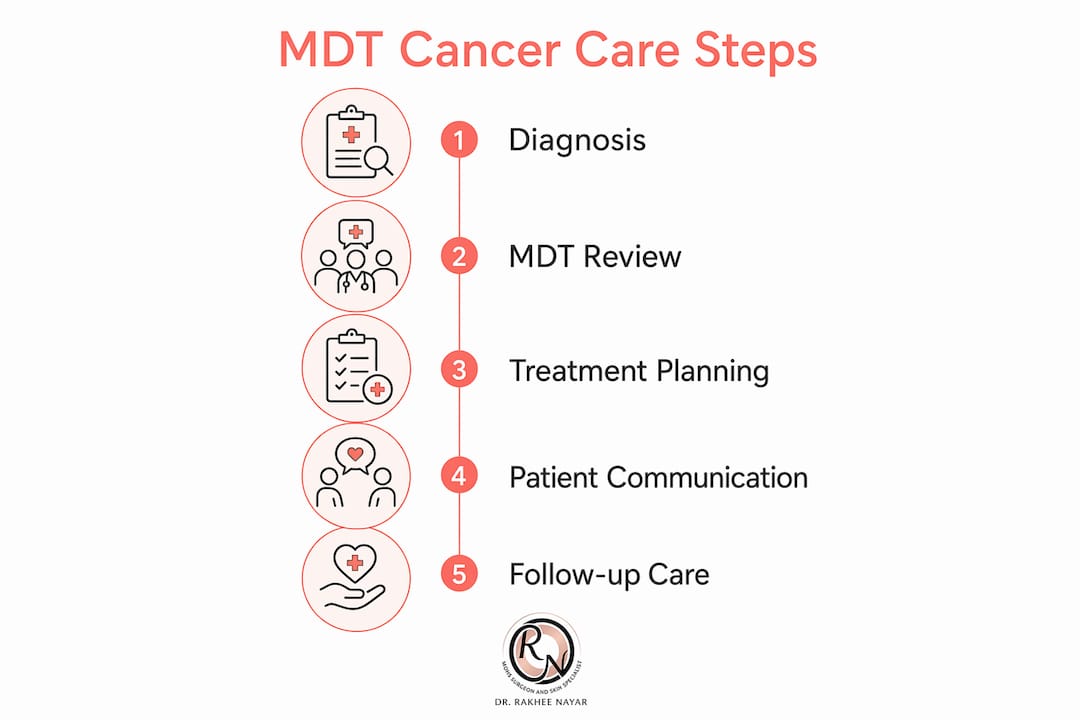
The structure of an MDT pathway varies by cancer type, but the underlying process is consistent: diagnosis, MDT review, treatment planning, and follow-up.
For breast cancer, the pathway typically involves a breast surgeon, oncologist, radiologist, histopathologist, and CNS meeting weekly to review new diagnoses and post-treatment imaging. Genetic counselling may be added for patients with a family history.
For colorectal cancer, the MDT includes a colorectal surgeon, gastroenterologist, oncologist, and radiologist. Liver metastases may trigger referral to a hepatobiliary MDT for additional specialist input.
For melanoma, the Specialist Skin Cancer MDT reviews staging scans, sentinel lymph node biopsy results, and genomic profiling before agreeing on surgery, immunotherapy, or targeted therapy. Miss Nayar’s melanoma treatment guide outlines how this pathway operates in practice for UK patients.
For head and neck cancers, the MDT typically includes maxillofacial surgeons, ENT surgeons, oncologists, speech and language therapists, and dietitians, reflecting the functional complexity of treatment in that region.
Adjunctive therapies, including hyperbaric oxygen therapy, are sometimes considered alongside conventional treatment. HBOT’s role in supporting cancer treatment is an area of growing interest within oncology MDTs, particularly for managing radiation-related tissue damage.
What does the evidence say about MDT effectiveness?
The evidence base for MDT working in oncology is well established. Studies consistently show that MDT review is associated with more accurate staging, greater adherence to clinical guidelines, and more consistent application of evidence-based treatment protocols compared with single-clinician decision-making.
Patients whose cases are reviewed by an MDT are more likely to receive treatment that aligns with national guidelines, and less likely to experience conflicting advice from different specialists. The collaborative peer-review model provides a structural safeguard against both under-treatment and over-treatment.
Governance frameworks, including cancer peer review programmes and the MDT review tools developed by NHS Scotland, provide ongoing quality assurance. These processes identify where teams are performing well and where improvements are needed, creating a feedback loop that raises standards over time.
How can patients and families get involved in MDT decisions?
Patients do not attend MDT meetings, but their voice is present through the CNS. Before the meeting, your CNS will gather information about your preferences, concerns, and personal circumstances to present alongside the clinical data.
After the meeting, your CNS or lead consultant will explain the team’s recommendation, walk you through the options, and support you in giving informed consent. You are not obliged to accept the recommended plan. If you want more time, a second opinion, or further explanation, you can ask for it.
Families and carers can be involved too, particularly if the patient wishes it. The CNS can arrange for a family member to be present during treatment discussions, and cancer support workers can connect families with practical resources including financial guidance, transport support, and emotional wellbeing services.
The skin cancer specialist referral guide on the Rakhee Nayar – Mohs Surgeon and Skin Specialist website explains how patients can access specialist MDT review and what to expect at each stage of the referral pathway.
If you have been diagnosed with a skin cancer and want to understand your options within a specialist MDT framework, Miss Rakhee Nayar offers private consultations at Circle Cheshire in North West England, as well as e-consultations for patients across the UK and internationally. Her dual training in plastic surgery and Mohs surgery means surgical planning and reconstruction are considered together from the outset.
To book a consultation or learn more about Mohs micrographic surgery, visit the Rakhee Nayar – Mohs Surgeon and Skin Specialist website. This article is for information only and does not constitute medical advice. Please consult a GMC-registered specialist for guidance specific to your situation.
Key takeaways
Multidisciplinary cancer care delivers better outcomes because no single specialist holds all the information needed to plan safe, evidence-based treatment.
| Point | Details |
|---|---|
| MDT is NHS standard practice | Every new cancer diagnosis in the UK must be reviewed by a multidisciplinary team before treatment begins. |
| CNS is your main contact | Your clinical nurse specialist attends MDT meetings, represents your preferences, and explains decisions to you. |
| You may not meet every specialist | Most patients interact only with the lead consultant and CNS; the wider team works behind the scenes. |
| Skin cancer uses a two-tier MDT structure | Local MDTs handle routine cases; Specialist Skin Cancer MDTs review complex melanoma and high-risk SCC. |
| Attendance gaps affect some specialist MDTs | Published evidence shows specialist skin cancer MDTs sometimes lack full clinical oncology representation. |
FAQ
What is a multidisciplinary approach to cancer care?
A multidisciplinary approach means a team of specialists from different fields, including surgery, oncology, radiology, and nursing, review each patient’s case together and agree on a treatment plan by consensus, rather than leaving decisions to a single clinician.
What does a multidisciplinary cancer team include?
A typical MDT includes a consultant surgeon, medical or clinical oncologist, radiologist, histopathologist, clinical nurse specialist, MDT coordinator, and, where appropriate, a research nurse and cancer support worker.
What is the role of the MDT in cancer care?
The MDT reviews diagnostic results, applies national guidelines, and agrees on the most appropriate treatment for each patient. Its peer-review structure helps avoid both under-treatment and over-treatment, and the CNS ensures patient preferences are represented throughout.
How does the MDT process work for skin cancer in the UK?
Skin cancer cases are reviewed at either a Local Hospital Skin Cancer MDT or a Specialist Skin Cancer MDT, depending on complexity. BAD and NICE guidelines determine which tier applies, and the specialist MDT is required for melanoma, high-risk SCC, and other complex presentations.
Can patients influence what the MDT decides?
Yes. Your CNS presents your preferences and personal circumstances to the team before a decision is made. After the meeting, you can ask questions, request a second opinion, or decline a recommended treatment before giving consent.
Recommended
- Why travel for skin cancer treatment: a patient guide
- How to support skin cancer patients: practical help guide
- High-risk skin cancer: Expert treatment guide for UK patients
- Melanoma cancer treatment: your complete UK guide
Filed under Choosing Your Care